


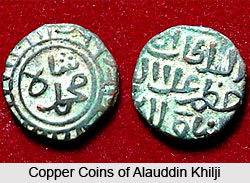
 Malwa was subdued by the Delhi Sultan Iltutmish and again by Ghiyasuddin Balban. The province was finally brought under the control of Delhi by Alauddin Muhammad Khilji in 1305 A.D. and remained so for about a century. Malwa was subdued by the Delhi Sultan Iltutmish and again by Ghiyasuddin Balban. The province was finally brought under the control of Delhi by Alauddin Muhammad Khilji in 1305 A.D. and remained so for about a century.
The first seven kings of Malwa, except the founder, struck coins in gold, silver and copper. The copper coins during this time were issued by Muhammad II the rebel, Bahadur Shah of Gujarat and Baz Bahadur, the last ruler. Mahmud Khilji had introduced billon and it was employed by his three successors. The characteristic feature of the Malwa coinage was its square shape. This pattern was introduced by Mahmud Khilji. Earlier kings used the usual round shape. Mahmud and his successor Ghiyas Shah issued both round and square coins, but under the reign of Nasir Shah, the square form was exclusively used. The gold and silver coins of the first two rulers of Malwa bore the names and titles of the kings. The names and titles of the kings were divided on two sides with the date and the name of the mint in the margin on one side. Mahmud I introduced for the reverse a device which divided the face of the coin into two equal parts by lengthening the tail of the last letter 'ye' of his name Khilji. Ghiyas Shah used a similar band on both he faces and this was found on almost all the succeeding coins in both the shapes. Mahmud I and Ghiyas Shah used elaborate titles in the inscriptions. 'Abul-mujahid, abul-fath, al-bazil, al-wasiq b-al-samad lam yizli' (trusting in the Lord, the eternal) were the titles and formulae that were seen on the coins issued during this time. Sadibad (Mandu) was the only mint that issued the coins and its name was seen on the coins of the earlier rulers. From the reigning period of Nasir Shah, the name of the mint did not appear on the coins. With the reign of Ghiyas Shah, a series of ornaments appeared on the coins. Though the coins were issued with an umpteen variations and were decked with a number of ornamentations, the purpose of the embellishments of the coins was uncertain. The weight of the gold and silver coins of Malwa followed the 170 grains standard of the Sultans of Delhi. Apart from these coins, coins in half weight were also issued. But the evidence was found about the existence of a few extraordinary coins too. A five-tankah gold coin of Mahmud Shah, dating back to 868 A.H., is presently to be found in a private collection in the personal assemblage in the Netherlands. These pieces demonstrate that the Khilji rulers of Malwa had complied with the Sultans of their own bloodline, who had earlier issued higher denominational coins from Delhi. A few coins were also found in the 'Mihrabi' shape and the Mughal emperor Akbar later issued coins of this shape. It seems that the copper coins followed a standard weight of 140 grains. In the closing years of Ghiyas Shah some coins were issued in the proximity of 176 grains and its half and quarter, weighing 88 and 44 grains, respectively. Though the coins of Malwa follow the standard of Delhi Sultanate, the coins of Malwa demonstrate a particular style of their own that was typical of their rulers. |
| |||



Home > Reference > Indian Administration > Indian Coins > History of Indian Coins > Coins in Medieval India > Coins During Muslim Rule > Coins of Malwa
Coins of Malwa
| Coins of Malwa were issued in different shapes and reflect huge variations. |
| ||||||||||||||||||||||||||||

