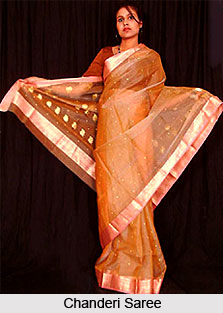
 Chanderi (Madhya Pradesh) is the most well-known centre of creating Chanderi sarees. Apart from this, many other towns further south, such as Berhanpur and Maheshwar are also considered as the major centres of producing Chanderi sarees. Like the aristocratic jamdanis of eastern India, their manufacture ceased at the collapse of the Mughal Empire and the spread of mill-spun thread from Manchester in the early nineteenth century. The sarees are discerned for the designs that are used keeping in mind the quality of the gold thread.
Since the 1940s silk warps have been used in Chanderi muslins instead of cotton. The silk is of an undyed, still-gummed, low-denier variety that gives the cloth a crisp sheen while maintaining the off-white colouring typical of Chanderi fabrics. Although the traditional unbleached colouring is still popular, many Chanderi muslins are found in pastel and even vibrant colours. Despite their transparency, these sarees often had two endpieces. The inner part incorporates white silk stripes and the outer part is called a `tarz` in colloquial language. It uses zari and coloured threads for further embellishment of the sarees. One characteristic of the recent made Chanderi muslins is that they have many buti in the field and endpiece. These designs were introduced in the late nineteenth century.
Three types of Chanderi sarees were traditionally woven in India by the artisans. The lightest muslins, which were almost completely plain, had a very narrow border of complementary-warp zari. The endpiece was decorated with a few narrow zari bands, or one single, wider band. Sarees with broader borders woven in supplementary-warp zari with coloured supplementary-warp silk embellishments were woven into small repeat geometric or floral designs. The endpiece consisted of the border elements repeated twice as two parallel bands. In addition to these, often narrow woven lines and many butis were woven between them. The artisans add buti also in the field. Many of the patterns woven into the borders are influenced by Banaras styles, with creeping vines, jhaalar and minakari.
For creating Chanderi sarees, the artisans use pure cotton, pure silk or a mix of both. The alluring effect of the sarees is sure to capture the eyes of any Indian woman who has an eye for gorgeous traditional sarees. The touch of royalty is manifested in the Chanderi sarees as the artisans give their effort to make the sarees exclusive ones.