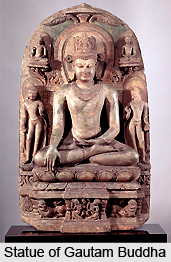
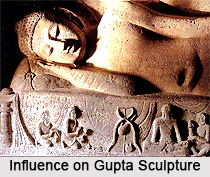
 Sculpture at Sarnath is a great example of Buddhist influence on Gupta sculpture. The Gupta sculptures in the Buddhist shrines are the primary sources that reflect such impact. It may be regarded as logical culmination of several continuous traditions. The traditions out of which the Gupta sculpture developed were mainly the Mathura school of art and the Greco- roman art of the North West frontier. One of the main features of these Gupta sculptures in the Buddhist shrines was the finished mastery in execution and a majestic serenity in expression.
The sculpture of Buddha from Mathura of the fifth century is covered by the monastic garment unlike the statues of Buddha that had been found from the earlier kingdom of the Kushanas. The style of the drapery bears a marked resemblance to certain late Gandhara Buddha. In the Mathura Buddha, the drapery formula has been reworked into a rhythmic pattern. These figures of Buddha were carved according to a fixed set of proportions intended to guarantee the more than mortal ideality of the conception; likewise, individual parts of the body continue to be fashioned in accordance with the entirely metaphorical description of Lord Buddha.
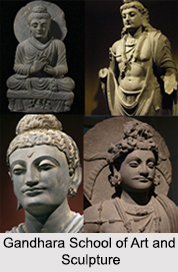
The head of the Gupta Buddha from Mathura resembles the traditions of Gandhara. The sharp definition of the planes is akin to the hard accuracy of the Gandhara Buddhas, with the disparity that the Mathura types avoid the mask-like coldness of the Gandhara Buddha. The eyes are loti form; the lips have the fullness of the mango; and the hair is represented by the snail-shell curls. Among the most beautiful features of the Mathura Buddhas are the carved haloes, the ornament consisting of concentric rings of floral pattern about a central lotus.
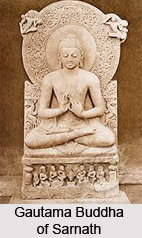
The material that the sculptors used for carving the innumerable Buddhas and Bodhisattvas that once decorated the stupas and viharas was the chunar sandstone that had served the craftsmen of the Maurya Dynasty. In all the Buddhas of the Sarnath workshops the planes have been so simplified that the sculpture takes on an almost abstract character. One of the master pieces of Gupta sculpture of Indian art is the high relief statue of Buddha preaching the first sermon. This sculpture was discovered in the ruins of Sarnath. The Teacher is represented seated in yoga posture, his hands in the wheel-turning. There are two groups of kneeling monks between whom is the symbol of the preaching, the Wheel. In early representations of the First Preaching, as in the reliefs of Gandhara, the Deer Park sermon is represented as an actual event, with the Buddha surrounded by his disciples, with all figures on the same scale. In the Sarnath relief it is the enormously enlarged figure of the Buddha in `dharmachakra mudra` that stands for the event; the narrative elements of the episode have been relegated to the base.
One of the most beautiful features is the carving of their haloes. In the present example the ornament of the nimbus consists of a wide band of deeply cut foliate forms framed in a pearl border with flower-bearing apsaras on either side. These Bodhisattva images of the Gupta Period are the artistic ancestors of the later icons of the Pala Period. Mahayana sculpture, as exemplified by the carvings of the Great Stupa at Barabudur, marks a final crystallization of the Gupta ideal.