Buddhist Art In India
|
Buddhist art in India comprising the paintings and monuments through ages has helped to visualise the different phases of Buddhism that existed or still exist.
|
|
|
 The main purpose of Buddhist art in India was to popularise the religion of Buddhism. Buddhist art in India came into being after the historical life of Gautam Buddha during the sixth to fifth century B.C. and then it developed by contact with other cultures as it spread all through Asia and the world. The main purpose of Buddhist art in India was to popularise the religion of Buddhism. Buddhist art in India came into being after the historical life of Gautam Buddha during the sixth to fifth century B.C. and then it developed by contact with other cultures as it spread all through Asia and the world.
The presence of Lord Buddha was portrayed by the symbols of empty throne, a pair of foot prints, a lotus, or a Bodhi tree. The sculpture developed later on into more precise and explicit definition of the episodes relating to the life of Lord Buddha and his teachings. It is in north India that the first anthropomorphic representation of Buddha is said to have emerged. The two main proponents of Buddhist art in India is the Gandhara School and the Mathura school of art.
Buddhist art flourished in the panorama of Indian art during the Maurya dynasty under the reign of emperor Ashoka, who embraced Buddhism. The several stupas like the one in Sanchi and the pillars adorned with Buddhist symbols were the earliest instances of Buddhist art in India. These stupas comprise a hemispherical dome with a harmika supporting the umbrellas. The sculpture of Bharhut depicts stories from the life of Lord Buddha and also tales from Jataka. The sculpture dealing with the life of Gautam Sakyamuni includes Buddha's enlightenment, the vision of Maya, and the defeat of Mara among others. In the sculptures of Bharhut, Amravati and Sanchi the worship of the Bodhi tree is widely prevalent. The Buddhist art in south India during this era is best represented by the Maha chaitya at Amravati which resembles the art at Bharhut. The Buddhist art at Amravati is noted for its sophistication and elegance.
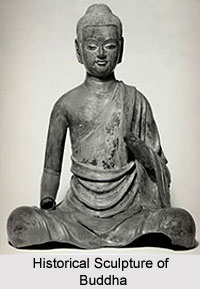 The Kushana dynasty came into power after the Mauryas and it was under their reign that the two major centers of the creation of the Buddhist art evolved namely the Gandhara School of art and the Mathura school of art. The art and sculptures of Gandhara had a strong influence of Greco- roman culture and thus was an amalgamation of Indian and foreign motifs. The art of Mathura on the other hand is completely Indian in style and form and draws heavily from the ancient school of art. Lord Buddha was illustrated both as a man and a god and this became the iconographic cannon for ensuing Buddhist art. Under the Gupta period which extended from fourth to sixth century A.D.
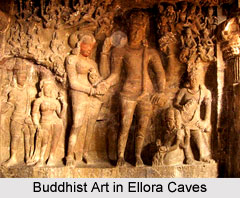
Buddhist art in India gained more prominence. It was combined with restraint and aesthetic sense. Nalanda, Sarnath and Mathura were the three pivotal regions which marked the Buddhist art in this period. The images of Lord Buddha from Sarnath and Mathura are hallmark of Buddhist Indian art. The caves of Ajanta contain illustrations depicting stories from Buddha's life and also tales from the Jatakas. There are numerous statuettes of Buddha and Bodhisattvas present in the Ellora caves.
By the seventh century A.D. with the invasion of the Huns Buddhist art gradually disappeared from the northern India leaving its trace only in Bengal and Nalanda. Buddhist art in this last phase of its development in India was produced under the patronage of the Pala and Sena Dynasties. The principal site of this last centre of Indian Buddhism and its art was the great university of Nalanda. The architecture reveals a style that is a continuation of the architectural form of the Gupta period. This last phase of Buddhist art flourished in Bengal from the eighth century until the extirpation of the religion by the Mohammedan invasions. Buddhist art in India gradually came to an end in the twelfth century A.D.
|
|
|
|





