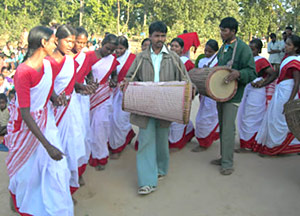
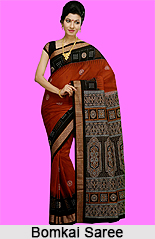
 Bomkai Saree, an ethnic combination of Ikkat style and supplementary thread work, showcases the unique excellence of tribal art. It is an outcome of Ikkat and embroidery interwoven into each other. This saree is also known as "Sonepuri" saree. Bomkai Sari is fabricated by the "Bhulia" community of Subarnapur region of the Ganjam district of Odisha. A Bomkai saree is largely worn by Kathak dancers around the world. The saree is traditionally worn as an auspicious attire by the Brahmins of the South during rituals, Bomkai today is counted amongst one of the most highly thought of attires in the state of Odisha.
Bomkai sarees are available in silk and cotton fabrics. Bomkai cotton sarees are mostly accepted for habitual wear and the silk saree is put on ceremonies and sacred occasions. In early times, the fabric of the saree was usually meant for the kings and monarchs, people from aristocracy and affluent people.
History of Bomkai Sarees
Locally known as "Bandha" Bomkai concept of sarees is a part of the Odishan culture since 600 B.C. The historical significance of Bomkai emerges from the fact that Bomkai is one of the traditional faces of a designer Odisha and, showcases the adept works of an artisan. Also known as Sonepuri, the embroidered cloth is a type of saree that was first crafted in the southern coastal parts of Odisha.
Designs and Motifs in Bomkai Sarees
The stylish designs are embodied with captivating colours to give the gracious look to the woman wearing the saree. The ancient belief is depicted in its border. The borders are often in contrasting colors and the pallus marked by intricate threadwork. The appearance of the saree is related to simplicity and has a tribal tinge in it. 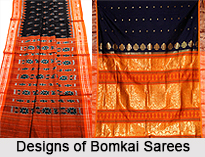 However, in general the saree is processed in warp and weft. The saree is extra-ordinarily woven in the end piece (pallu) with several contrasting colours and designs. The saree is normally dyed to attain the red, black and white background colours. The weaving of Bomkai saree is time consuming and labour intensive.
The motifs on the Bomkai are inspired from nature and tribal art, giving the saree a fascinating look that makes it perfect for aristocracy. Several patterns are found in the saree which has different names like "pestle" (rukha), "hour-glass shaped drum" (dambaroo), "small flowers" (kanthi phoola), "bitter gourd" (karela), "peacock" (mayur/mayuri), "fish" and few designs custom made. Mostly the design of fish is seen in the saree as it is believed to be a sign of success and affluence. The supplementary-warp model of the borders in the saree is called "Mikta Panji", which is a trelliswork with diamond form that gives the saree its prominence and distinctive attribute.
Varieties of Bomkai Sarees
Innumerable varieties of Bomkai Saree have been introduced till date by people belonging to the Southern parts of Odisha. Some of the most popular ones though include "Sonepuri", "Pasapali", "Barpali" and "Bapta" sarees.