
Architecture Of West India - Informative & researched article on Architecture Of West India
  Indianetzone: Largest Free Encyclopedia of India with thousand of articles Indian Monuments


in  
Art & Culture | Entertainment | Health | Reference | Sports | Society | Travel
Forum  | Free E-magazine
Indian Monuments : Indian Monuments l Palaces of India l Indian Buddhist Sites l Arts in India l Historical Buildings in Rajasthan l Indian Historical Monuments l World Heritage Monuments in India l Indian Religious Monuments l Indian Regional Monuments l Indian Monasteries
Home > Art & Culture > Indian Monuments > Arts in India > Indian Architecture > History of Indian Architecture > Architecture Of West India
Architecture Of West India
Architecture in Western India comprises Indo- Aryan temples of Gujarat, Kathiawad and Kachchhchhchh and also Jain sanctuaries in Rajasthan.

The architecture of the West India consists of the Indo- Aryan temples of Gujarat, cave shrines of Maharashtra and the temples of Kathiawad and Kutch that were constructed during the tenth century. The renowned Jain sanctuaries of Mount Abu in Rajputana in Rajasthan are also noteworthy for its exquisite architecture. Architecture in the western India is predominant in the Indo-Aryan buildings in the city of Gwalior where there is a blend of Hindu and Buddhist architectures.

A brief peep into the history of architecture of West India would take one to the ancient era of cave temples and rock cut monuments. It was the architecture in these monuments that tell the tale of excellent craftsmanship. The architectures of Ajanta and Ellora caves in Maharashtra bear testimony to this fact. However, with the emergence of Shivaji in the political scenario several forts were built here. With the passing time West India witnessed changes in the style of its architecture. Under the Rajputs, a new school of art and architecture evolved. This style was partly influenced by the Mughals. At this point of time Rajasthan became a primary seat of architecture. Numerous forts, palaces, gardens, havelis, temples, both Hindu and Jain, were extensively built. The Rajput’s love for grandeur is obvious even today from these monuments. Whilst Rajasthani architecture basked in the glory of royal grandeur, religious monuments built throughout Gujarat. The colonial introduced completely different schools of art and architecture to India. This style is evident from the buildings of Goa.
Religious architecture has always been a significant part of Indian architecture. The diversity of India is also reflected in its religious beliefs. Hindu, Buddhist and Jain architectures are scattered throughout the country. As far as the architecture of West India is concerned, the caves shrines and chaityas of Maharashtra demonstrate the aspects of Buddhist architecture that was so prevalent in ancient India. On the other hand, the temples of Gujarat, Kathiawad and Kutch date from 1025 A.D till the advent of the Delhi Sultanates in the year 1298. The magnificence of these shrines was made possible by the commercial wealth of Gujarat under the Solanki Dynasty. These originally jewel-encrusted temples were not entirely the result of royal patronage, but were communal dedications in the true sense of the word, in that they were erected through charitable subscriptions and contributions of skilled labour of all kinds. The most famous of the Gujarat temples was the Lord Shiva shrine at Somanatha-Patan that was the special object of Mahmud of Ghazni `s fury and religious zeal against idolatry, when, in 1025, he smashed the jeweled lingam and put the temple to the sack. The shrine, although restored after this sacrilege, was totally ruined by the final Mohammedan invaders at the end of the thirteenth century. The plan, which is approximated in other examples in Kathiawad, consisted of a closed pillared hall, octagonal in shape, preceding a square cella surmounted originally by a sikhara.

Similar architecture is perceived in the ruined temples of Navalakha at Sejakpur and Ghumli. The polygonal hall with its multiple step-backs in plan precedes a cella set in the core of an attached sikhara. These pillared porches in western India were covered with low terraced roofs, some of them perhaps originally in several storeys. On the exterior the temples of Gujarat and Kathiawad are generally divided into three zones of horizontal ornament and mouldings including the base, the main body of the wall up to the cornice, and the roof over the cella. These divisions are in turn separated into numerous horizontal courses, each specifically named and its exact measurement prescribed in the sastras. The sikharas differ from the usual Indo-Aryan type in being composed of clustered turrets, each a replica of the main tower, and almost free-standing from the fabric of the principal spire. The reconstruction of the temple of Nilakantha at Sunak gives us a very good idea of the original elevation of these sanctuaries.

The Sun Temple, Modhera in Gujarat is another distinct example of architecture in western India. It is built of the soft golden-brown sandstone of the region, and its dilapidated splendour is romantically reflected in the disused tank or pool for ablutions that lies beneath its eastern approach. One of the most impressive features of the Modhera temple and other Gujarat shrines is the entirely organic plan in the relation of all the parts of the shrine to the whole and its functional arrangement of all the architectural accessories of religious worship. The Surya temple consists of an open pillared porch connected by a narrow passage to a building containing an assembly hall and the garbhagriha itself. The seemingly separate portions of the structure are related by the horizontal lines of the mouldings that follow the usual tripartite division of the wall. A similar division in the proportion and adornment of the pillars of the interior brings them into unity with the whole scheme. The carving typical of the Solanki Period is at once extremely lavish and exquisitely refined in the rendering of detail. Special attention should be called to such beautiful ornamental motifs as the cusped arches introduced as tympana to the entrances and also linking the summits of the columns in the interior of the porch. Always there is such a depth to the relief that the effect is almost that of pierced and applied metal-work rather than stone. In the technique of this extremely delicate carving, which certainly must have been done by laborious abrasion rather than direct cutting, the sculpture at Modhera is not far removed from the famous carved domes at Mount Abu.

The renowned Jain sanctuaries of Mount Abu in Rajputana in Rajasthan mark the final baroque culmination of the Gujarat style of architecture. The most famous buildings are the Dilwara temple of the tenth century and the Tejpal temple of the thirteenth century. These are constructed of white marbles. Although the exterior of the temple is in no way distinguished, the interior of the pillared hall reveals a dome rising in many concentric circles supported on a circular arcade of dwarf pillars joined by cusped arches. The dome culminates in an ornately carved pendant, like a stalactite hung in the centre of the vault. Placed transversely the lower rings of the dome are brackets with representations of Jain goddesses of wisdom. In their semi-detached projection they appear like struts actually upholding the cupola. It is difficult to give an adequate account of the effect of this extraordinary decoration. Any real sense of architectural construction is lost beneath the intricacy of the carving and the profuseness of detail. Looking up at this ceiling is to behold a dream-like vision looming, in the half-light, like some marvelous underwater formation in coral and mother-of-pearl. The deeply pierced working of the figures and the unbelievably delicate foliate motifs has the fragility of snow-flakes.

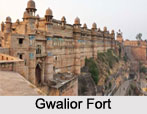
A centre of Indo-Aryan building in West India is the city of Gwalior, on the main railway between Delhi and Mumbai. A little group of disused and largely ruined temples and fragments of shrines crown the plateau of Gwalior Fort. The earliest of these is the Telika-Mandir of the eleventh century. The structure as it stands today is better described as a shrine than a complete temple. The building rises to a height of eighty feet and is in the shape of an oblong, a plan repeated in the cella and the porch. This design is unique in later Hindu architecture and the roof is in the shape of a barrel-vaulted chaitya with the sun-windows of the Buddhist type plainly indicated at each end; the resemblance to the Buddhist basilica type extends to the representation of arcades. This is one of the last appearances of the rare Vesara type of temple. The deeply sculptured panels on either side of the main entrance, although badly damaged by iconoclasts, are magnificent examples of later relief carving. In both one can see a female personage, possibly a river goddess, with three attendants, one of whom holds an umbrella over her; in the subtly swaying movement of the elegantly attenuated figures and the contrast between the broadly realised forms and exquisitely defined details of ornament, the style is a prolongation of the magnificent Gupta workmanship in West India which we have already examined in a relief from the Gwalior region.

The other buildings of Gwalior are the great and the small Saas Bahu temples and the former is dedicated to Lord Vishnu. The great Saas Bahu mandir is divided into three storeys of open loggias separated by massive architraves. The penetration of the mass of the building by these deep balconies provides a feeling of lightness and elegance; the design is also helped by the alternation of accents of light and shade provided by the columns set off against the porches. On the exterior the building terminates in a rather flattened terraced pyramid which continues to the very peak of the structure the eccentric and striking plan with its multiple set-backs and recesses. Inside, the impression is that of a single large hall rising to the full height of the building, rather like the crossing of a cathedral. The effectiveness of this motif has been partially spoiled and an effect of crowding introduced through the necessity for four gigantic stone piers to support the great mass of masonry of the superstructure. The carving of the under-surfaces of the massive stone beams in an all-over foliate design does much to relieve the heaviness of these members, an effect of lightness and fragility continued in the dome, which in the intricacy of its fretted carving is suggestive of fan vaulting.

The architecture of Goa stands out amidst the others in West India. The buildings here display an Indo-Portuguese style of architecture. There are several heritage buildings, though most of these are in ruins. Catholic churches and temples are part of its religious architecture.

Thus, the architecture in West India is, primarily, an amalgamation Hindu, Jain and Buddhist architectural styles. Although most of the architectural monuments are in ruins but most of them bear testimony of the magnificent past.

(Last Updated on : 27/08/2009)
  More Articles in History of Indian Architecture
 
Architecture Of Orissa Architecture Of West India Architecture Under The Nayak Dynasty
Pratihara Architecture In India Solanki Architecture In India Architecture of Indus Valley Civilisation
Paramara Architecture in India Rajput Architecture in India Badami Chalukya Architecture
Recently Updated Articles in Indian Monuments
  • Allahabad Fort
    Allahabad Fort is located on the banks of the Triveni Sangam. This Fort was built by Akbar in 1583. Currently the fort is occupied by the Indian Army.
  •  
  • Jama Masjid
    The Jama Masjid is Delhi`s famous mosque depicting beautiful Islamic style of architecture.
  •  
     
  • Modern Indian Art
    Modern Indian Art consists of various form of art, and ever since independence it has come a long way.
  •  
  • Kittur Chennamma Fort
    Kittur Chennamma Fort of Karnataka lies on the Pune Bangalore Highway in a small town of Kittur.
  •  
  • Madras School of Arts
    Madras school of arts was set up in the year 1850 by the British Empire. It believes in creating new ideas.
  •  
    E-mail this Article | Post a Comment
    RSS Feeds
    Forum
    Forum on Indian Monuments

    Free E-magazine
    Subscribe to Free
    E-Magazine on Indian Crafts
     
     
    Architecture Of West India - Informative & researched article on Architecture Of West India
    Sitemap
    Contact Us   |   RSS Feeds
    Copyright © 2008 Jupiter Infomedia Pvt. Ltd. All rights reserved including the right to reproduce the contents in whole or in part in any form or medium without the express written permission of Jupiter Infomedia Pvt. Ltd.
