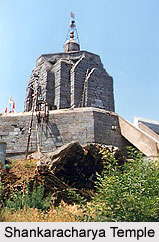
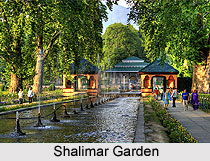
 Srinagar is the most important town in Jammu and Kashmir and is located at the edge of the Dal Lake. Architecture in Srinagar demonstrate the influence of both Muslim and Hindu architectural styles. The main monuments and buildings of Srinagar are Shalimar Bagh, Shankaracharya temple, Jami Masjid, Martand Surya temple and Nishatbagh. Archeological evidences have proved that the early architecture of Srinagar dates back to the Vedic period. Foreign invasions like the Mughals have left considerable impact on the architecture. Most of the architectures of Srinagar are religious architecture such as temples and mosques. Apart from religious architecture there are the scenic gardens which are a contribution of Mughal architecture.
 The architecture of Jami Masjid mosque in Srinagar is noted for its fascinating art work as well. It is the most magnificent of all wooden mosques in Jammu and Kashmir. Originally built of wood in 1385 AD by Sultan Sikhander Butosikan, it was destroyed in a fire some time later. It was rebuilt and this time the outside walls were made of brick. The present mosque was built in 1674 and belongs to the era when Aurangzeb was the emperor. To the west of the courtyard, is an arched entrance built in the traditional style. The arched entrance faces Mecca and has a prayer room inside. This style has been adopted from the Hindu temples in Kashmir. As expected, the steeple of the roof acts as a reminder to believers to assemble for prayer. The other three arched entrances are simple allowing access into the courtyard. Inside the building is an imposing hall, which has pillars made from the trunks of three seventy Himalayan cedars. Originally there must have been obscure carvings on the pillars. The large spaces spanned by the long beams, using methods like the present day laminate lumber is interesting. The Shah Hamadan mosque in Srinagar has an independent hall like structure which is very different from the courtyard type of mosque. The sculpted effect of this mosque when seen from the banks of the Jhelum River is magnificent. The mosque is cubical in shape and the interior is embellished in rich colours.
The Shalimar garden of Srinagar is based on Mughal architecture. Shalimar Garden developed by Jahangir and later his son Shah Jahan, has achieved the epitome of Islamic garden design brought to India by Babur. The linear water channel, formed by diverting the water from the mountain to the lake, is the central axis in this symmetrical garden.The row of square gardens is connected by canals with pavilions built over them. There is a segregated area for women on the inner side of the garden built by Shah Jahan, which has bowers of black marble. The Nishatbagh is a symmetrical garden where the central axis is emphasised more than in square gardens. The step incorporated on either side of the central axis is reminiscent of the terraced gardens of the Italian Renaissance Period. Earlier, this fairly large garden could only be approached by boat from the lake. Today unfortunately the pavilions are broken and weeds cover the waterways.
Amongst some of the most well known religious monuments in Srinagar is the Shankaracharya temple, dedicated to Lord Shiva. It was built in the eighth century and displays Hindu architecture. The temple is located on a summit of a hill. This limestone temple has an octagonal terrace surrounding it, which appears to have been a corridor. The top of the temple which must have been a stone steeple is broken. It is said that this temple was originally a Buddhist temple. The tomb of Zain al Abidin`s mother in Srinagar was built in the Persian style and was made of bricks. It appears from the remains seen on the walls that it was decorated with colourful tiles. The corridor in the Hindu style which is seen in the precincts indicates that the tomb was built on the foundations of a destroyed temple.
 The Martand Sun temple, another instance of Hindu architecture in India, was built during the Vedic period and was dedicated to the sun god. It is situated to the south east of Srinagar. The temple precinct is surrounded by pillars and small rooms. The Hellenic architectural style brought to India by Alexander was incorporated along with Gandhara sculptures, thereby lending a unique character to the Hindu temples. There is a tank in the precincts of the temple. A room in front of the sacred room has features found only in temples constructed much later. Very similar to the temple of Martand are the Avantisvamin and Avantiswara temples. But these temples are simple, with no front shrine. It is strange to note that the importance given to the entrance is the same as that given to the main shrine. The Vishnu temple at Buniyar is another example of Hindu architecture. It is built on a small scale, with sturdy granite most of the temple except for the pyramidal roof remains intact. Pillars surrounding the temple are very well preserved. The Shiva temple in Srinagar was constructed during the eleventh century. All four sides of this serene shrine are open, with a gabled roof over each of the four entrances. The effect of the Hellenic style, on the cornice of the roof and sculptures of Hindu deities on the tympanum of the three-petal arch, are an interesting combination.
The architecture of Srinagar, thus, combines both the Hindu and Islamic styles and forms of architecture.