Soya Samosa
|
Soya Samosas are one of the variations of Samosas which are also preferred by people of India.
|
|
|
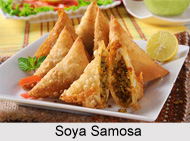 Soya Samosas are stuffed with spiced Soya granules and is the more popular as Indian snack. Samosas are the most traditional and popular snacks of India. Samosa is prepared with an innovative filling in Soya Samosa. They are so delicious that Indians often make a meal of them. An easy to prepare recipe at home, Soya Samosa is delicious. The deep fried patties with cooked soya granules and spices can be prepared in various shapes and sizes. Soya Samosas are stuffed with spiced Soya granules and is the more popular as Indian snack. Samosas are the most traditional and popular snacks of India. Samosa is prepared with an innovative filling in Soya Samosa. They are so delicious that Indians often make a meal of them. An easy to prepare recipe at home, Soya Samosa is delicious. The deep fried patties with cooked soya granules and spices can be prepared in various shapes and sizes.
Ingredients for Stuffing:
1/2 cup Green Peas
1 cup Soya Granules
1 big Onion
2 tsp chopped Green Chillies
1 tsp grated Ginger
1 tsp Garam Masala
1/2 tsp roasted Cumin powder
1 tsp Coriander powder
1 and 1/2 tbsp Lemon juice
1tsp red Chilli powder or as needed
1 tbsp Coriander leaves, finely chopped
1 tbsp Oil
Salt to taste
For outer layer:
1 and 1/2 cups Flour
3 tbsp Ghee
3/4 tsp Carom seeds
Salt to taste
Oil for deep frying
Method for preparing the Dough:
Take the flour, salt and carom seeds in a mixing bowl. Combine well.
Add ghee and mix well to get a breadcrumb like consistency.
Make a firm dough by adding water little by little.
Cover the dough and keep aside for 15 - 30 minutes.
 Preparing the Soya Stuffing:
Cook the green peas until they are tender and keep aside.
Boil enough water with little salt. Turn off the heat and add the soya granules. Let it soak for 10 minutes.
Drain water and rinse with cold water twice to get rid of raw smell of soya granules. Keep aside.
Heat a tablespoon of oil in a pan and add the grated ginger and finely chopped green chillies. Saute for a minute.
Then add the finely chopped onion and fry till light golden colour.
Add the turmeric, garam masala, cumin, coriander and red chilli powders and combine.
Now add the drained granules, cooked peas and salt and mix well. Sprinkle little water if required.
Cover with a lid and let it cook for 5 minutes.
Add the chopped coriander leaves and turn off the flame.
Finally add the lemon juice and combine.
Keep it aside to cool.
Preparing and Frying the Samosas:
Knead the dough and divide into 8 - 9 equal round balls.
Roll each ball into a circle and cut it into 2 equal parts with knife. The rolled dough should not be too thick or too thin.
Wet the straight edge with little water.
Now make a cone by joining the two edges by overlapping them. Press the edges well.
Stuff the cone with prepared soya stuffing.
Close the cone and seal it well. The edges of the cone should be sealed well so that the filling does not come out while frying.
Continue filling the rest of the samosas and cover them with a moist kitchen towel.
Heat oil until hot and gently drop 3 - 4 samosas at a time. Reduce the flame to low.
Turn over in between and fry the stuffed samosas till they become golden and crisp.
Drain in paper towels and serve hot with mint coriander chutney.
Baking the Samosas:
Preheat the oven to 180 degree C.
Brush the stuffed samosas with oil and place them on a baking tray.
Bake them for 30 - 35 minutes or till golden colour at 180 degree C.
Serve hot with tomato ketchup or coriander mint chutney.
|
|
|
|





