Ajrak printing has become famous in all the northwestern states of India. However, Rajasthan and Gujarat are the major hubs for this kind of printing. The term ajrak may have evolved from the Sanskrit word jharat, from which a-jharat or stable object was coined. This term could also be a derivation of azrak, meaning blue in Arabic, as traditionally; blue happens to be one of the principal colours in ajrak printing.
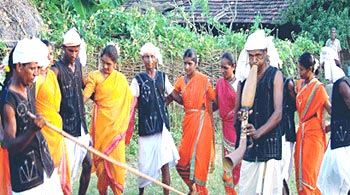
This style of printing is restricted to certain areas in Rajsthan and Gujarat, like Banner and Akola in Rajasthan. The ajrak technique is used to create various functional garments, like the head covering and the sarong-like lungi, both of which are popular with the men in this region. It is also used as a wrap, a carrying cloth or a floor sheet. Meghval and Sindhi Muslim women wear ajrak printed ghaghra and odhni. The process of this kind of printing is very interesting. The raw fabric in full length is pulled exhaustively through the river many times, scoured, beaten, steamed, mordanted, printed with resist mud-pastes from the banks of the river, covered with powdered camel dung and ground rice husks; dyed in deep, deep madder and indigo.
Ajrak fabrics are very precious in the world of textiles. Before the actual process of printing begins, the fabric is washed and treated with a harda solution. Thorough washing and de-sizing is necessary, as it improves the cloth`s capacity to absorb the colour.
Kariyanu is the first step in Ajrak printing. A resist paste of lime is imprinted on to the fabric. This distinguishes the white outlines of the design. The borders are printed from left to right and always before the main body of the fabric. Ajrak printing can be single or double sided. When the reverse side is printed, the process is carried out; while the material is still damp, as fabric tends to shrink when it dries. Syahi paste, which turns black on contact with alizarin, is used in the second stage of printing. All areas to be resisted for indigo arc printed with gach, alum resist-mixed with mordant. Dried rice husk is then speckled on the damp areas to fix the resist. The fabric is now immersed in an indigo vat, then washed and finally dried. The next treatment applied is with alizarin. The cloth is washed and dried, once again. It is then printed with fresh resist on all areas of the ajrak, except those, which have been hued with indigo in the first immersion.
The fabric is dyed once again to develop its colour in a special process called mina. The deep, rich shade of blue so obtained is characteristic of ajrak printing. Subsequently, the cloth is put through a final washing and a special finishing thus gives the ajrak its characteristic lustre. In recent times, the inclusion of nasphal in the dyeing process has added yellow and green to the ajrak palette. The ajrak is clearly distinguished from other block-printed textiles not only due to its deep red and blue hues but also in its structuring of motifs. Here, each of the motif`s quarters is produced by an identical impression of the block, the four parts coming together forms the whole motif.
The Ajrak print is employed within a grid, the repetitive pattern creating a web-like design or the central jaal. Apart from this jaal, border designs are also employed in the fabric. These borders are aligned both vertically and horizontally and frame the central field, distinguishing one ajrak fabric from another. The lateral ends are printed using a wider, double margin in order to differentiate the layouts of borders.
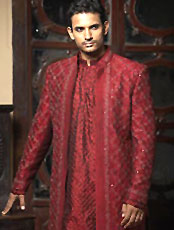
Ajrak printing has recently gained great momemtum in the region and this form of prints is often employed by the urban designers to give the garments a folk touch.