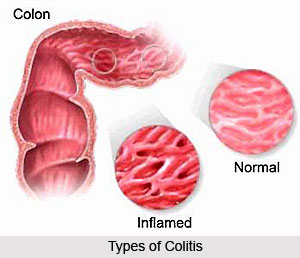
 There are different types of colitis including ulcerative colitis (UC), Crohn`s colitis, diversion colitis, ischemic colitis, infectious colitis, fulminant colitis, collagenous colitis, chemical colitis, microscopic colitis, lymphocytic colitis, and atypical colitis. A well-known subtype of infectious colitis is pseudomembranous colitis that results from infection by a toxigenic strain of Clostridium difficile. Parasitic infections also cause colitis.
Any colitis with a speedy downhill clinical course is known as fulminant colitis. Besides, diarrhea, fever, and anemia seen in colitis, the patient has severe abdominal pain and presents a clinical picture similar to that of septicemia, along with shock. Approximately half of these patients require surgery. Irritable bowel syndrome, a separate disease, has been called convulsive colitis or spastic colon. This name causes confusion, since colitis is not a feature of prickly bowel syndrome. Enterohemorrhagic colitis may be caused by Shiga toxin in Shigella dysenteriae or Shigatoxigenic group of Escherichia coli (STEC), including serotype O157:H7 and other enterohemorrhagic E. coli.
Infectious colitis is another type of Colitis, where many bacteria normally reside in the colon; they live in accord with the body and cause no symptoms. However, if disease-causing bacteria are ingested with bacteria-contaminated foods, these bacteria may contaminate the small intestine or colon. Common infecting bacteria include ampylobacter, E. Coli, Shigella, and Salmonella. These infections, with the exception of Campylobacter infection, often cause bloody diarrhea and can direct to dehydration from the loss of fluids in the diarrheal stools. Similar symptoms can be seen with viral and parasitic infections of Colitis, though common viral infections of the gastrointestinal tract more often involve infection of the small intestine rather than the colon.
Sometimes colitis also occurs after antibiotics have been prescribed for an infection elsewhere in the body. The antibiotic suppresses some of the normal bacteria within the colon and allows an overgrowth of another type of bacteria, some of which can lead to colitis. Most commonly the bacterium that overgrows is a bacterium called, Clostridium difficile (C. difficile, C. diff). This bacterium produces toxins that causes diarrhea, usually that is non-bloody, associated with a fever and is called C. difficile colitis or pseudomembranous colitis due to the membrane-like clumps of pus that form on the inner lining of the colon.
Ischemic colitis is one of the types of Colitis, where the colon takes the shape of a hollow muscle. It requires a supply of blood to bring oxygen and nutrients in order for the muscles to function normally. When the colon loses its supply of blood and becomes restricted of blood supply, it may become inflamed. Ischemia or lack of blood supply causes pain, fever, and bloody bowel movements. As a person ages, the arteries that supply blood to the colon gradually narrow and can cause ischemic colitis. These arteries get narrower even faster if the individual has diseases that promote narrowing of the arteries, for example, high blood pressure, diabetes, high cholesterol and smoking. Ischemia also may be brought on by low blood pressure or anemia (low red blood cell count) in connection with the arterial narrowing, since these further diminish blood flow. The blood supply to the colon may be compromised because the blood vessels are mechanically obstructed.
Inflammatory bowel disease is classified into Ulcerative colitis and Crohn`s disease that are the inflammatory bowel disease (IBD), giving rise to colitis. Ulcerative colitis always begins in the rectum and sigmoid colon and frequently progresses over time through the ascending, transverse, and then ascending colon. It is thought to be a disease caused by over activity of the immune system and usually causes abdominal pain, and bloody, diarrheal bowel movements. Crohn`s disease may occur anywhere in the digestive tract - in the esophagus, stomach, small intestine, or colon. It most commonly involves the small intestine and colon. In Crohn`s disease there may be "skip lesions," that is, abnormal segments intermingled between normal segments. If segments of the colon are involved, then symptoms of colitis may be present.
Microscopic colitis is classified into two types, namely collagenous colitis and lymphocytic colitis. Either collagen or lymphocytes engorge the layers of the wall of the colon, presumably a result of inflammation. This is an uncommon illness and may be an autoimmune disease. It is more observed in older women. The diarrhea often is watery, but no blood is present in the stool.