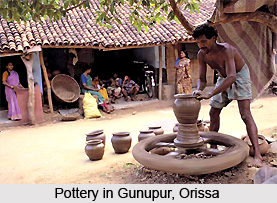
Pottery in Indian villages presents a wonderful amalgamation of concept, design and execution. There are many villages in India that are famous for producing extraordinary pottery products. The Indians are expert in moulding clay with their hands to form various things of daily utility, toys and deities of worship since the ancient period. Pottery in Indian villages can be classified in religious aspect as well.
History of Pottery in Indian Villages
The history of pottery in Indian villages dates back to the earliest civilisation of India, the Indus Valley civilisation. Many wonderful pieces of pottery have been found from the excavation of the Harappa and Mohenjo-Daro cities.
Types of Pottery in Indian Villages
Potteries can be both handmade and wheel-made, which is practised all over India. There are mainly 2 types of pottery found in the Indian villages namely the "Unglazed Pottery" and "Glazed Pottery".
•Unglazed Pottery: There are three different styles in unglazed pottery namely; the Paper-Thin, Scrafito and Highly Polished. In the paper thin pottery, the biscuit coloured pottery is decorated with incised patterns. In the scrafito technique, the pot is polished and painted with red and white slips along with intricate patterns and the outline is incised.

•Glazed Pottery: Glazed pottery is another ancient form of pottery in Indian villages. The inception of glazed pottery in India dates back to the advent of Arab influence. The villages in the places like Delhi, Amritsar, Jaipur, Khurja, Chunar and Rampur and Karigari in Tamil Nadu are famous for making glazed pottery.
Apart from the unglazed and glazed pottery, there are also a few other types of pottery produced in the villages of India. The major types of pottery in Indian villages include the common earthenware, Kulhar (cup-like container), lamps for Diwali, toys for Dussehra, pots for seedling at Makar Sankranti, painted pots for marriages, etc.
•Karigari Pottery: This is a major type of pottery in Indian villages that is made with special attention by putting intricate designs on it. Ashtrays, flower vases, tea sets, paper weights, decorative animal figures, etc. are some of the examples of Karigari pottery.
•Blue Pottery: This is another common form of pottery in Indian villages.
•Black Pottery: This is another famous form of unglazed pottery in Indian villages and it resembles the Harappan pottery style. The villages of Kangra District in Himachal Pradesh are noted for black pottery and Pokhran in Rajasthan has stylised forms with incised decorative patterns. The villages of Nizamabad District in Uttar Pradeshare also quite famous for black pottery with silver patterns worked in it. This type of pottery resembles the Bidar work of Andhra Pradesh where oxidised gunmetal is decorated with silver wire.
•Terracotta: This is probably the most famous form of pottery in Indian villages. The villages of West Bengal, Bihar and Gujarat are best known for terracotta works.
Pottery of North Indian Villages
 The villages of Jammu and Kashmir are famous for producing quality earthenware of ordinary clay, with a glaze-like surface. The villages of Uttar Pradesh in India are well known for making some of the finest, most decorative and fine black clay pottery items. The other important places for pottery in Uttar Pradesh include Meerut, Hapur, Chinhat and Mansalia. The villages in these places are famous for making ordinary domestic articles and glazed items. Meerut and Jhajjar are famous for making slim necked water containers called Surahis.
Pottery of East Indian Villages
The people in Sunderban area make Dakshinirai pots, which are round with an edging running along the mouth signifying a crown. The people also worship these pots as the God, who will protect them from tigers.
Pottery of West Indian Villages
The villages of Gujarat are famous for making items using a mixture of white and black pottery. The villagers make designs by using dots, zigzag stripes and diagonals and the floral and animal patterns are occasionally used. Villages in Kutch and Saurashtra in Gujarat are quite famous for their beautiful earthenware. Kutch is famous for pots, terracotta horses and elephants. On the other hand, earthenware made in the villages of Goa has a charm of its own.
Pottery of South Indian Villages
Vellore is famous for black and red wares and Usilampatti in Madurai district is also famous for Black Pottery. However, the Karigari pottery in South Arcot of Tamil Nadu is the most famous form of pottery in south Indian villages. Khanapur in Belgaum district of Karnataka is also quite popular for making large sized containers and jars for storage and preservation. The villages of Tamil Nadu are also quite famous for the figures of the Deity. The figures are huge and they are found standing guard at the entrances of villages protecting the insiders from evil spirits.
Pottery in Indian Villages is one of the most ancient and popular art forms of Indian village. Pottery in Indian villages has been in existence since the Indus Valley Civilisation and is still practised in most of the Indian villages.