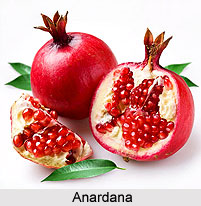
 Anardana or Pomegranate is an attractive shrub that has several useful features, including medicinal values. The origin of Anardana was in Iran, however, it has later been cultivated and naturalised in India, and other countries, quite extensively. Anardana first came to the central and southern India from Iran around the first century AD and has been cultivated since then. Though cultivated extensively throughout India, Anardana is mostly found in the Himalayas in northern India, between altitudes of 900-1800 m.
Anardana need a certain climatic condition to grow properly. The climatic condition of India is considered suitable for the growth of Anardana. The Anardana species grows in abundance in mild-temperate to subtropical regions and is naturally adapted to the regions, having cool winters and hot summers. However, certain types of Anardana are also grown in home dooryards in tropical areas. The soil of India provides all the necessary components for the growth of Anardana. Anardana mostly thrives on calcareous, alkaline soil and also on deep, acidic loam and a wide range of soils. It is spontaneous on rock strewn gravel in the northern India.
Anardana or Pomegranate is called in different names in different parts of India. The Hindi and Punjabi speaking people know the tree as Anardana. Its Sanskrit name is Dadima. It is known as Dalim in Bengali and Assamese, and Dalam or Dadam in Gujarati. The Kannada speaking people call Anardana as Dalimbari, the Kashmiri people know it as Daan and in Malayalam and Tamil; it is called as Mathalam Pazham. The Marathi name of Anardana is Dalimb, the Oriya name is Dalimba and its name in Telugu is Dannima Pandu. The tree is called as Anardana in Urdu, as well.
Many cultivars of Anardana are found in India. The types of Anardana that has relatively soft seeds are often classified as "seedless" Anardana. However, the best types of Anardana found in India are Bedana and Kandhari. Bedana is a medium to large sized fruit, having brownish or whitish rind, and a pinkish-white pulp. The pulp of Bedana is sweet in taste and its seeds are quite soft. On the other hand, the size of Kandhari is large and this deep-red, deep-pink or blood-red fruit has sub-acid pulp and hard seeds.
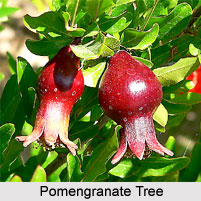 The other cultivars of Anardana found in India include the Alandi or Vadki. This medium-sized fruit is of fleshy red or pink colour, and contains sub-acid pulp and very hard seeds. Dholka is another type of Anardana. This fruit is large and yellow-red in colour, with patches of dark-pink and purple at base. Sometimes, it is also found in greenish-white colour. The thick rind of the fruit is fleshy and purplish-white or white in colour. The pulp of Dholka is sweet in taste and its seeds are quite hard. Dholka is an evergreen, non-suckering plant and is highly desirable for commercial purposes in Delhi. A large-sized variety of Anardana plant is Kabul. The fruit of this tree has dark-red and pale-yellow rind and its dark-red pulp is fleshy, and sweet or slightly bitter in taste. The other cultivars of Anardana include Muscat Red, Paper Shell, Poona, Spanish Ruby, Vellodu, Muscat White, etc.
Anardana or Pomegranate has different pollination habits. It can be self-pollinated or can also be cross-pollinated by insects. The size and fertility of the pollen vary with the cultivar and season. The Anardana seeds can germinate readily even when they are merely thrown onto the surface of loose soil. Selected cultivars of Anardana are sometimes reproduced by means of hardwood cuttings 10 to 20 in (25-50 cm) long, to avoid seedling variation. However, though grafting between different cultivars of Anardana has never been successful, the plant`s branches can be air-layered and the suckers from a parent plant can be taken up and transplanted.
Anardana is widely distributed throughout India. The fruit ships well, and is generally transported after being cushioned with paper or straw, in wooden crates. They are also transported in baskets for nearby markets, in India. The fruit is also transported in different sizes, packed in layers, unwrapped but topped with shredded plastic, in covered wood boxes.