 Non-renewable resources of energy in India are the natural resources of energy that cannot be produced, renewed, re-grown, or recycled on a large scale. These non-renewable resources generally exist in a fixed amount and are consumed much faster than nature can reconstruct them. Fossil fuel including Indian coal, petroleum, oil and natural gas are some examples of non-renewable resources of energy in India. Non-renewable resources of energy in India such as coal, petroleum, oil and natural gas need millions of years to form naturally and cannot be replaced as rapidly as they can be consumed. In due course natural resources will become too expensive to reap and mankind will look for alternate sources of energy. At present, the most important energy sources used by the Indian population are non-renewable sources of energy.
Coal as Non Renewable Resource of Energy
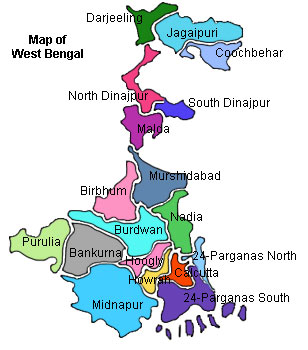
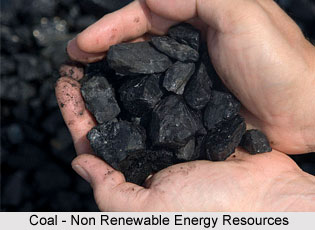
Coal occupies the leading position as a non-renewable resource of energy in India. The coal industry in India contributes immeasurably to the present profit-making and economic successes. Industries such as steel and carbo-chemicals to a large extent depend upon coal industry. The method of coal mining in India was started in the year 1814. Coal is mostly obtainable in the valleys of rivers Damodar River, Son River, Godavari River and Vardha River. Generally Anthrasite and Bituminous qualities of coals are found expansively in these areas. Major coal belts lie in the states of Jharkhand, Andhra Pradesh, Chhattisgarh, Orissa, Madhya Pradesh and West Bengal. The lignite quality of coal is found in Tamil Nadu, Rajasthan, Meghalaya and Jammu and Kashmir. Presently the Coal India Limited (CIL) and Singarene Collieries Company Limited (SCCL) control the coal industry in India.
 Petroleum as Non Renewable Resource of Energy
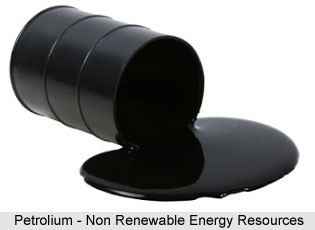
The India Petroleum Industry has improved enormously after Indian independence towards its stride to accomplish a self-reliant market in the nation. During the Independence era of 1947, foreign companies controlled the Indian Petroleum Industry and India`s own potential in this sector was inadequate. Now, after sixty years, petroleum has become an imperative source of energy in India and also has become an important public sector undertaking with abundant capable officers and updated technology is being used that is comparable with some of the most advanced nations of the world. The consumption of petroleum has multiplied itself almost thirty times in the post-independence era.
Natural Gas as Non Renewable Resource of Energy
Non renewable sources of energy in India have been used since the primitive times in the nation and the increase in population justifies the increase in use of these resources. However, the unimaginable usage of these resources has created an air of conservation requirements. These non-renewable resources of energy are now of a serious concern to the Indian government. The role of oil and natural gas in India is very noteworthy as it is one of the biggest contributors to both the Central and State treasuries. Natural gas is at present one of the most preferred fuels due to its environmentally gentle nature, greater competence and cost effectiveness. The demand for natural gas has to a great extent increased in the last two decades at the global level. In India too, the natural gas sector has gained importance, particularly in the last decade, and natural gas is said to be the fuel of the 21st century.