Konrad Sarees
|
Konrad sarees have the distinguishable designs that are typical example of South India.
|
|
|
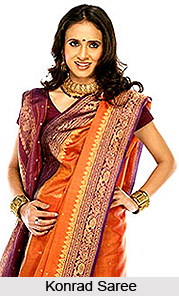 Konrad Saree is one of South India’s most well-known sarees. This type of saree originated from Tamil Nadu and has earned fame due to the traditional affluence and the usage of excellent fabrics. The Konrad also known as "Temple Saree" and "Mubbhagam Saree", a hand woven Konrad Saree is expensive. These sarees were originally woven for temple deities. The main attraction of Konrad Sarees is their border which is exclusively designed wide and with exclusive designs of motifs of natural elements and animals with a royal touch. These motifs need not be mythological in nature, but rather, seem to pay homage to natural flora and fauna such as floral motifs including flowers, vines, and creepers, and also animals and birds such as peacocks, elephants, parrots, double headed eagles, and others. Another distinguishing feature which sets a traditional Konrad saree apart from other South Indian sarees, is the fact that it has a distinctive appearance and feel to it, which does not look or feel like silk, although it is very much a silk saree. These sarees are widely famous for their extensive use in marriages and other occasions. Konrad Saree is one of South India’s most well-known sarees. This type of saree originated from Tamil Nadu and has earned fame due to the traditional affluence and the usage of excellent fabrics. The Konrad also known as "Temple Saree" and "Mubbhagam Saree", a hand woven Konrad Saree is expensive. These sarees were originally woven for temple deities. The main attraction of Konrad Sarees is their border which is exclusively designed wide and with exclusive designs of motifs of natural elements and animals with a royal touch. These motifs need not be mythological in nature, but rather, seem to pay homage to natural flora and fauna such as floral motifs including flowers, vines, and creepers, and also animals and birds such as peacocks, elephants, parrots, double headed eagles, and others. Another distinguishing feature which sets a traditional Konrad saree apart from other South Indian sarees, is the fact that it has a distinctive appearance and feel to it, which does not look or feel like silk, although it is very much a silk saree. These sarees are widely famous for their extensive use in marriages and other occasions.
Design of Konrad Saree
The borders of these sarees are decorated with different designs. The borders of these sarees are approximately 10 to 40 cm wide, woven in a plain colour. The body of the Konrad saree traditionally contains a woven pattern, usually checks or stripes. This is known as "Kampi" or "Pettu" (stripe). The endpiece of the saree contains either a series of widely spaced zari stripes or supplementary-weft figuring. The common form of the endpiece of Konrad saree is found in a wide band which is usually of zari, with weft-wise triangular points woven in the interlocked-weft technique. The designs of these sarees also vary as the designs differ from straight edged border or with various styles of triangular motifs called, "Mokku" (flower bud) ranging from simple triangles (pogudi) to serrated mounds (pillaiyar mokku). Such serrated borders are also known as "Karavai" (sawtooth). Many Konrad sarees are named after the colour of their borders like "Arakku" saree has a lac-dyed (red) border, and "Pudapayalam Karavai" a yellow serrated border.
Konrad Sarees of Different Areas
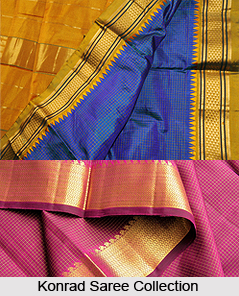 The Konrad saree of south India are mostly woven in eastern Tamil Nadu, in Kanchipuram, Salem, Arni, Madras, Kumbakonam and Thanjavur (Tanjore). Though Arni was considered to be the birthplace of Konrad Saree in the 19th century, but today Kanchipuram is regarded as the most important Tamil silk-weaving centre. The Kumbakonam or Thanjavur area of South India creates heavy- to medium-weight Konrad silks similar in style and technique to Kanchipuram’s although the endpiece warps are attached differently.
Technically the Konrad saree is a figured silk, but its distinctive appearance sets it apart from the others. The Konrad saree of south India has been occupying the position of one of the traditional sarees because of its exclusive designs and weaving technique. The exclusive representation of natural elements gets an extra charm in the hands of the weavers. The sarees are available in soothing and traditional colours. The exclusively designed borders of Konrad sarees make them stand apart among the other sarees.
|
|
|
|





