 Kampilla or Kamala is a shrub or a small evergreen tree having a short, often buttressed, trunk and thin, grey bark. The Botanical name of the plant is Mallotus philippensis (Lam.) Muell. Arg. and it is known as Kamala tree or Monkey Face tree in English. There are several names of the plant in different Indian languages. Kampilla is the Sanskrit name of the plant and it is also called as Kampillaka, Kampillakah or Rechanaka in Sanskrit. Besides Kamala, the other Hindi names of the plant include Kamila, Raini, Rauni, Rohini, Rori or Sindur. The Bengali speaking people call the plant as Kamala, Kamalagundi, Kamila or Tung and its name in Gujarati is Kapilo. In Marathi; the names of the plant are Kuku, Shendri and Shindur and its Oriya names are Bosontogundi, Kapilogundi, Kunkumo, Punango and Sinduri. Kampilla or Kamala is known as Kamal, Kamela or Rulya in Punjabi and in Tamil; it is called as Kamala, Kapila, Kapli and Kungumam. The Telugu speaking people know the plant as Chendiramu, Kumkuma, Kunkuma, Sinduri and its Urdu name is Kalileh.
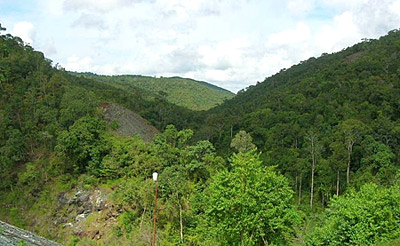
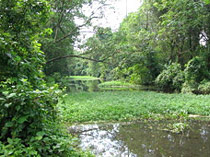
Kampilla or Kamala is quite extensively found in northern India. The plant is also grown throughout the country except in the driest regions. It is grown at up to 1500 m elevation in the Himalayas and the Western Ghats as well. Kampilla or Kamala is a pioneer species characteristic of secondary vegetation and is commonly found in moist habitats like stream banks in Sal-dominated forests. The plant is found in mixed deciduous and dry, open, thorn forests and abandoned agricultural fields as well. Kampilla or Kamala usually flowers from the month of August to December and fruits between the months of November and March in peninsular India.
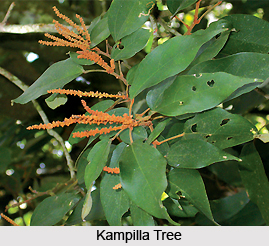
Kampilla or Kamala is a much-branched, evergreen tree with tawny or rusty-tomentose twigs, young leaves and inflorescences. The leaves of the plant are alternate or sub-opposite and the variable leaves have a length and width of 8-16 cm and 1.5-7.5 cm, respectively. The leaves are usually ovate-elliptic or ovate-lanceolate with acute to acuminate apex and the base is rounded. The margins are entire or slightly toothed and glabrous above and have numerous red glands beneath. The venation of the leaves is reticulate and strongly 3-nerved at the base and there are 4-7 pairs of nerves above the basal ones. The petiole is 1.5-9 cm long and has 2 small glands on each side of the apex.
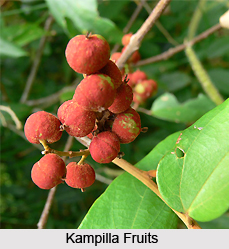 The small flowers of Kampilla or Kamala are dioecious and greenish-yellow in colour. They are borne in simple or branched terminal paniculate spikes and the pedicels are very short or absent. The 3 mm long, lanceolate male flowers have 4 sepals and the broadly ovate bracts are 1.5 mm long. On the other hand, the calyx of the female flowers is divided nearly to the base and the flowers have 3-4 sepals. The sepals of the female flowers are thicker than those in the male and they are ovate-lanceolate. The plant`s fruit (capsule) is globose and has 3-lobe and 3-valves. The 0.8-1 cm long fruit has a diameter of 0.6 cm and it is densely covered with reddish-brown glandular pubescence. The black and smooth seeds of Kampilla or Kamala are sub-globose and have a diameter of 0.4-0.5 cm.
Kampilla or Kamala has several medicinal properties and various parts of this plant are used quite frequently in different traditional medicines. In Ayurveda, the dried, powdered, red pubescence surrounding the ripe fruits is known as Kamala or Kampillakah. It is commonly used as a styptic and anthelmintic and if taken with milk or curd (yoghurt), it can be quite useful for expelling tapeworms. Kamala or Kampillakah is also used as an oral contraceptive. The powder and a few other parts of Kamala are also used in external applications to promote the healing of ulcers and wounds. They are used to treat parasitic affections of the skin like scabies, ringworm and herpes as well.
Sometimes, a decoction of the stem bark of Kampilla or Kamala, along with that of Mangifera indica, the whole plant of Cuscuta reflexa and the leaves of Dendrocalamus strictus is used as a bath for treating jaundice. The Gonds of Uttar Pradesh use this decoction most frequently. The tribal inhabitants of Sundargarh District in Orissa use another decoction of the flowers of Kamala as an anthelmintic. Apart from medicinal uses, the Kamala powder was also used quite extensively in the past for dyeing silk and wool, as it can produce a bright orange or flame colour.