


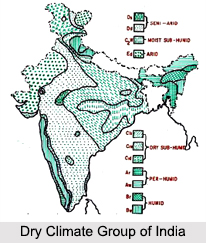
 Dry Climate Group of India consists of regions where the rate of evaporation of water is higher than the rate of moisture received through precipitation. India is a vast country and different regions experience different climatic conditions. More specifically, four principle climatic groups are experienced in the various Indian Climatic Regions. The Dry Climate Group of India is one such group which significantly affects lives and settlement where it is experienced. This kind of climatic group is classified into 3 types namely, the tropical semi-arid steppe climate, sub-tropical arid desert climate and sub-tropical semi-arid steppe climate. Dry Climate Group of India consists of regions where the rate of evaporation of water is higher than the rate of moisture received through precipitation. India is a vast country and different regions experience different climatic conditions. More specifically, four principle climatic groups are experienced in the various Indian Climatic Regions. The Dry Climate Group of India is one such group which significantly affects lives and settlement where it is experienced. This kind of climatic group is classified into 3 types namely, the tropical semi-arid steppe climate, sub-tropical arid desert climate and sub-tropical semi-arid steppe climate.
Tropical Semi-Arid Steppe Climate Tropical Semi-Arid Steppe Climate is experienced by a long stretch of land situated to the south of the Tropic of Cancer and east of the Western Ghats and the Cardamom Hills. It includes the Indian states of Karnataka, interior of Tamil Nadu, western Andhra Pradesh and central Maharashtra. These regions are prone to famines with very unreliable rainfall. The rainfall varies between 40 and 75 cm, annually. Towards the north of Krishna River, the summer monsoon is responsible for most of the rainfall, while the southern regions of the river experience rainfall during the months of October and November. The coldest month in these areas is December but even in this month the temperature remains between 20 degree Celsius and 24 degree Celsius. The months from March to May are extremely hot and dry with average monthly temperatures of around 32 degree Celsius. The vegetation mostly consists of grasses with a few speckled trees due to rainfall. Hence, the area experiencing tropical semi-arid steppe climate is not appropriate for permanent agriculture. Sub-Tropical Arid Desert Climate Sub-Tropical Arid Desert Climate is experienced in maximum portion of western Rajasthan. This region is a sparingly populated one owing to extreme climatic conditions. Scanty rainfall characterizes sub-tropical arid desert climate. More specifically, the rainfall is less than 30 cm. This type of rainfall is a result of cloud bursts. Monsoon winds prevail in the months of July, August and September and lead to cloud bursts. Apart from being scanty, the rainfall is also very inconsistent. It is also important to note that for several years a few regions may not even experience rainfall. The region experiencing this kind of condition has very hot summers in the months of May and June. During the winter months, cold waves are experienced causing the temperatures to fall below freezing point in some areas. The diurnal range of temperature is about 14 degree Celsius during summers, which increases a little during winters. Sub-Tropical Semi-Arid Steppe Climate Sub-Tropical Semi-Arid Steppe Climate is experienced towards the east of the tropical desert from Punjab and Haryana to Kathiawar in India. This climate is intermediary as it lies between tropical desert and humid sub-tropical conditions. The rainfall which takes place during the summer monsoon season is characteristically undependable. The annual rainfall in the regions experiencing this kind of climate ranges between 30 and 65 cm. There are chances that the maximum temperature of about 45 degree Celsius may be reached during summers and during winters, temperature may fall down to freezing point. It is only during the monsoon season that the regions experiencing this climatic condition experience high humidity. The region under sub-tropical semi-arid steppe climate has short coarse grass and crops like jowar and bajra, as part of its vegetation. |
| |||



Dry Climate Group of India
| Dry Climate Group of India is exemplary of the diversity in Indian climate. The various types of climate under the dry climate group are Tropical Semi-Arid Steppe Climate, Sub-Tropical Arid Desert Climate and Sub-Tropical Semi-Arid Steppe Climate. |
| ||||||||||||||||||||||||||||

