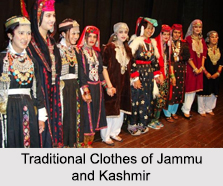
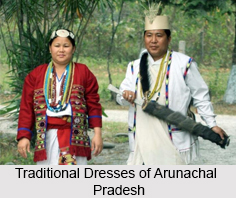
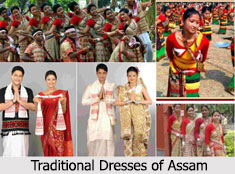
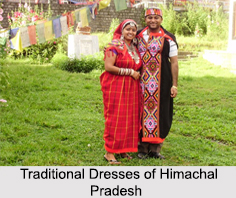
Basic draping in Indian sarees are influenced by the way India`s regional sarees were woven and embellished, just as the natural environment, history and culture also had an impact on the styles. In the present era, as the subcontinent is going through rapid technological, economic and social changes, the saree is proving to be a still-thriving part of Indian material culture. The regional designs, fabrics and even draping styles of South Asia`s sarees retain echoes of a past that was possibly ancient when the Indo-Aryans arrived.
The basic draping styles of sarees are different if categorized according to the region, ethnic and tribal communities of India. There are literally dozens draping styles of sarees, which is common among urban middle-class Indian women. Among the different saree styles and the draping methods these can be divided into six major types. In recent times most saris are tied in place with a string or sometimes to a petticoat.
Draping Style in different states
The northern styles of draping sarees have skirt pleats in the front and the free end draped around the back and over the front, so that the end piece of the saree covers the wearer`s breasts. There are many variations on this style, with the Gujarati, Bihari and Orissan versions being the most well known. The Bengali drape shows elements of both the northern and Dravidian styles. Not surprisingly, traditional sarees from the northern areas have large decorated end pieces because they are so visible. The age of the northern draping styles is revealed by the fact that even today in the north Indian state of Bihar they are called `sidha` while the `nivi` style is called an `ulta` style.
Draping styles in different regions
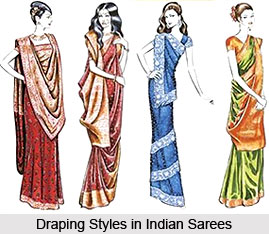 Among the several draping styles of sarees, there are some draping styles which are common among the local people of particular states and in tribes. The Deccan styles of draping sarees include the `nivi` alteration, which has various names in the different regions of south and south-west Deccan where it originated. The `nivi` style of sari drape is very ubiquitous among urban and middle-class Indians. Tamil ladies wearing saris draped in the `nivi` style, with garlands of fresh flowers or `kanakambara` in their hair, a traditional and commonly worn ornament in southern India.
Another, once more widely distributed type of draping style that is also traditional to the Deccan and parts of south India is the `kachchha` style. The Kachchha style of draping sarees resembles a pair of trousers that is literally `tucking the sari between the legs`. Kachchha drapes vary in complexity but all require long lengths of cloth. After the popularity of the `nivi` drape, the women of upper class and middle class started preferring the `nivi` style and `Kachchha` style lost favour to some extent. There are many ways of tying and draping `kachchha` saris, each giving a different result - from tight to loose around the legs. Each style uses a different part of the cloth to begin the often complicated draping sequence.
Though these `kachchha` styles of draping sarees are associated with Maharashtra but they are found throughout the Deccan plateau of Andhra Pradesh, Madhya Pradesh and the south part of India like Karnataka and Tamil Nadu. Until the 1960s, they were also worn by many tribal groups such as the `Bhils` of Western India and the `Ho`, `Munda Tribe` and `Bhumij` of the Chota Nagpur Plateau. The most well-known form, however, is the `Maharashtrian kachchha` style which resembles the `nivi` drape except that the free end of the front pleats is drawn between the legs and tucked into the back waist. As defined by the Shunga terracotta, `kachchha` styles have the distinction of being perhaps the oldest saree styles.
Traditional draping styles
The northern Indian style of draping saree involves the traditional way of wearing the saree with the end piece falling across the front of the body. In western India and the Ganga plain where the Muslim cultural influence was strong, women also draped the sari over their heads, hiding the face, a practice still continued in most wedding ceremonies. The `mundu veshti` of Kerala consists of two almost identical lengths of cloth which look like a full-body Dravidian sari when draped. Similarly, the `chadar` (shawl) and `mekhla` (lungi) of Assam, as well as other north-eastern tribal costumes, often use matching fabrics. This style is also followed by the women of Nepal. Particularly in the west side of India, states like Gujarat, Rajasthan and Haryana follow a distinct style of draping saree that necessitates wearing `odhnis` or half-saris worn with either the `ghagra` or `lungi`. This particular style of draping saree is common and is also reckoned as the precursor to many full-body saris.
Ancient Draping styles
The basic draping styles of sarees in Dravidian fashion are probably indigenous to southern India and Sri Lanka. Moreover, Bengali and some tribal like `Santhal Tribe` and `Oraon Tribe` drape sarees in similar fashion and in combinations of Dravidian and northern draping styles.
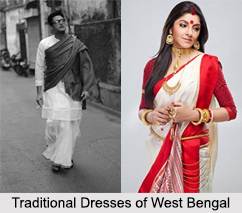
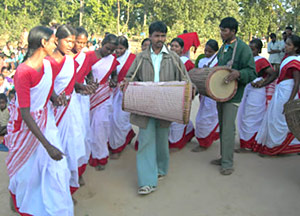
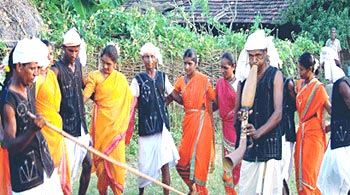
Another basic draping style of sarees is the Dravidian style where the pleats of the skirt are created first, so that they hang inside the sari and the skirt fabric wraps around them. The Bengali style of draping saree is very common and worn by women living in the lower Ganga area, including West Bengal and Bangladesh. It contains both northern Indian and Dravidian draping elements, with the fabric folded in front of the skirt and the end piece around the head and shoulders. Many tribal women in both peninsular India and the north-east, such as the `Gond Tribe` of eastern Deccan , `Hallaki Gauda` and `Coorgs` of southern Karnataka, `Khasi Tribe` and `Jaintia` of Meghalaya follow this pattern of draping sarees. The `Coorgs` wear sarees that are pinned rather than knotted, with full pleats at the back rather than at the front. On the other hand most tribal women tie short, heavy cotton saris without any pleats in this manner.
Popular Saree draping styles in India
Some regional draping styles of saree have gained popularity all over India for their uniqueness, appeal, and comfort.
Madisaru Saree Drape: The Madisaru saree, also referred to as the Kosavam saree, originated in Tamil Nadu, specifically among Brahmin women. Its history traces back to the 2nd century BC. Variations in the original Kosavam style can be observed across different Tamil communities. The Madisar drape is categorized into two styles, namely the Iyer and the Iyengar kattu (tie).
Coorgi Saree Drape: In Karnataka, women don the Coorgi style saree, accompanied by a matching head scarf. The Kodagu saree, as it`s also known, involves tucking the saree pleats at the rear while draping the pallu beneath the left shoulder and securing it over the right shoulder, referred to as molakattu. The Coorgi saree boasts a mythological origin and harmonizes with the hilly terrain`s demands, enabling Coorgi women to traverse slopes effortlessly.
Nivi Saree Drape: Originating in Andhra Pradesh, the Nivi drape is a contemporary saree draping style that has garnered popularity across the nation. The Nivi style entails pleat tucking at the waist`s center, with the pallu draped from the right side and pinned to the left shoulder. The Nivi drape ensures unrestricted movement, making it suitable for active women.
Nauvari Saree Drape: The Nauvari saree, also known as the Kasta saree, emerges from Maharashtra. Its distinctiveness lies in its nine-yard length, giving rise to the name "Nauvari." A favorite among Marathi women, this style showcases dhoti-like pleating, with pleats tucked at the back. Notably, Nauvari sarees are worn sans the petticoat, denoted as Akanda Vastra, signifying self-sufficiency. This attire facilitates unhindered movement, even enabling women to engage in physical tasks and warfare.
Mundum Neriyathum Saree Drape: Kerala`s traditional saree, Mundum neriyathum, embodies a two-piece ensemble where mundu is the lower garment and neriyatu is the upper one. The mundu envelops the waist in the manner of ancient sarees, while the neriyathum adorns the blouse diagonally from the right hip to the left shoulder. Typically white or cream with colored borders, it may feature a broad gold zari border for festivals and weddings, recognized as the Kasavu saree, a Kerala classic.
Pin Kosuvam Saree Drape: Tamil Nadu sees women adorning the Pin Kosuvam saree, characterized by its pleats at the back, referred to as "pin kosu." This saree is draped around the waist with extra folds, and the pleats cascade externally, embodying the traditional saree look. The Pin Kosuvam style is ideal for Tamil Nadu`s warm climate, and handloom cotton sarees are favored, as the underside remains visible in this style.
Seedha Pallu Saree Drape: The Seedha Pallu drape, a traditional style seen in Gujarat, Uttar Pradesh, and Odisha, distinguishes itself by draping the pallu at the front. This style, popular in Gujarat and extending its appeal nationwide, is embraced during special occasions and spans light fabric sarees like Georgette to heavy ones such as Banarasi and Kanjivaram.
Atpoure Saree Drape: Hailing from West Bengal in India and Bangladesh, the Atpoure saree, a traditional Bengali attire, features an exclusive pleat and pallu arrangement on both shoulders. Typically white with a red border, this saree carries cultural significance, with the pallu often bearing a bunch of keys on the right shoulder
Halakki Vokkaliga Saree Drape: Indigenous to Karnataka`s Western Ghats, the Halakki Vokkaliga saree showcases a distinctive drape involving multiple pleats. The majority of the saree is pleated in sections, tucked at the waist, draped on the upper body, and brought under the shoulder to the back. The saree`s end is knotted on the right shoulder with the pallu in front and the saree`s tail at the back.
Parsi Saree Drape: The Parsi community in Gujarat, Mumbai, and Kolkata embraces the Parsi drape, also known as the Gol saree. Its defining characteristic is draping the pallu from the back to the front over the right shoulder, then diagonally across to the left shoulder, similar to the Seedha Pallu style. This elegant drape extends beyond India, being favored by the Parsi diaspora worldwide.