|
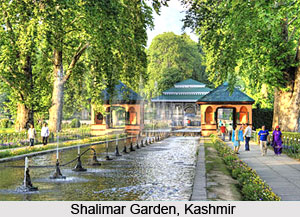 Architecture of Thatta during Shah Jahan completely falls under the western Indian category, with masterworks of patronaging and able backing. The western Indian Thatta and its architectural compositions under Shah Jahan, were ones to look out for, lending the rather dull place some zing. Architecture of Thatta during Shah Jahan was not one that had come completely out of the blue, but a rather expected one at that. Near Burhanpur in the Deccan, Shah Jahan had built a fine hunting resort on an artificial lake he had created by adding a second dam to one constructed before his time. Even earlier, he had commenced construction of the distinguished and celebrated Shalimar Garden in Kashmir. Shah Jahan deeply loved the Shalimar garden and in 1634; after his coronation, the site was further embellished. Architecture of Thatta during Shah Jahan completely falls under the western Indian category, with masterworks of patronaging and able backing. The western Indian Thatta and its architectural compositions under Shah Jahan, were ones to look out for, lending the rather dull place some zing. Architecture of Thatta during Shah Jahan was not one that had come completely out of the blue, but a rather expected one at that. Near Burhanpur in the Deccan, Shah Jahan had built a fine hunting resort on an artificial lake he had created by adding a second dam to one constructed before his time. Even earlier, he had commenced construction of the distinguished and celebrated Shalimar Garden in Kashmir. Shah Jahan deeply loved the Shalimar garden and in 1634; after his coronation, the site was further embellished.
Architecture of Thatta during Shah Jahan, owing to being a zealous Islamic propagator, was very firstly begun with constructing mosques. Nowhere in western India is the debt to Timurid-inspired brick construction and tile-covered surfaces more apparent than in the Jami mosque in Thatta. This is not surprising since the rulers of Sind, whom the Mughals had defeated, indeed had arrived from Afghanistan. Persian inscriptions rendered in tile indicate that the Jami mosque of Thatta was constructed between 1644 and 1647 at Shah Jahan's order. However, since Shah Jahan was nowhere near Thatta during that time, there is little reason to believe he was personally involved in the project. Nevertheless, the unusually careful crafting of this brick structure and its magnificent profuse tile-work suggest that the mosque was subsidized by the imperial treasury and assets. The Jami mosque might also have been constructed in part, to reverse the effects of a devastating storm that had swept through the city in 1637.
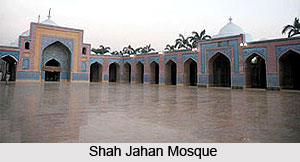 Jami mosque's prayer chamber's plan and even elevation derive from older conservative Timurid-influenced structures, such as the Kachpura mosque in Agra or the Akbari one in Ajmer. The surface and its decor, however, are modelled on local brick buildings that in turn were based on Iranian prototypes, for instance, the nearby tomb built in 1601 for Mirza Jani Beg, an earlier ruler of Thatta. There are no projecting eaves or other members that pronounce the building's surface as characteristic of much Indo-Islamic architecture. Rather, deeply recessed arches pierce the brick-and-tile covered facade, producing a structure that appears to be composed of two contrasting planes. Shah Jahan's architecture of Thatta and his consistent and clever backing in such far-off places from Delhi and Agra, did not once hinder the completion of such almost-massive projects. The placement and colour of the inlaid tiles on the façade of Jami mosque recall this monument's Iranian ancestry. For instance, unlike tiles in contemporary Lahore, where only a single colour was glazed on a tile, here in Thatta multiple colours and patterns appear on a single tile.
It becomes quite evident that architecture of Thatta during Shah Jahan, an integral part of Mughal architecture, had verily pivoted around the one of the umpteen Jami mosques that were erected in India, under Mughal rule. The interior of the Jami mosque of Thatta, is a showpiece of glazed tilework. The central dome is embellished with tiles, arranged in a stellate pattern designed to symbolise the heavens, while the walls are covered with floral, geometric and calligraphic patterns. The three mihrabs, also extraordinarily designed, are composed of pierced stone screens that allow the passage of light. Thus, in an area where often a lamp is carved referring to the Quranic verse that likens God's presence to a lamp within a niche, here actual light enters for men to view. The use of pierced screens allowing for the entrance of light was common on Mughal funereal architecture, but unique here to a Mughal mosque. While this Jami mosque in Thatta architectured under Shah Jahan, reveals a close adherence to forms and techniques used earlier in this region, its plan and design suggest an awareness of architectural traditions beyond these local roots.
|





