


 Jaunpur, approximately 40 km north of Benaras, also known as Varanasi, had been a leading intellectual nerve centre in northern India during the fourteenth and fifteenth centuries. Until Akbar's forces took Patna and other territories in the Bihar Gangetic valley, Jaunpur had remained the most important eastern seat of the Mughal empire. In 1567, Mughal emperor Akbar had appointed Khan-i Khanan Muhammad Munim Khan, a noble faithful since the days of Humayun, as governor there. Slowly, however, this mentioned region had fallen to the Mughals. The effort to assert Mughal authority in eastern India was accompanied by vigorous architectural construction on the part of Mughal governors and other officials, an attempt to underscore a permanent Mughal presence there. As such, architecture in Jaunpur and the legendary under Akbar Chunar had gained supreme importance, in order to upheld Mughal prestige. Jaunpur, approximately 40 km north of Benaras, also known as Varanasi, had been a leading intellectual nerve centre in northern India during the fourteenth and fifteenth centuries. Until Akbar's forces took Patna and other territories in the Bihar Gangetic valley, Jaunpur had remained the most important eastern seat of the Mughal empire. In 1567, Mughal emperor Akbar had appointed Khan-i Khanan Muhammad Munim Khan, a noble faithful since the days of Humayun, as governor there. Slowly, however, this mentioned region had fallen to the Mughals. The effort to assert Mughal authority in eastern India was accompanied by vigorous architectural construction on the part of Mughal governors and other officials, an attempt to underscore a permanent Mughal presence there. As such, architecture in Jaunpur and the legendary under Akbar Chunar had gained supreme importance, in order to upheld Mughal prestige.
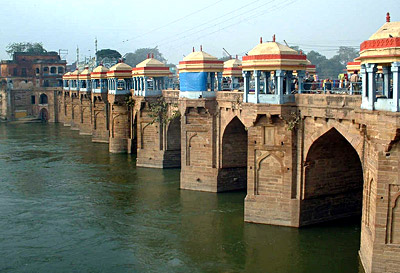
Muhammad Munim Khan, the trusted noble from Jaunpur, and his tenure in the stated place and the extensive surrounding territory, including the stronghold of Chunar, indeed lasted until his death in 1575. Instrumental in Mughal expansion to the east, Munim Khan was considered one of Akbar's most loyal nobles. Architecture of Jaunpur and Chunar was consistently preserved and looked after by Munim Khan during Akbar's reign, which are still evident in present times. He extensively had refurbished the city of Jaunpur, which had been ravaged by the Lodis from the Delhi Sultanate. Amongst Munim Khan's works there exists a bridge and additions to the older fort. Tradition records that he also had constructed mosques throughout the city. Epigraphic evidence from Jaunpur and Chunar Mughal architecture under Akbar however, indicates that these were built by others, suggesting that Munim Khan's own patronage served as a stimulus for nobles directly responsible to him also, and not only this royal-backed noble himself. 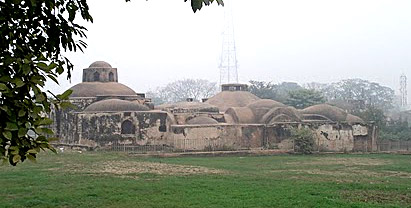 Munim Khan's bridge, still used in contemporary times, is generally recognised as Jaunpur's most significant Mughal structure. Amidst the architectural excellence the Jaunpur bridge, preserve the name of Mughals for ages. It consists of ten arched openings supported on massive pylons; chattris line either side of the top. The six inscriptions on the bridge indicate that it was commenced in 1564-65 and completed in 1568-69. A Persian history of Jaunpur states that Munim Khan had constructed the bridge in response to a discourse by Akbar in which he, hearing a widow complain about the lack of ferry service across the Gumpti, had proclaimed that it is better to provide public works than religious edifices. The story is probably apocryphal, but it suggests that just as amirs in Ajmer had erected in response to Akbar's decree, so here, too, the Khan-i Khanan's architectural patronage was inspired by the ruler himself. This earlier bridge in Jaunpur and consequent Mughal architectures in Chunar during Akbar would perhaps have remained a dream never coming true, which Munim Khan had lent his hand to turn it to be true.
The fort walls in Jaunpur were constructed much earlier. The gate is embellished with blue and yellow tiles, similar to those on contemporary buildings of the independent sultans of Bengal. While traditionally the palace is believed to have been built in the 14th century, early 19th century drawings indicate that this administrative or residential structure was constructed in a typical Akbari idiom. These drawings of the now demolished palace advocate the early introduction of an imperial style in these eastern hinterlands, a must for domination of eastern India, which was inaugurated with architecture of Jaunpur and Chunar during Akbar. The ground floor of this square double-storied structure is encompassed by a pillared veranda or aiwan; the whole is surmounted by a large pillared chattri. While no specific remaining structure at the Agra Fort or Fatehpur Sikri can be cited as the model, the Jaunpur palace charms the flavour of contemporary imperial architecture. In turn, it may have been instrumental in the design of the palace Raja Man Singh had constructed in the Rohtas fort approximately twenty years later, when he had served as Akbar's governor of Bihar. 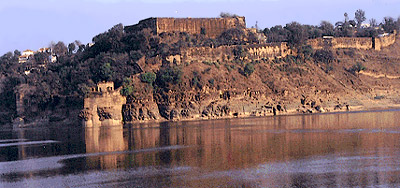 Near the site of the Chehil Sutun, can be witnessed a domed and vaulted multi-chambered hammam that closely resembles the baths of Fatehpur Sikri. This Jaunpur bath, with its carefully planned arrangements for hot and cold water, is a rare illustration of an intact 'provincial bath'. Since the hammam appears not to have been introduced to India until the Mughal period, its presence in the easternmost hinterlands early during Akbar's reign and architecture of Chunar and Jaunpur, is indicative of the swift spread of technology and style.
Although the Jaunpur fort had served as the governor's residence early during Akbar's reign, two forts were defensively and strategically more important, comprising the fort of Chunar, acquired by Akbar in 1561, and the fort of Allahabad, constructed in 1580. Eventually as the Mughals amplified their landholdings further to the east, as far as present-day Bangladesh, Jaunpur's significance was eclipsed and gradually overshadowed. Chunar fort's west gate is its only inscribed structure still standing. It bears four Persian epigraphs indicating that the gate was built during the reign of Akbar in 1573-74, by Muhammad Sharif Khan. His identity has not yet been established, although he may have been the son of Abd al-Samad, the illustrious painter. Muhammad Sharif probably had served under Munim Khan, who had been granted Chunar also and a great deal of surrounding territory as income-yielding land. In 1567, Munim Khan held Chunar until his death in 1575, granting service to his Baadshah in an unwavering manner, thus hinting the amount of solemnity that was instilled into building Chunar and Jaunpur during Mughal architecture under Akbar. This west gate from Chunar fort bears but little ornamentation, other than the beautifully executed calligraphic slabs. The fort's other gates, by contrast; possess intricately carved panels and brackets. Such carving in general fits well with contemporary trends. For instance, the S-shaped brackets of the oriental windows on some of these gates more closely resemble works in Agra than any pre-Mughal monuments in eastern India. However, some of the designs, for example, a continuous knot motif, are closer to work on Sur-period architecture in Chainpur and Sher Shah's fortress at Shergarh, both roughly 60 to 75 km east of Chunar, than they are to the Mughal material. This suggests not only a reliance on local artisans, but also a continuation of some regional traditions. This very feature, the 'reliance on local artisans' is one basic element that recurrently comes back in works of all the three initial Mughal rulers, Babur, Humayun and Akbar. Mughal architecture during Akbar, in Chunar and Jaunpur, very much had echoed an 'Indianised' ethos for the years to flow by. |
| |||



Home > Reference > History of India > Medieval History of India > Mughal Dynasty > Mughal Emperors > Akbar > Mughal Architecture during Akbar > Architecture of Jaunpur and Chunar During Akbar
Architecture of Jaunpur and Chunar During Akbar
| Architecture of Jaunpur and Chunar during Akbar was accepted with much seriousness to fortify the eastern Ganges side. |
| ||||||||||||||||||||||||||||

