





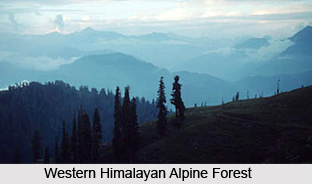
 The Western Himalayan alpine shrub and meadows form an ecoregion that has large areas of habitat, which are suitable for conserving viable populations of several important fauna species. The ecoregion is located between approximately 3,000 and 5,000 meters (m) elevation and is situated to the west of the deep Kali Gandaki River gorge in central Nepal and on to the northern Indian State, Uttar Pradesh. About a fourth of this high-elevation ecoregion is bare composition of rocks and ice. This ecoregion was formed during the early Pleistocene, after a long geological process that thrust up the Inner Himalayas. The ecoregion receives most of its annual rainfall due to the southwestern monsoon that also provides most of the moisture, originated from the Bay of Bengal. However, the monsoon expends most of its precipitation in the eastern Himalayas and as a result; the west receives less rainfall, usually ranging from 1,500 to almost 1,900 millimeters (mm). The tree line in this ecoregion responds to the drier conditions in the west by being almost 1,000 m lower than in the east. The Western Himalayan alpine shrub and meadows form an ecoregion that has large areas of habitat, which are suitable for conserving viable populations of several important fauna species. The ecoregion is located between approximately 3,000 and 5,000 meters (m) elevation and is situated to the west of the deep Kali Gandaki River gorge in central Nepal and on to the northern Indian State, Uttar Pradesh. About a fourth of this high-elevation ecoregion is bare composition of rocks and ice. This ecoregion was formed during the early Pleistocene, after a long geological process that thrust up the Inner Himalayas. The ecoregion receives most of its annual rainfall due to the southwestern monsoon that also provides most of the moisture, originated from the Bay of Bengal. However, the monsoon expends most of its precipitation in the eastern Himalayas and as a result; the west receives less rainfall, usually ranging from 1,500 to almost 1,900 millimeters (mm). The tree line in this ecoregion responds to the drier conditions in the west by being almost 1,000 m lower than in the east.
The Western Himalayan alpine shrub and meadows ecoregion witnesses cold winters for a few months every year and during this period, snowfall blankets the slopes. Snow usually melts during the months of April and May and that results in additional moisture. The summers in this ecoregion are mild and cloudy days and fog, are quite common here. The natural vegetation in this ecoregion is highly influenced by climate and aspect. The north-facing slopes that are less exposed to sunlight are usually cooler and retain more moisture and they also harbour a more typical Himalayan flora. However, the complex topography also creates rain shadows within this general trend and this, results in much localised climatic variations. 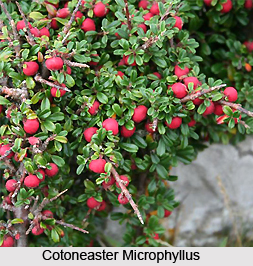 In the ancient period, the vegetation in the Western Himalayan alpine shrub and meadows ecoregion was dominated by Quercus semecarpifolia and Betula utilis. However, periodic climatic changes and glaciation events have given rise to the present alpine vegetation. The forest-alpine transition is now marked by the krummholz-type vegetation of the species like Rhododendron campanulatum, Rhododendron barbatum, Salix spp., and Syringa emodia, etc. The alpine scrub flora is primarily dominated by several colourful, dwarf rhododendron species, including the other shrubby species like Hippophae rhamnoides and Cotoneaster microphyllus. The Junipers contribute to the floral diversity along the transition area in this ecoregion, with the alpine conifers lower down. Many of the rhododendron species in these western Himalayan habitats have differences in comparison to those found in the eastern extent of this long mountain range.
The Western Himalayan alpine shrub and meadows ecoregion has quite a rich meadow flora that is mainly dominated by the herbaceous plants, especially the species of Anaphalis, Aster, Cynanthus, Jurinea, Morina, Potentilla, Gentiana, Delphinium, Gentiana, Meconopsis, Pedicularis, Anemone, Aster, Polygonum, Primula, and Saussurea, etc. Apart from these, the species like Willows line the sides of shallow, montane streams. The species of Saxifraga, Allium, Corydalis, Eriophyton, Stellaria, Soroseris, and Cremanthodium grow on the alpine scree with scattered rocks and boulders, at higher elevations. In the northern extent of the ecoregion, one can easily find a steppe-type vegetation of the species like Caragana pygma, C. gerardiana, Lonicera spinosa, Juniperus squamata, J. indica, Ephedra gerardiana, Hippophae tibetana, Myricaria rosea, Lonicera spinulosa, and Berberis spp., as well. 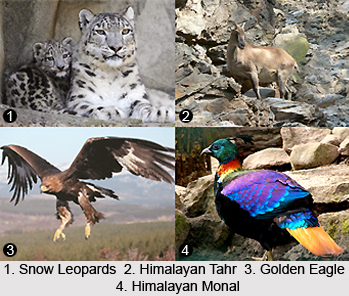 The shrub and meadows in the Western Himalayan alpine shrub and meadows ecoregion provide habitat for a number of high-altitude Himalayan predators like the Snow Leopard, and also for the large montane ungulates like Goral, Tibetan Wolf, Argali, Blue Sheep, Himalayan Tahr, Himalayan Musk Deer, and Serow, etc. All these large beasts are now considered locally extinct throughout most of their former distribution and they have not been recorded in Indian Territory recently, as well. Most of the rich variety of mammal fauna species in the Western Himalayan alpine shrub and meadows ecoregion are small species like the Himalayan Palm Civet, Pale Weasel, Himalayan Weasel, Pikas, and Voles, etc. These species scurry about the undergrowth and among the boulders. The meadows that are locally known as the Bughiyals become a resplendent tapestry of contrasting blue, purple, yellow, pink, and red flowers of delphiniums, gentians, poppies, roseroots, louseworts, anemones, and asters, in spring and summer. The ecoregion also contain a large number of localised hotspots of floral diversity and endemism. Some of the notable areas include the Valley of Flowers, Nanda Devi (India's second-highest mountain), Tinker Valley, Rara-Shey-Dolpho, Dhorpatan-Annapurna, Pokhara, and Gorkha-Himalchuli, etc. A total of forty mammal species have been found in this ecoregion so far and none of them is considered as endemic. However, several species among those are considered as threatened, including the Snow Leopard, Serow, Himalayan Tahr, Argali, and Himalayan Goral.
The bird fauna in the Western Himalayan alpine shrub and meadows ecoregion is even richer than the mammal fauna. The ecoregion is home to a total of 130 species including one endemic species named the Cheer pheasant. Some of the other important bird species found in the ecoregion include the Blood Pheasant, Western Tragopan, Satyr Tragopan, and Himalayan Monal, etc. Apart from these, the large avian predators like Lammergeier, Golden Eagle, and Himalayan Griffon, etc are also commonly found in the Western Himalayan alpine shrub and meadows ecoregion. |
| ||||||||||||||||||||||||||||

