Trisul Peaks, Mountain Peaks Of India - Informative & researched article on Trisul Peaks, Mountain Peaks Of India
  Indianetzone: Largest Free Encyclopedia of India with thousand of articles Geography of India


in  
Art & Culture | Entertainment | Health | Reference | Sports | Society | Travel
Forum  | Free E-magazine
Geography of India : Indian Climate l Indian Mountains l Indian Forests l Indian Soil l Indian Vegetation l Animal Husbandry in India l Resources in India l Indian Demography l Indian Natural History l Indian Astronomy l Indian Industries l Indian Islands l Indian Airports l Zoos in India l Indian Mines and Minerals l Indian Physiography l Indian Transport l Indian Geology l Communication in India l Indian Trade l Indian Astronomers l Indian Telecommunications
Home > Reference > Geography of India > Indian Mountains > Mountain Peaks of India > Trisul Peaks
Trisul Peaks, Mountain Peaks Of India
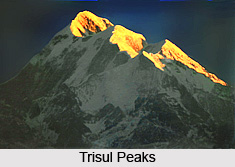
Trisul Peaks are a group of three Himalayan Mountain peaks, situated western Kumaun of Uttarakhand.

Trisul Peaks are a group of three Himalayan Mountain peaks, lying in the western Kumaun, situated in the central part of Uttarakhand state of India. The Trisul Peaks are clustered near the Bageshwar district. They form the southeast corner of the ring of peaks enclosing the Nanda Devi Sanctuary, and are located at the west-southwest of Nanda Devi itself at a distance of about 15 kilometres (9 mi). Trisul is named after the trident of Lord Shiva. The main peak, Trisul I, is best known for being the first peak over 7,000 m (22,970 ft) to have ever been climbed, in 1907.

Trisul Peaks, Mountain Peaks Of India The three peaks of Trisul Peaks are named as Trisul I, Trisul II, and Trisul III. The massif is a north-south ridge with Trisul I lying at the north end and Trisul III at the south. Trisul is best viewed from Kausani and Bedini Bugyal. Nanda Ghunti is situated a few kilometers to the northwest, while Mrigthuni lies just to the southeast.

Routes on the west face and south ridge of Trisul I have been climbed. The west face was first ascended in 1976; this was the first climb of the main summit not using the first-ascent route. Trisul II and III were first climbed in 1960 by a Yugoslav team. They climbed from the Bidalgwar glacier, thus achieving the summit of Trisul II through the southern ridge and Trisul III via the north ridge. Another Yugoslav expedition made the first traverse of the three peaks in 1987, and two of the members` paraglided from the summit of Trisul Peaks. Alex Kunaver was a member of the first Yugoslav team who climbed Trisul Peaks in 1960. In 1987, his daughter Vlasta Kunaver also climbed Trisul I and was one of the renowned paragliders.

The Trisul Peaks can be accessed through the following routes, namely Almora - Kausani - Garur- Gwaldam - Debal - Bagargad - Wan - Bedini Bugyal - Kelva Vinayak - Roopkund - Trisul.

(Last Updated on : 26/10/2010)
  More Articles in Mountain Peaks of India
 
Anamudi Peak Arwa Group Avalanche Peak
Burphu Dhura Peak Changabang Peak Changuch Peak
Chembra Peak Chiring We Peak Dunagiri Peak
Guru Shikhar Peak Hardeol Peak Kamet Peak
Kodachadri Peak Nagalaphu Peak Nanda Pal Peak
Nilkantha Peak Om Parvat Peak Panchchuli Peaks
Phalut Peak Rajrambha Peak Rimo I Peaks
Saltoro Kangri Peak Suj Tilla East Peak Tadiandamol Peak
Teram Kangri Peaks Trisuli Peak Abi Gamin
Agastya Malai Mountain Balakun Bamba Dhura
Chaudhara Nanda Kot Nanda Devi
Rishi Pahar Kanchenjunga Peak Mount Mawma Peak
Suitilla Peak Siniolchu Peak Suli Top
Doddabetta Peak Chhiplakot Peak Sandakphu Peak
Swargarohini Anginda Peak K12 Peak
Kalsubai Peak Mount Abu Peak Nanda Devi East Peak
Nanda Gond Peak Nun Kun Peaks Sangthang Peak
Sispara Peak Trisul Peaks Badrinath Peak
Yamunotri Peak Moon Peak Kapilash Peak
Phawngpui Mountain Peak Bandarpunch Chandrashila Peak
Nag Tibba Suj Tilla West Haathi Parvat
Recently Updated Articles in Geography of India
  • Multi-purpose River Valley Projects in India
    Multi-purpose River Valley Projects provide water resources that have been systematically and successfully collected into several regions that are affected by water shortage.
  •  
  • Non-Conventional Sources of Energy in India
    Non-Conventional Sources of Energy in India mainly include wind, tidal energy or solar energy that are very much renewable and are widely used.
  •  
     
  • Soil Erosion in India
    Soil Erosion in India or degradation of soil is one of the prime concerns of the nation as agriculture is adversely affected to a great extent.
  •  
  • Soil Conservation in India
    Soil Conservation in India is a prime measure taken to check the ravages of soil erosion in the nation, particularly in Punjab, Maharashtra, Karnataka etc.
  •  
  • Land Resources in India
    Land Resources in India comprises of 1.3 million sq miles and includes the Non-Renewable Energy Reserve which is utilised for several purposes
  •  
    E-mail this Article | Post a Comment
    RSS Feeds
    Forum
    Forum on Geography of India

    Free E-magazine
    Subscribe to Free
    E-Magazine on Indian Crafts
     
     
    Trisul Peaks, Mountain Peaks Of India - Informative & researched article on Trisul Peaks, Mountain Peaks Of India
    Sitemap
    Contact Us   |   RSS Feeds
    Copyright © 2008 Jupiter Infomedia Pvt. Ltd. All rights reserved including the right to reproduce the contents in whole or in part in any form or medium without the express written permission of Jupiter Infomedia Pvt. Ltd.