





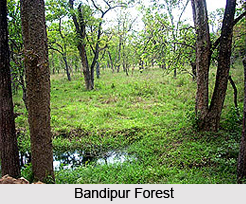
 Lying adjacent to the montane rain forest ecoregion in the southern extent of the Western Ghats Mountain Range, the South Western Ghats moist deciduous forests in India create a wonderful landscape. The landscape extends from the lowlands to the highest peaks of one of the richest and most diverse ecosystems of the bioregion. The forests are located between 250 and 1000 meters elevation and they create an ecoregion that is wider in the drier, leeward side of the mountain range. Covering an area of 23,800 square kilometers, the ecoregion drops down to the dry Deccan Plateau, in this side, to encompass some prime habitat. Some of the most important populations of Tiger, Asian elephant, and Gaur live in these forests. The forests also represent a transition area between the South Western Ghats Montane Rain Forests and the South Deccan Plateau Dry Deciduous Forests. They include species from both types of forests, as well. For this reason, the species richness in these forests is high. Lying adjacent to the montane rain forest ecoregion in the southern extent of the Western Ghats Mountain Range, the South Western Ghats moist deciduous forests in India create a wonderful landscape. The landscape extends from the lowlands to the highest peaks of one of the richest and most diverse ecosystems of the bioregion. The forests are located between 250 and 1000 meters elevation and they create an ecoregion that is wider in the drier, leeward side of the mountain range. Covering an area of 23,800 square kilometers, the ecoregion drops down to the dry Deccan Plateau, in this side, to encompass some prime habitat. Some of the most important populations of Tiger, Asian elephant, and Gaur live in these forests. The forests also represent a transition area between the South Western Ghats Montane Rain Forests and the South Deccan Plateau Dry Deciduous Forests. They include species from both types of forests, as well. For this reason, the species richness in these forests is high.
The South Western Ghats moist deciduous forests in India provide continuity of ecological processes between the lowland and montane ecosystems. The moister forests support many of the larger vertebrates that are also found in the dry forest ecoregion but at higher densities. These forests surround the montane evergreen rain forests in the southern part of the Western Ghats Mountains. They extend across the southern Indian states of Kerala and Tamil Nadu and as they are a part of the Deccan Plateau, they have Gondwanaland origins. The swath of the moist deciduous forests is very narrow on the steeper, windward side of the mountain range. The southwest monsoon rains promote a wet evergreen forest in this side. However, the drier conditions caused by the rain shadow, result in a broader, uneven swath of moist deciduous forests, on the shallower leeward side. These forests extend further, into the Deccan Plateau. The complex landform influences rainfall on the leeward side and some of the areas can receive less than a fifth of the 3,000 mm or more of annual rainfall that is deposited higher in the mountains. 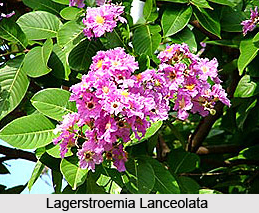 The vegetation in the South Western Ghats moist deciduous forests in India is principally characterised by the species like Adina cordifolia, Albizzia odoratissima, Albizzia procera, Alstonia scholaris, Bombax ceiba, Toona ciliata, Dalbergia latifolia, Grewia tiliaefolia, Holoptelea integrifolia, Hymenodictyon excelsum, Lagerstroemia lanceolata, Lagerstroemia speciosa, Lannea coromandelica, Miliusa velutina, Pterocarpus marsupium, Schleichera oleosa, Spondias pinnata, Radermachera xylocarpa, Tectona grandis, Terminalia bellerica, Terminalia paniculata, Terminalia tomentosa, Vitex altissima, Xylia xylocarpa, and Machilus macrantha, etc. The South Western Ghats moist deciduous forests in India are home to a rich variety of flora and fauna, out of which, a very few are considered as endemic. There are a total of eighty-nine mammal species found in these forests, out of which, six are counted among the near-endemic species. These species include the Suncus dayi, Latidens salimalii, Semnopithecus johnii, Viverra civettina, Paradoxurus jerdoni, and Funambulus layardi. There is no strict endemic species found in these forests. Three popular mammal species like the Nilgiri Langur, Malabar Large-Spotted Civet, and Jerdon's Civet also extend into the montane rain forests and the semi-deciduous coastal forests on either side, of these forests. 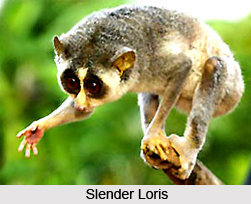
There are several threatened mammal species found in the South Western Ghats moist deciduous forests in India. The species include the Tiger, Asian Elephant, Gaur, Nilgiri Langur, Wild Dog, and Sloth Bear (IUCN 2000). Two of India's most important Elephant populations like the Nilgiri-Eastern Ghats population (estimated at more than 6,300 animals), and the Anaimalais-Nelliampathis population (estimated at 1,200 to 2,000 animals) also venture into these forests. Some of the smaller threatened species found in the forests include Jerdon's Palm Civet, Slender Loris, Grizzled Giant Squirrel, and Indian Giant Squirrel (IUCN 2000). Apart from the rich vegetation and large number of mammal species, the South Western Ghats moist deciduous forests in India are also home to several important bird species, including nine near-endemic ones. The total number of bird species found in the forests is 322 and the near-endemic species include the Nilgiri Wood-Pigeon, Malabar Grey Hornbill, Grey-Headed Bulbul, Rufous Babbler, White-Bellied Treepie, Black-and-Rufous Flycatcher, Nilgiri Flycatcher, Yellow-Throated Bulbul, and Malabar Parakeet. The globally threatened bird species like the Lesser Florican can also be found in patches of grassland habitats in these forests. |
| ||||||||||||||||||||||||||||

