Sispara Peak, Mountain Peak Of India - Informative & researched article on Sispara Peak, Mountain Peak Of India
  Indianetzone: Largest Free Encyclopedia of India with thousand of articles Geography of India


in  
Art & Culture | Entertainment | Health | Reference | Sports | Society | Travel
Forum  | RSS Feeds  | Free E-magazine
Geography of India : Indian Climate l Indian Mountains l Indian Forests l Indian Soil l Indian Vegetation l Animal Husbandry in India l Resources in India l Indian Demography l Indian Industries l Indian Islands l Indian Airports l Zoos in India l Indian Mines & Minerals l Indian Physiography l Indian Transport l Indian Geology l Communication in India l Indian Trade l Indian Astronomers l Indian Telecommunications
Home > Reference > Geography of India > Indian Mountains > Mountain Peaks of India > Sispara Peak
Sispara Peak, Mountain Peak Of India
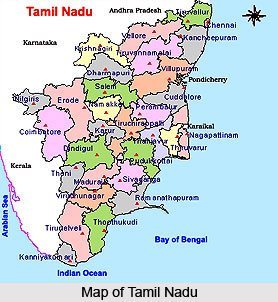
Sispara Peak is an Indian mountain peak, situated in the south Indian state of Tamil Nadu.

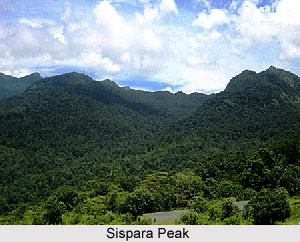
Sispara Peak is an Indian mountain peak, situated in Tamil Nadu. The elevation of Sispara Peak is 2,206 metres (7,238 ft) and the strategic location of this peak co ordinates 11°12?12?N 76°25?56?E and 11.20333°N 76.43222°E 11.20333; 76.43222. The Sispara Peak lies in the northeast end of Silent Valley National Park, in Kerala state, in the core area of the Nilgiri Biosphere Reserve, in the Western Ghats of South India. Sispara Peak is situated near the southwest end of Mukurthi National Park in Tamil Nadu state.

One can approach this peak by passing northwest up behind the bungalow, and ascending the high bluff below the peak. Half an hour`s walk leads to a vertical cliff of the escarpment facing the plains of Malabar. Numerous lofty trees growing at the foot of the precipice of Sispara Peak reach the brim of this point. A walk along the edge of this escarpment brings one to a massive peaking mass of rock, a few hundred yards from the foot of the highest Sispara Peak, which stands like a battlement on a wall. The view from this point is magnificent, particularly that of the gigantic amphitheatre to the right, the termination of the Koondahs on this side. It is a remarkable view of this stupendous semicircular recess, formed by high lofty mountains, the summits of which rise vertically upto thousands of feet, and whose abrupt sides are deeply eroded by ravines and chasms, down which small but romantic waterfalls precipitate themselves, adding to the magnificence of this stupendous scenery.

Sispara peak is the abode of the Toda tribes and they are said to possess ancestral spirits. It is the second highest peak in the core area of Silent Valley, Anginda peak at 2,383 metres (7,818 ft), being the highest. The forests near Sispara Peak experience the full force of the southwest monsoon and receive up to 250 inches (635 cm) per year of rain, but suffer from a long drought during the winter.
The Sispara peak extends across the northeast over 20 miles (32 km) in a magnificent amphitheatre of cliffs and steep hills in the Nilambur South Forest Division to Mukurthi peak and is the great western escarpment of the Kundah Range. In literary books it is mentioned that there is perhaps no scene in Southern India more grand and imposing than this gigantic escarpment. Rising abruptly from the low jungle covered plains of Malabar, to the lofty surface of the Koondah plateau, an elevation of Sispara peak upto nearly 8,000 feet (2,400 m), a precipitous hill face covered with dense jungle, crumpled but not broken up by countless hill torrents which course down its surface, and sparkle like silver threads in the midst of the dark green foliage of the forest. Sispara peak apparently seems like completely inaccessible from the plains below, and the way is rugged and tough throughout the greater portion of its extent.

Lately, it is only at Sispara Peak that, with considerable engineering skill, a road has been constructed, thus forming a communication between the hills and the low country of Malabar, and it is from this road that the finest view of the escarpment is obtainable.

(Last Updated on : 9/11/2009)
  More on Mountain Peaks of India...
 
Anamudi Peak Arwa Group Avalanche Peak
Burphu Dhura Peak Changabang Peak Changuch Peak
Chembra Peak Chiring We Peak Dunagiri Peak
Guru Shikhar Peak Hardeol Peak Kamet Peak
Kodachadri Peak Nagalaphu Peak Nanda Pal Peak
Nilkantha Peak Om Parvat Peak Panchchuli Peaks
Phalut Peak Rajrambha Peak Rimo I Peaks
Saltoro Kangri Peak Suj Tilla East Peak Tadiandamol Peak
Teram Kangri Peaks Trisuli Peak Abi Gamin
Agastya Malai Mountain Balakun Bamba Dhura
Chaudhara Nanda Kot Nanda Devi
Rishi Pahar Kanchenjunga Peak Mount Mawma Peak
Suitilla Peak Siniolchu Peak Suli Top
Doddabetta Peak Chhiplakot Peak Sandakphu Peak
Swargarohini Anginda Peak K12 Peak
Kalsubai Peak Mount Abu Peak Nanda Devi East Peak
Nanda Gond Peak Nun Kun Peaks Sangthang Peak
Sispara Peak Trisul Peaks Badrinath Peak
Yamunotri Peak Moon Peak Kapilash Peak
Recently Updated Articles in Geography of India
  • Grand Trunk Road
    Grand Trunk Road is one of the oldest, longest and most important roads of South-Asia.
  •  
  • Types of Forests in India
    Elevation, topography, climate and soil type are the major factors which determine the type of forest.
  •  
  • Indian Railway Zones
    Indian Railway network is classified into seventeen zones for administrative purposes.
  •  
  • Central Highlands in India
    Central highlands in India are made of the Malwa Plateau, Deccan Plateau and Chota Nagpur Plateau.
  •  
E-mail this Article | Post a Comment
Free E-magazine
Subscribe to Free
E-Magazine on Geography of India

 
Sispara Peak, Mountain Peak Of India - Informative & researched article on Sispara Peak, Mountain Peak Of India
Sitemap
Contact Us   |   RSS Feeds
Copyright © 2008 Jupiter Infomedia Pvt. Ltd. All rights reserved including the right to reproduce the contents in whole or in part in any form or medium without the express written permission of Jupiter Infomedia Pvt. Ltd.