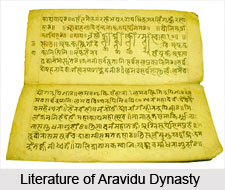
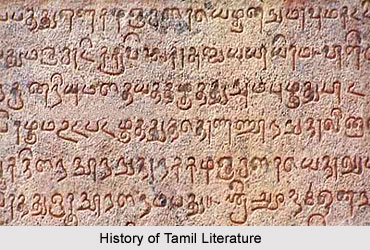
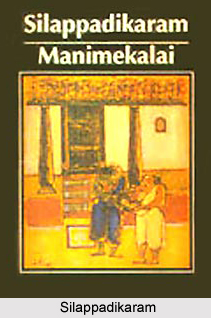
 The post-Sangam age (200 - 600 A.D.) in Tamil literature is indeed remarkable for the composition of five great Tamil epics, comprising of Silappadikaram, Manimekalai, Jivaka-cintamani, Valaiyapati and Kundalakesi. Silappadikaram is deemed and esteemed to be the most lustrous treasure of early Tamil literature. It is a priceless source book of ancient Tamil dance and classical music. The other path-breaking epics created during this period in Tamil include - Jivakachintamani or Mudiporultodarnilaiseyyul, Valaiyapati and Kundalakesi. Excluding these, the Jain authors have also developed five minor works -- Yasodhara-kaviyam, Chulamani, Perunkathai, Nagakumara-kaviyam and Nilakesi.
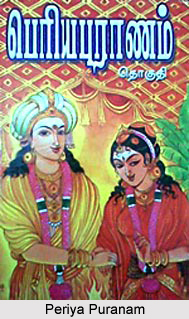
By the next century, the Shaiva and Vaishanva writers began rising from their slumber, heading towards a religious renaissance. It was the turn of devotional literature to dominate the limelight during post-Sangam age in Tamil literature. Within the period of 600 and 900 A.D., Tamil literature of post-Sangam age had come under the tremendous influence of Saiva and Vaisnava saints, referred to as Nayanmars and Alvars respectively. The Saiva saints had first piled up their hymns into the Devaram. The hymns of the Saiva saints were later amassed into twelve anthologies, acknowledged as Tirumurais. The corpuses of Shaiva hymns, sung till to this date, were compiled in fact compiled in these Tirumurarais (early 11th century). The Vaishnava saints had laid the foundation of the Bhakti cult not only for South India (500-1000 A.D.), but also for the whole of India. Their songs were put together in the colossal Nal-ayira-p-pirapantam or the `Book of 4000 Hymns`. The Periya Puranam or Tiruttondar Puranam, deemed as the twelfth Tirumurai, was authored by Sekkizhar (12th century A.D.). The Vaishnavaite saint Nathamuni (824-924 A.D.) had collected and amassed the Vaishnava hymns into four books, referred to as Divya Prabandham or Nalayira Divya Prabandham. The other Alvar saints who significantly contributed to the Tamil religious literature consist of Periyalivar, Poigaialvar, Bhutattalvar, Andal (the only woman saint amongst the Alvars) and Nammalvar. Nammalvar`s Tiruvaymozhi, the third book of Divya Prabandham, is conceived to be a perfect personification of the Upanishads.
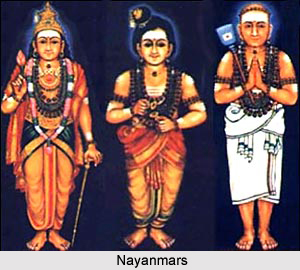
 The post-Sangam age in Tamil literature had witnessed a widespread Hindu revival, during which numerous Saiva Nayanmars and Vaishnava Alvars furnished great stimulus to the expansion of popular devotional literature. Karaikkal Ammaiyar, who lived in the sixth century, was the earliest of these Nayanmars. The celebrated Saiva hymnists Sundaramurthi, Thirugnana Sambanthar and Thirunavukkarasar (also acknowledged as Appar) belong to this period. Of Appar`s hymns, 307 have survived till present times.
Classed together, these form the first six books of the Saiva Canon, gathered and compiled by Nambi Andar Nambi during the 10th century. Sundarar had penned Tiruttondartokai, which affords the list of sixty-two Nayanmars during post-Sangam age in Tamil literature. Sekkilar in his Periyapuranam later had elaborated this. Manikkavasagar, who lived around the 8th century, was a minister in the Pandya court. His Tiruvasakam consisting of 51 hymns is noted for its passionate and zealous devotion.
Along with the Saiva Nayanmars, Vaishnava Alvars of the post-Sangam age of Tamil literature were also producing devotional hymns. The three earliest Alvars consisted of Pygai, Pudam and Pey. Each of them additionally has authored one hundred Venpas. Tirumalisai Alwar who was a contemporary of the Pallava Mahendravarman I, wrote such works as Naanmugantiruvadiandadi. Tirumangai Alvar who lived in the eighth century CE, was a more capacious writer and his works constitute approximately a third of the Diyaprabhandam.
 Peiyalvar and his daughter Andal, belonging to the post-Sangam age in Tamil literature, had contributed virtually 650 hymns to the Vaishnava Canon. Andal symbolises purity, love for the God and hence wrote her hymns personifying Vishnu as a lover. The hymn of Andal, which begins with Vaaranam Aayiram (One Thousand Elephants) chronicles of her dream wedding with Vishnu and is sung even today at Tamil Vaishnava weddings. Nammalvar, who lived in the ninth century, wrote Tiruvaimoli, comprising 1101 stanzas and is held in great honour for its elucidation of the Upanishads.
The post-Sangan age in Tamil literature, also classified into distinctive periods, holds within itself the so termed Didactic Age. Three centuries after the Sangam age, Tamil literature had passed through an escalation in the mutual interface of Sanskrit and Tamil languages. A number of words and concepts associated with ethics, philosophy and religion were loaned and exchanged in a reciprocal manner between the languages. Approximately in 300 CE, the Tamil land came under the sway of a group of people acknowledged as the Kalabhras. The Kalabhras were Buddhists by faith and several Buddhist authors indeed were seen to flourish during this period. Jainism and Buddhism also witnessed a vigorous and dynamic growth. These authors, conceivably reflecting the severe and stern inclination of their beliefs, had given rise to works primarily based on morality and ethics. A number of Jain and Buddhist poets contributed to the founding and innovation of these didactic works, as well as grammar and lexicography. The collection of the minor eighteen anthologies in Tamil literature of the Post-Sangams, was also of this period.
The most renowned of these works on ethics is the Tirukkural by Thiruvalluvar. The book is a wide-ranging and all-inclusive manual of ethics, polity and love, comprising 1330 distiches or kural fractioned into chapters of ten distiches each: the first 38 on ethics, the next 70 on polity and the remaining on love. Other celebrated works of Tamil literature of the post-Sangam age include: Kalavali, Nalatiyar, Inna Narpathu and Iniyavai Narpathu. The Jain texts Nalatiyar and Pazhamozhi Nanuru each comprises 400 poems, each of which quotes a proverb and then instances it with a narrative.