With the gradual rise of the Vijayanagara Empire and extensive contacts among diversified people of peninsular India, old styles of expression were yielding place to new morphological alterations in the dialects of the Empire. Indeed, in this context Kannada literature in the mystic period was once more a personified traveller, awaiting to witness the journey of metamorphosis under separate geniuses. The Haridasas began to employ umpteen modes of speech popular amongst the people and amongst the different classes in the social hierarchy and thus had enriched Kannada literature. The Haridasa Movement, in this milieu, had contributed an enormous deal to Kannada language and literature basically redefining mysticism and the model of mystic literature in such former periods. The movement had preached the tenets of Dvaita Philosophy (tattvavada) pretty exhaustively, but in a very simple and unambiguous style through the medium of `sweet songs`. The tenets therefore inject a direct appeal and reach the hearts of the masses to satisfy and provide comfort.
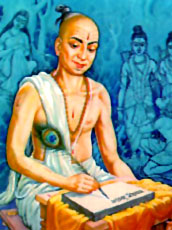
Kannada literature of the Dasas in the Mystic period, falls under the three groups, comprising - general, special and sectarian. The earliest and most distinguished Dasas like Sri Sripadaraja, Sri Purandara Dasa and Sri Kanaka Dasa, had given rise to a literature that was appropriate for all classes and communities. Inspiring and enlivening songs of Sri Vyaasaraja Tiirtha, Sri Gopala Dasa and others, who composed for the Brahmanical world in particular, exemplifies the second group. The stimulating and soul-stirring songs of Sri Vijaya Dasa, Sri Jagannatha Dasa and others embody the third group. These were designed for the followers of Madhva and which dwelt solely upon theological issues. The Haridasa Movement strove to set forth an entire scheme of religion and morality before the people.
Dasas from all over the world sing and eulogise in the praise of God. Umpteen Dasas have composed songs in simple language to enable common people to comprehend God`s greatness, his merciful nature, together with his omnipotence, omniscience and omnipresence. The literature of dasas had expounded the primary principles of the Dvaita system in a popular and attractive form in the language of the people. Kannada literature during the mystic period basically was nicknamed `dasa literature`, dealing with the mystic and spiritual experiences of enlightened life, i.e. the supra-normal encounters and awareness or cognisance of religious sublimity. The songs of specific saints can be distinguished by their style and mudrikas/ankithas (pen-names). The bulk of the Kannada literature in mystic period has been published from Udupi, Belgaum, Lingasugur, Mysore (University of Mysore) and Bangalore. The songs of earlier saints like Sri Padaraja, Sri Purandara Dasa and Sri Kanaka Dasa are to be translated into English and other languages, a programme that is very much in the pipeline. Yet, following in the strict lines of mysticism amongst these Dasas, or the singing minstrels from the Hindu kingdoms, Kannada literature can be classified into two principal categories: the Veerashaiva movement in Kannada literature and Vaishnava. Movement in Kannada literature