


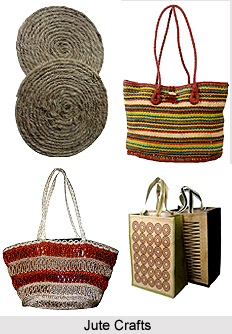
 Jute in India, addressed as the "Golden Fibre," is one of the most common raw materials for packaging and for making exquisite craft items. Indeed jute conquers the major arenas of human world of utilitarian artistry. Eco friendly and cheapest known natural fibre- jute has offered global market a chance to bequeath plastic generation a formal good bye. Apart from its coarse character and heavy texture, the natural color increases its unique charm. It does not shrink or fade, is available easily and also durable. Jute in India, addressed as the "Golden Fibre," is one of the most common raw materials for packaging and for making exquisite craft items. Indeed jute conquers the major arenas of human world of utilitarian artistry. Eco friendly and cheapest known natural fibre- jute has offered global market a chance to bequeath plastic generation a formal good bye. Apart from its coarse character and heavy texture, the natural color increases its unique charm. It does not shrink or fade, is available easily and also durable.
History of Jute craft Jute as a raw material has been explored in the industrial paraphernalia opening the surreptitious doors to a new horizon, an ever present tense never a past one! The usage of Jute as a raw material unfurled its existence in the ancient Indian scriptures namely 'Manu Samhita' and 'Mahabharata'. Evidence of the trade of jute cloth in the 16th century still whispers from the pages of history. "Ain-i-akbari" (1590) mentions sackcloth originating from Bengal. The jute craft has developed in India centering the Eastern India. Bengal reveled in sacks and saris made of jute were usually used in the Middle Age producing maximum jute globally. Export of jute sacks, as an essential commodity, started in the 18th century. During the 19th and early 20th centuries jute had grown to be an indispensable industry. The uses included sacking bag, ropes, boot linings, aprons, sandbags, meat wrappers, tapestries, oven-cloths, carpets, tents, horse covers, cattle bedding, electric cable, and even parachutes. The developing heaven of jute craft marks its accomplishment on the sweet note of it being granted a permanent entry to the middle class domesticity. Benefits of Jute Crafts In the jute products, there is no joinery. Smaller products like doormats and phone covers are made out of the leftovers of the larger ones. Jute fibre is completely biodegradable and recyclable and thus environment friendly. Jute has low pesticide and fertilizer needs. It is the second most important vegetable fibre after cotton, in terms of global consumption, production, and availability. Other advantages of jute include good insulating and anti static properties, as well as having low thermal conductivity and a moderate moisture regain. Other advantages of jute include acoustic insulating properties and manufacture with no skin irritations. Jute has the ability to be blended with other fibres, both synthetic and natural, and accepts cellulosic dye classes such as natural, basic, vat, sulfur, reactive, and pigment dyes. Jute can also be blended with wool. Concentration of Jute Craft in India Early nineteenth century marked an epoch in history with Bengal topping the chart and earning the title of the home of jute handicrafts from India. Craftsmen here create a myriad of utilitarian items made from jute. Madhya Pradesh is also known for Jute craft from Bhopal, Indore and Gwalior, which include hanging lamps, baskets, flower vases, purses, table mats and footwear etc. Types of Jute Craft in India An elegant range of home decor and furnishings like cushion covers, table covers, tea cozies etc. are available as attractive jute crafts. Exquisite and colourful jute floorings, Garments made out of woven jute fibre are hugely in demand for its texture, design strikingly positioning themselves as popular crafty ingredients. Jute fabrics are decorated with tie and dye, embroidery and block printing. Jute has strategically placed itself as a status symbol with its characteristic feature of high availability in a developing country like India. Government initiative to promote Jute Craft Indian states have taken initiative to promote the creativity and sales of jute crafts. The Pondicherry Pudhumai Handicraft Artisans Cooperative Society arranges a sale of Pondicherry Jute Craft twice a year at the Gandhi Thidal on Goubert Avenue in Pondicherry. The sale brings forth a range of artefacts via utility items bringing artisans under a unified umbrella for the overall development of the craftsmen. The artisans are provided with training in design and skill development to keep pace with the demands of time and cultural globalization. Different types of handicrafts fair in Bengal and Odisha are also organized by the state to popularize the use of Jute crafts. Since the antiquity jute has remained the favourite material for its utilitarian and eco friendly quality. The present scenario of jute industry offers a huge inspiration to the jute craft in India and encourages its expansion and demand in abroad. With the progression of time, this established form of Jute craft is flourishing in the national and international market. |
| |||



Jute crafts
| Jute craft in India is an established form of art that represents the craftsmanship of Indian artisans. Besides gifting the country a host of decorative and utility items, Jute is also a means of livelihood for several craftsmen in different parts of India. |
| ||||||||||||||||||||||||||||

