





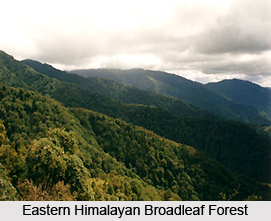
 The Eastern Himalayan broadleaf forests in India form an ecoregion that is globally outstanding for both species richness and levels of endemism. The eastern Himalayas are actually a crossroads of the Indo-Malayan, Indo-Chinese, Sino-Himalayan, and East Asiatic floras and also of several ancient Gondwana relicts that have taken refuge here. The ecoregion is considered as a biodiversity hotspot for the species like Rhododendrons and Oaks. The forests are spread across the countries like India, Bhutan, and Nepal. In India, these forests can be found mainly in the state of Sikkim. The Eastern Himalayan broadleaf forests in India form an ecoregion that is globally outstanding for both species richness and levels of endemism. The eastern Himalayas are actually a crossroads of the Indo-Malayan, Indo-Chinese, Sino-Himalayan, and East Asiatic floras and also of several ancient Gondwana relicts that have taken refuge here. The ecoregion is considered as a biodiversity hotspot for the species like Rhododendrons and Oaks. The forests are spread across the countries like India, Bhutan, and Nepal. In India, these forests can be found mainly in the state of Sikkim.
The Eastern Himalayan broadleaf forests in India are located between 2,000 and 3,000 m elevation and they stretch from the deep Kali Gandaki River gorge in central Nepal, eastward through Bhutan, into India's eastern states of Arunachal Pradesh and Nagaland. They are playing an important role in maintaining the altitudinal connectivity between the habitat types that make up the larger Himalayan ecosystem. The forests witness several birds and mammals exhibiting altitudinal seasonal migrations. The habitat continuity and intactness of the species are also essential for maintaining the integrity of watersheds along these steep slopes. Several bird species can be found in the temperate broadleaf forests of Bhutan where the habitat is more intact and continuous with the subtropical broadleaf forests lower down. The annual rainfall in the Eastern Himalayan broadleaf forests in India is about 2,000 mm and it is mainly caused by the monsoon during the months of May to September. As these monsoons are funneled in from the Bay of Bengal, these eastern Himalayan forests receive the greatest rainfall, with a progressively drier trend toward the west. As a result, the rainfall, topography, and temperature get together and influence the vegetation across this ecoregion. The ecoregion comprise two distinct ecological formations of broadleaf forests like the temperate evergreen forests of Oaks; and the temperate deciduous forests dominated by species like Acer campbellii, Juglans regia, Alnus nepalensis, Betula alnoides, Betula utilis, and Echinocarpus dasycarpus, etc. The Eastern Himalayan broadleaf forests in India are globally popular for both species richness and endemism, especially for its rich variety of flora species. There are numerous localised areas of floral richness and endemism-floral hotspots in these forests that are especially rich in Rhododendrons and Oaks. The forests are home to a total of 125 mammal species, out of which, four are considered as endemic to the ecoregion. These four species include the Semnopithecus geei, Petaurista magnificus, Biswamoyopterus biswasi and Niviventer brahma. Out of these four species, three are shared with adjacent ecoregions. However, the species like Namdapha Flying Squirrel is a strict endemic species whose range distribution is limited to the Eastern Himalayan broadleaf forests in India. Apart from these, the forests also harbour several other threatened mammal species like the endangered species of Tiger, Red Panda, Takin, and Serow, etc. The vulnerable species like Vespertilionidae Bat, Assamese Macaque, Stump-Tailed Macaque, Wild Dog, Back-Striped Weasel, Clouded Leopard, and Irrawaddy Squirrel (IUCN 2000), are also found in these forests. 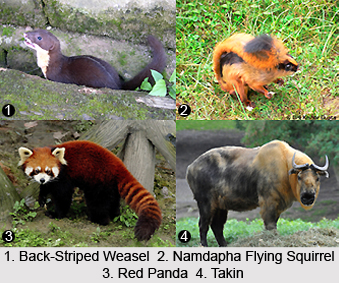 The ecoregion formed by the Eastern Himalayan broadleaf forests in India, overlaps with a high priority (Level I) TCU and is a landscape with the ecological resources to support a viable Tiger population over the long term. The ecoregion also represents the only opportunity to conserve a Tiger population that is adapted to survive in these Himalayan temperate broadleaf forests, where the Tiger's prey densities are much lower. The Red Panda is limited only to the patches of mature fir (Abies) forests with a bamboo understory, in this broadleaf forest ecoregion.
Apart from the rich variety of mammal species, the Eastern Himalayan broadleaf forests in India are also home to a total of 500 bird species that is one of the highest across all the ecoregions in this bioregion. Out of the 500 species, twelve species are considered as endemic to the ecoregion. The species include named the Chestnut-Breasted Partridge, Hoary-Throated Barwing, Ludlow's Fulvetta, Rusty-Bellied Shortwing, Elliot's Laughingthrush, Grey-Headed Parrotbill, Immaculate Wren-Babbler, Grey-Crowned Prinia, Mishmi Wren-Babbler, Rufous-Throated Wren-Babbler, Snowy-Throated Babbler, and Spiny Babbler. Apart from these, eleven species are considered as near-endemic species, and one species, the Rufous-Throated Wren-Babbler is a strict endemic that is restricted only to the Eastern Himalayan broadleaf forests. Several threatened species of Pheasants, Tragopans, and Hornbills are also found in these forests. These species include the globally threatened species like Rufous-Necked Hornbill and Sclater's Monal, and also the threatened species like White-Bellied Heron, Blyth's Tragopan and Ward's Trogon (IUCN 2000). |
| ||||||||||||||||||||||||||||

