





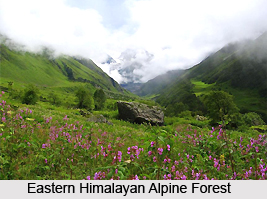
 The alpine ecoregion of the Eastern Himalayan alpine shrub and meadows is spread across the countries like India, Bhutan, China, Myanmar, and Nepal. This ecoregion lies between the tree line and snow line in the eastern portion of the Himalaya Range and it covers a huge area of 70,200 square kilometers. The ecoregion extends along the north and south faces of the Himalaya Range from the Kali Gandaki Gorge in central Nepal and eastwards through Tibet and Indian states like Sikkim, Arunachal Pradesh and Bhutan and northernmost Myanmar. The shrub and meadows lie between approximately 4000 and 5500 meters elevation and permanent ice and snow lies above 5500 meters. The tallest mountains in the world like Everest, Makalu, Dhaulagiri, and Jomalhari are situated within this ecoregion. The alpine ecoregion of the Eastern Himalayan alpine shrub and meadows is spread across the countries like India, Bhutan, China, Myanmar, and Nepal. This ecoregion lies between the tree line and snow line in the eastern portion of the Himalaya Range and it covers a huge area of 70,200 square kilometers. The ecoregion extends along the north and south faces of the Himalaya Range from the Kali Gandaki Gorge in central Nepal and eastwards through Tibet and Indian states like Sikkim, Arunachal Pradesh and Bhutan and northernmost Myanmar. The shrub and meadows lie between approximately 4000 and 5500 meters elevation and permanent ice and snow lies above 5500 meters. The tallest mountains in the world like Everest, Makalu, Dhaulagiri, and Jomalhari are situated within this ecoregion.
The Eastern Himalayan alpine shrub and meadows ecoregion supports one of the richest alpine floral displays of the world, which becomes vividly apparent during the spring and summer. The meadows explode into a riot of colour from the contrasting blue, purple, yellow, pink, and red flowers of alpine herbs, during that period. The species like Rhododendrons characterise the alpine scrub habitat closer to tree line and the tall, bright-yellow flower stalk of the Noble Rhubarb, Rheum Nobile, stands above all the low herbs. The plant richness in this ecoregion is estimated to be at more than 7,000 species, which is three times better than what is estimated for the other alpine meadows in the Himalayas. In fact, only the famous rain forests of Borneo are estimated to have a richer flora than this ecoregion, among all the Indo-Pacific ecoregions. 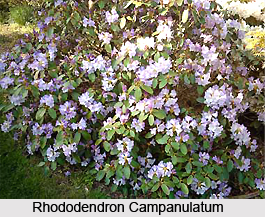 There are several hotspots of endemism, created by the varied topography within the species-rich landscape of the Eastern Himalayan alpine shrub and meadows ecoregion. This results in much localised climatic variations and high rainfall and also enhances the ability of specialised plant communities to evolve. For this reason, the ecoregion boasts the record for a plant growing at the highest elevation in the world. The small, dense, tufted cushion-forming plant with small, stalk less flowers, named the Arenaria bryophylla was recorded at an astonishing 6,180 m. There are several hotspots of endemism, created by the varied topography within the species-rich landscape of the Eastern Himalayan alpine shrub and meadows ecoregion. This results in much localised climatic variations and high rainfall and also enhances the ability of specialised plant communities to evolve. For this reason, the ecoregion boasts the record for a plant growing at the highest elevation in the world. The small, dense, tufted cushion-forming plant with small, stalk less flowers, named the Arenaria bryophylla was recorded at an astonishing 6,180 m.
The Eastern Himalayan alpine shrub and meadows ecoregion receives rainfall due to the southwest monsoon that occurs during the months of May to September. The water it brings from the Bay of Bengal is first intercepted and expended in this ecoregion. However, the complex topography creates rain shadows within this general trend, which results in much localised climatic variations. The annual rainfall in different parts of the ecoregion ranges from 300-3,500 mm. Apart from the annual rainfall, aspect is another important criterion that determines local climatic variation in this ecoregion. The north-facing slopes remain less exposed to sunlight and are thus cooler and retain more moisture. For this reason, they are more likely to harbour a specialised Himalayan flora adapted to these moist, microclimatic conditions. The Eastern Himalayan alpine shrub and meadows ecoregion is primarily dominated by colourful Rhododendron species that exhibit high species turnover. Some of the common species of this ecoregion include the Rhododendron campanulatum, R. wallichi, R. campylocarpum, R. thomsonii, R. wightii, R. bhutanense, R. aeruginosum, R. succothii, R. fragariiflorum, R. pumilum, R. baileyi, R. pogonophyllum, R. calciphila, R. crebriflorum, R. chryseum, R. riparium, R. sanguineum, and R. saluenense, etc. On the other hand, the herbs lend springtime colour to the alpine meadows ecoregion. These herbs include hundreds of species from the genera like Alchemilla, Androsace, Primula, Diapensia, Impatiens, Draba, Anemone, Gentiana, Leontopodium, Meconopsis, Saxifraga, Sedum, Saussurea, Rhododendron, Potentilla, Pedicularis, and Viola, etc. Several of these species are considered as valuable medicinal herbs. 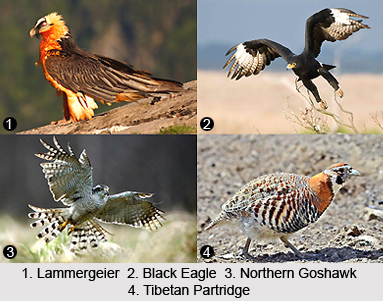 Apart from the natural vegetation, the Eastern Himalayan alpine shrub and meadows ecoregion is also surprisingly rich in fauna species. The ecoregion provides habitat to about 100 mammal species, out of which, only one species named the Eptesicus gobiensis or the Vespertilionid Bat is considered as near endemic. This species can also be found in the Karakoram-West Tibetan Plateau Alpine Steppe ecoregion. The fauna of this ecoregion comprise several large vertebrates and some of the important mammal species of this region include the Snow Leopard, Blue Sheep or Nilgai, Himalayan Tahr; Himalayan Goral, vulnerable Serow, and the formidable Takin. Apart from the natural vegetation, the Eastern Himalayan alpine shrub and meadows ecoregion is also surprisingly rich in fauna species. The ecoregion provides habitat to about 100 mammal species, out of which, only one species named the Eptesicus gobiensis or the Vespertilionid Bat is considered as near endemic. This species can also be found in the Karakoram-West Tibetan Plateau Alpine Steppe ecoregion. The fauna of this ecoregion comprise several large vertebrates and some of the important mammal species of this region include the Snow Leopard, Blue Sheep or Nilgai, Himalayan Tahr; Himalayan Goral, vulnerable Serow, and the formidable Takin.
The Eastern Himalayan alpine shrub and meadows ecoregion is also home to the avian predators like the Lammergeier, Himalayan Griffon, Black Eagle, and Northern Goshawk. About 115 bird species can be found in different parts of this ecoregion, out of which, one is considered as near-endemic. This species is the Chestnut-breasted partridge and it is mainly limited to the eastern Himalayas. This species can also be found in the adjacent Himalayan Subtropical Broadleaf Forests, Eastern Himalayan Broadleaf Forests, and Eastern Himalayan Sub-Alpine Conifer Forests. Some of the other important bird species include the Himalayan Snowcock, Tibetan Partridge, Snow Partridge, Satyr Tragopan, etc. |
| ||||||||||||||||||||||||||||

