





 Located between the deciduous forests of the Eastern Ghats and Satpura Range and of the lower reaches of the Gangetic Plains, the Chhota-Nagpur dry deciduous forests in India harbour numerous flora and fauna species. The forests are home to large populations of Asia's largest predator and largest herbivore, the Tiger and the Asian Elephant. Both the animal species are still able to roam and live within the large habitat blocks of these forests that is considered as a rare phenomenon in this bioregion. The Chhota-Nagpur Plateau dry deciduous forests also have a flora and fauna that are distinct from the adjacent areas, with several pockets of endemic plants. Located between the deciduous forests of the Eastern Ghats and Satpura Range and of the lower reaches of the Gangetic Plains, the Chhota-Nagpur dry deciduous forests in India harbour numerous flora and fauna species. The forests are home to large populations of Asia's largest predator and largest herbivore, the Tiger and the Asian Elephant. Both the animal species are still able to roam and live within the large habitat blocks of these forests that is considered as a rare phenomenon in this bioregion. The Chhota-Nagpur Plateau dry deciduous forests also have a flora and fauna that are distinct from the adjacent areas, with several pockets of endemic plants.
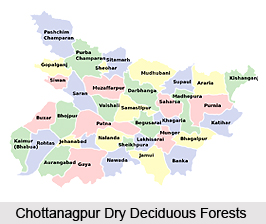
The Chhota-Nagpur dry deciduous forests in India extend across the eastern Indian states of Bihar, Madhya Pradesh, and West Bengal. The plateau's ancient origin is attested to the Gondwana substrates and it is also part of the Deccan Plate. The forests in this ecoregion receive less rainfall compared to that of the adjacent ecoregions, which support the moist deciduous forests. For this reason, the vegetation in these forests is drier than that of the adjacent ecoregions. These dry deciduous forests are typically composed of three stories. The upper canopy of the forests reach 15-25 meters, the high understory reaches 10-15 meters, and the undergrowth reaches at about 3-5 meters. 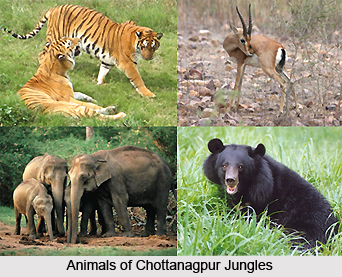 The vegetation in the Chhota-Nagpur dry deciduous forests in India is primarily characterised by the species like Shorea robusta. This species usually habitats in association with the other species like Anogeissus latifolia, Terminalia alata, Lagerstroemia parviflora, Pterocarpus marsupium, Aegle marmelos, Syzygium operculatum, Symplocus racemosa, and Croton oblongifolius, etc. The Lianas are more common in the denser forests. A common habitat type in the forests is the dry deciduous scrub that grows to about 3-6 meters in height. This scrub includes the species like bamboo and shrubs like Holarrhena and Dodonaea. The Shola-type forests are located at higher altitudes and they are mainly characterised by Phoenix robusta, Pterospermum acerifolium, and Clematis nutans. The forests house a few endemic, endangered plant species like the Aglaia haselettiana, Carum villosum, and Pycnocyclea glauca, etc. Apart from these, there are also a few other plant species that are more economically useful species. These species include the Diospyros melanoxylon, Madhuca longifolia, Butea monosperma, and Shleichera oleosa, etc. The vegetation in the Chhota-Nagpur dry deciduous forests in India is primarily characterised by the species like Shorea robusta. This species usually habitats in association with the other species like Anogeissus latifolia, Terminalia alata, Lagerstroemia parviflora, Pterocarpus marsupium, Aegle marmelos, Syzygium operculatum, Symplocus racemosa, and Croton oblongifolius, etc. The Lianas are more common in the denser forests. A common habitat type in the forests is the dry deciduous scrub that grows to about 3-6 meters in height. This scrub includes the species like bamboo and shrubs like Holarrhena and Dodonaea. The Shola-type forests are located at higher altitudes and they are mainly characterised by Phoenix robusta, Pterospermum acerifolium, and Clematis nutans. The forests house a few endemic, endangered plant species like the Aglaia haselettiana, Carum villosum, and Pycnocyclea glauca, etc. Apart from these, there are also a few other plant species that are more economically useful species. These species include the Diospyros melanoxylon, Madhuca longifolia, Butea monosperma, and Shleichera oleosa, etc.
The Chhota-Nagpur dry deciduous forests in India are neither home to a rich variety of fauna species, nor the species are distinctive. There are a total of seventy-seven mammal fauna species available in the forests and none of them is considered as endemic. Apart from that, several of India's large charismatic vertebrates, including the threatened species like Tiger, Asian Elephant, Wild Dog, Sloth Bear, Chousingha, Blackbuck, and Chinkara, are also found here. The forests still have large areas of habitat capable of supporting viable populations of these species, unlike in many other ecoregions in this bioregion. All these habitat blocks are included in two Level I TCUs that extend into the ecoregion. Apart from the rich mammal fauna species, the Chhota-Nagpur dry deciduous forests in India are also home to a large number of almost 280 bird species. Though, none of the species is considered as endemic, there are some species that are of conservation importance. These species include the globally threatened Lesser Florican and other species like the Indian Grey Hornbill and Oriental Pied-Hornbill. |
| ||||||||||||||||||||||||||||

