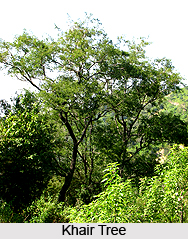
 The tree that is of small or medium height and posses attractive and rich green foliage is named as the `Easter Tree`. The scientific name of this tree is `Holarrhena Antidysenterica`. This is member of the `Apocynaceae` family. It is named as `Hat`, `Kureya`, `Karva-indarjau`, `Dhudi`, `Kura` and `Kurchi` in Hindi and in Bengali, the names that it got are `Dhudi`, `Kurchi` or `Tita-indarjau`. In Tamil language, it is called as `Vepali` while the Telugu people named it as `Pala` or `Kodaga`.
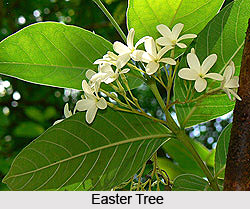
The `Easter Tree` grows widely not only in the gardens but one can see it growing abundantly in the forests also. It is very easily found in the forests of India. By decorating itself with hundreds of tiny and white blooms, the tree makes itself a very appealing garden tree. It stays decorated in such way for almost two or three months every year. It can reach the height of only 2 to 3 m in the gardens. The bark of the tree is pale grey in colour and is spotted with brown. It is also very rough and cracked. The leaves are oval shaped and quite large in size. They are normally 15 to 30 cm in length and pointed at the tip. At the base, their shapes are like block. They are marked with long and arched veins and usually grow opposite on short stalks.
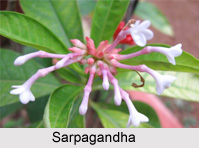
From about the months of March to May, the full clusters with slightly scented flowers appear and usually bloom well at Easter. During this time, the people in the church pluck them in order to decorate the church. Each of the bendable flowers stands on a pale, slim stalk. A lean, narrowing tube emerges from a tiny, deeply cleft calyx. The tube is often tinged with red colour and opens into five soft petals. The petals are round-ended and overlap slightly to the left. The whole thing measures about 2.5 cm across. The stamens are invisible. The fruit of the `Easter Tree` is about 30 cm in length. They are narrow and slim and also contain brown seeds. The seeds have a bunch of silky hair at the upper end. The seeds are bitter in taste and also have an obnoxious scent.
As the `Easter Tree` has the quality of being the last to disappear in bared tracts and the first to come up on wastelands, it is considered amongst the most important forest trees in India. Another reason of being considered so is that it bears flowers and seeds in large quantities and when quite young, they also grove well. They have the ability to send up strong shoots even from the burnt land. So it is very useful for paving the way. The bark is known as `Kurchi` and bears tonic and astringent properties. However, it`s primarily reputed as a cure for dysentery. From the seeds of this tree, some remedies for fevers, piles, dysentery and worms can be made. These are known as `Indarjau` and have been employed in the pharmacy for several centuries. Decoctions from the roots of the tree are also used as a cure for dysentery. The name `Antidysenterica` resembles this quality. The tree grows to a greater height in Assam and the people of Assam use the pale timber of it in making furniture. In other places, the wood is used for small curved articles, turnery and droplets.