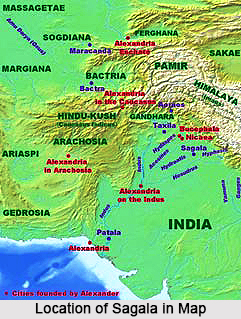
 Sagala is believed to be modern Sialkot, which is located in northern Punjab, Pakistan. Also known as Sangala, it finds mention in the Indian epic Mahabharata. In the earlier days, it was known as Sakala to the natives of the Indian sub-continent. Sagala was a great center of trade and commerce. Sagala was described as "Sagala or Euthydemia" in the Geography of Ptolemy in the 1st century. It was also the capital of the Indo-Hepthalite King Mihirakula. It is also believed that Sagala or Sakala was the capital of the successor Greek kingdom when it was made the capital by King Menander I, son of Demetrius.
Historical Significance of Sagala
The city of Sagala appears in the accounts of Alexander the Great`s conquests of India. It is said that after crossing the Hydraotes (the Ravi River) Alexander joined Porus and 5,000 Indian soldiers and laid siege to Sagala. Alexander laid siege to the city and its inhabitants were killed.
During the Sunga Period, Pusyamitra Sunga is believed to have expanded northwest as far as Sagala. In the Indo- Greek period, the Indo- Greeks repelled the Sungas and Sagala was used as a capital by them.
Though Indo-Greek cities were designed along Greek architectural lines, Sagala was clearly an Indian city. The best description of Sagala comes from the Milinda Panha, a dialogue between King Menander and the Nagasena (a Buddhist monk). The rule of King Meander bears testimony to his benevolence. He was considered as a Chakravartin - King of the Wheel or literally Wheel-Turner in Sanskrit. He was very efficient that, as a king, it was he who turned the wheels of Sagala.
Architectural Significance of Sagala
It is described, as a delightful country well watered and hilly, abounding in parks and gardens and groves and lakes and tanks, a paradise of rivers and mountains and woods. The country had strong towers and ramparts, with superb gates and entrance archways. There was a royal citadel in the midst of the city. So the people of Sagala did not have any fear of enemies. It is said that in wealth, Sagala rivaled Uttara-kuru.