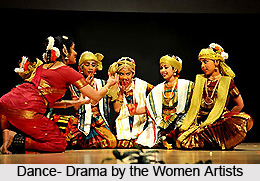
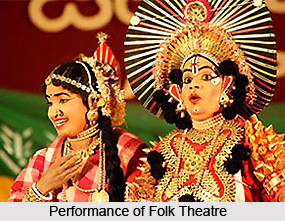
Regional theatre in India encompasses all the regional flavour of the Indian states. The multilingual aspect of India`s poetic articulation amidst Indian theatre, have been severely appreciated by people around the country. Diverse culture, varied religion and most importantly the multi-dimensional nature of Indian language has played a great role in shaping up India`s rich heritage and culture. The fusion of different Indian language and the union of varied Indian traditions from different region have enriched India`s ethnicity in quite a large way since the remote past. India, as a multilingual and multi religious state can not be allied with one particular kind of trend and aspect in its theatres and dramas. This is the reason why the deep fervor of Bengali theatre has gelled well with the passion of Hindi Manipuri, Kannada and Marathi theatre and has given birth to a whole new concept of "Indian theatre". It is right after the independence of India, Indian theatre in different Indian languages and regions developed as an important element in taking theatre to the further level of maturity.
Malayalam Theatre, Gujarati Theatre, Kannada Theatre all has its roots associated with the British rule as the seed of the contemporary drama in India was sown during that era. Bengali theatre started with an intention of private entertainment however gradually it became the weapon to illustrate the dislikes and frustration of the British imperialism in India. As an art form Bengali theatre has its roots associated with the British Raj. Although started as private entertainment in the early 19th century Bengali theatre gradually became not only an eminent art form but also started playing the major role in illustrating the discomforts of the administration of British Empire in India. The year was 1947 and the day was 15th August - Indian Independence Day.
 The day is indeed a red letter day in the history of Indian theatre. Not only India stood apart as a socially and politically sovereign state but also Indian culture, art, music, literature all witnessed a colossal change. Theatre and Indian drama, in various regional languages of the state, gradually became an art form, to illustrate the social and political ailments of independent India. Right after the independence of India the communist consolidation and the growth of left ideologies in India specially in West Bengal, used Bengali theatre as a typical means of advertisement or propaganda. Quite ideally, therefore, a new trend in Multi lingual and regional theatre gradually developed and the emergence of the theatre companies in India is one of them. All these theatre groups carried somewhat an ideological belief at the same time as distinct cultural inspiration to differentiate themselves from the typical artistry of the ancient Indian theatre.
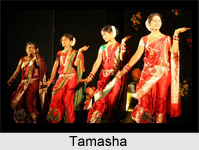
Multi lingual and regional theatre in India can actually be classified into two distinct streams like the urban theatres and the rural theatres (like tamasha, swang, Jatra etc). This was even particularly common in the classical art form of the Marathi theatre and Hindi theatre. With the thriving development of the various Indian metropolises Marathi, Kannada and Hindi theatre developed in accord to the Bengali theatre. With the direct influence of the "Yakshagana" the ethnic dance drama of Karnataka which offered a distinct shape to the artistry of Marathi and Kannada Theater in the late 19th century. This was the time when Indian drama witnessed the emergence of subtle contrivances and ploys, in illustrating a particular kind of idea. Multi lingual and regional theatre in India, thus for the first time, saw the materialization of allegorical fantasies in farcical comedies. Some more regional languages in which theatre later developed as an important element took this art form to further level of maturity.
 Sindhi Theatre which further popularized the folk art again reshaped the contour of regional theatre in India. With the establishment of the Hyderabad Amateur Dramatic Society in 1912, the change in theme of Sindhi drama became evident. The society`s mainstay, Nanikram Mirchandani, introduced social realism in Sindhi theatre to aid it in befitting the modish aspect of the society. Konkani theatre, Kashmiri Theatre and also the Maithili Theatre witnessed a marked change. Maithili Theatre spread to Assam and Nepal, producing a huge corpus of Maithili drama. Siddhi Narasinghadeva and Bhupatindra Malla were among the known playwrights in Nepal. At the end of the nineteenth century Parse theatre and Ramlila reached Mithila, leading to the premature burial of Kirtaniya. Oriya Theatre blended a deep philosophical meaning with that with the religious fervor to make regional theatre in India to stand out with pride.
Development of Assamese Theatre, Dogri Theatre, Manipuri Theatre needs mention in shaping the structure of regional theatre in India. It is with the colors of Rajasthani Theatre, the verve of regional theatre in India gained a dimension. Rajasthani theatre as a popular theatre form was formed in the late nineteenth century. Nepali Theatre, Tamil Theatre, Telugu Theatre, and Urdu Theatre all aided in shaping the Indian regional theatre to a great extent
The journey of the Multi lingual and regional theatre in India thus unfolds Indian natural history of British period and the independence of India. It is the saga of a changing trend; the account of an altering pattern which made Indian theatre lot more contemporary with its entire sophistication and modishness.
 The beginning of the twentieth century brought in the era of social reforms and the national movement. Many social and historical plays written for the
  Regional theatre in Madhya Pradesh

 Regional Theatre of North India lays bare the regional streaks of drama within the frame work of Indian cultural scenario. The north Indian states include Haryana,