





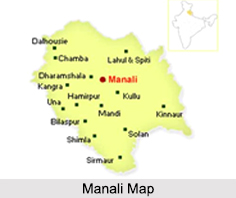
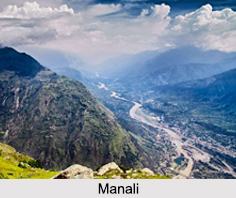
 Nestled in the mountains of the Indian state of Himachal Pradesh, the resort town of Manali is located near the northern end of the Kullu Valley in the Beas River Valley. Known to be the gateway to Lahaul and Spiti district as well as Leh, Manali is a popular tourist destination in the state. Nestled in the mountains of the Indian state of Himachal Pradesh, the resort town of Manali is located near the northern end of the Kullu Valley in the Beas River Valley. Known to be the gateway to Lahaul and Spiti district as well as Leh, Manali is a popular tourist destination in the state.
The small town of Manali is a part of the Kullu district and the beginning of an ancient trade route to Ladakh. From there, the route passes over the Karakoram Pass on to Yarkand and Khotan in the Tarim Basin. Etymology of Manali Derived from the Sanatan Hindu lawgiver Manu Smriti, the name Manali is also regarded as the derivative of ‘Manu Alaya’, which literally means ‘the abode of Manu’. Legend of Manali As per ancient Hindu texts and legends, it is said that it was here in Manali, also known as the Valley of Gods, is the place where sage Manu stepped off his ark to recreate human life after a great flood had deluged the world. There is also an old temple in the town of Manali dedicated to sage Manu.
 History of Manali History of Manali
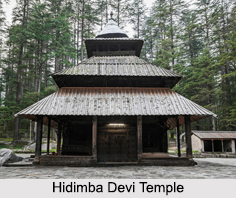
It was during the reign of the British East India Company that apple trees were introduced in the area. Before the advent of the British imperialism in India, there were no apple trees in Manali and thus the first apple orchard was set up near Patlikuhl by the British. And in present times, with the abundance in growth of apple along with pear and plum has contributed to the best source of income for the majority of inhabitants. Other than fruits, the colonisers had also introduced rainbow and brown trout into the rivers and streams of the area. In the late 1980s, there was an increase in disposable incomes and the rise of disturbances in Kashmir had resulted in a surge of tourists in Manali. The once quiet village of Manali was transformed into a bustling town with numerous home stays as well as the occasional boutique hotel. Climate of Manali With a strategic location, Manali rises approximately to a height of 2, 625 m or 8, 612 ft above the mean sea level. The climate of Manali is quite cold during the winter season and during the summer season it remains moderately cool. The temperatures vary from 4 degree Celsius to 30 degree Celsius throughout the year. The average temperature during summer is between 10 degree Celsius to 30 degree Celsius, and from -7 degree Celsius to 15 degree Celsius in the winter. Demography of Manali As per reports of Census India 2011, Manali has grown from a trading outpost or village to a small town with a total population of about 8, 096. Out of which 4, 717 were males and 3, 379 were females. The population of children between the ages of 0 to 6 years old is 836, which 10.33 percent of the total population of Manali. The child sex ratio is 841 compared to the state average of 909. The literacy rate in the town of Manali is 82.91 percent, which is a little higher than the state average of 82.80 percent. The male literacy is around 86.49 percent while female literacy rate is 77.81 percent. Tourism in Manali This hill station offers several exploring options. Manali in Himachal Pradesh with its mountaineering institute is considered as a popular base for trekking and mountaineering in summer and skiing in winter season. Interesting routes into the surrounding valleys, over the high passes, are provided with tourist huts and rest houses for trekking enthusiasts. Some of the popular tourist spots in Manali are Hidimba Temple which is located in the middle of a forest called the Dhungiri Van Vihar. Winding paths through forests and glades of whispering Deodars form the setting for the majestic wooden temple of Hidimba Devi.
 Another popular attraction is Jagatsukh, which is famous for its Shiva temple. Other major tourist spots are Arjun Gufa, Beas Kund and Rohtang Pass. Naggar Fort is one of the most significant tourist spots of Manali and it is a reminder from Pala Dynasty. This fort is made from rocks, stones, and wood carvings and is known for elegant art works. Rahla waterfalls and Solang valley are other tourist interests. Solang Valley is also known as Snow Point. Another popular attraction is Jagatsukh, which is famous for its Shiva temple. Other major tourist spots are Arjun Gufa, Beas Kund and Rohtang Pass. Naggar Fort is one of the most significant tourist spots of Manali and it is a reminder from Pala Dynasty. This fort is made from rocks, stones, and wood carvings and is known for elegant art works. Rahla waterfalls and Solang valley are other tourist interests. Solang Valley is also known as Snow Point.
Environmental Concerns at Manali Recent activities surrounding hydroelectric power and an influx of tourists, there have been a flurry of activity in Manali. This along with unplanned and rampant construction has led to severe depletion of forests and pollution of river bodies, along with garbage being disposed on the side of the mountains. This kind of pollution has also resulted in a loss of habitat to various species of fauna, including the Himalayan Monal, which is the state bird of Himachal Pradesh. Visiting Information on Manali The nearest airport is the Bhuntar Airport about 50 km south of Manali. There is no close railhead available close to the town and with plenty of broad gauges; the nearest one is at Kiratpur Sahib at a distance of 268 km from Manali. And the nearest narrow gauge railhead is at Joginder Nagar at a distance of 175 km. By roadways, Manali can be reached by using the National Highway 1 and 21 that passes through the towns of Bilaspur, Sundernagar, Mandi and Kullu. |
| ||||||||||||||||||||||||||||

