 Sri Ekambareswara Temple is the most famous Shiva temple at Kanchi is the Ekambareswara temple where he is worshipped in the form of Prithivi Linga (Earth Linga). This temple was built around 600 AD and there is no separate shrine for Parvati here.
Legend of Ekambareswarar temple
The Sthala Purana says that when Lord Shiva was deeply immersed in the task of creating, protecting and destroying the Universe, Parvati, his consort, in a jocular mood, closed his eyes. This resulted in staying the process of creation and destruction as well as obstruction to the natural law of things. It was a serious matter and Shiva became angry and cursed Parvati to go to the Earth and expiate her misdeed. Accordingly Parvati came to the banks of the river Kampa under a single mango tree at Kanchi and made a Shivalinga out of sand and worshipped it. To test her sincerity Shiva placed various obstacles and hindrances in the way of Parvati`s penance. But with the help of Lord Vishnu she could tide over all the difficulties. At last Shiva hurled a deluge by taking out the River Ganges from his matted hair, to wash away the Linga worshipped by Parvati. She clasped it with all veneration to her breasts and this pleased Shiva who took her again as his consort.
Architecture of Ekambareswarar Temple
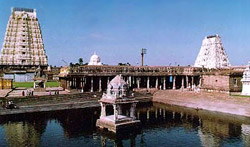
Ekambareswarar temple has high rising gopurams dominates the skyline. The temple covers an area of 40 acres. The Raja Gopuram or the entrance tower is 172 feet high and was built by Krishnadevaraya. He also built the pillared hall in front of the sanctum. A corridor surrounds the principal shrine representing a sequence of receding piers.
There are idols of the 63 Nayanmars. There are two tanks in the temple, Kampa Nadi and Shivaganga. There is a Vishnu shrine in the Shiva temple and the name of the Vishnu is Nilatingal Tundattan. The temple has silver and gold-plated vahanams of considerable value.
Deities of Ekambareswarar Temple
The presiding deity is Ekambareswarar or Shiva, worshipped as the Prithvi Lingam. A Somaskanda panel features Shiva, Parvati and Skanda on the rear of the main shrine.
Worship and Festivals of Ekambareswarar Temple
Six worship services are offered in the temple of Sri Ekambareshwar Temple every day. They are known as "UshadKalam", "Kaalasanthi", "Uchi Kaalam", "Pradosham", "Sayaratchai" and "Ardhajamam".
Several festivals are also celebrated in the temple. Some of the colourful festivals that are celebrated in the temple are Ani Tirumanjanam (June-July), Adi Kritikai (July-August), Avani Moolam (August - September), Navaratri (September-October), Kartikai Deepam (November-December), Thai Poosam (January-February), Panguni Uthiram (March-April), Chitra Pournami (April-May) and Vaikashi Vishakam (May-June). All these festivals throng the calendar of the temple throughout.
The Phalguni Festival is the most important temple festival of Ekambareswar. It is celebrated for a period of 13 days and it is during this festival that the wedding of Shiva and Parvati are performed.