


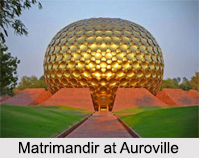
 Auroville is an experimental township in the Viluppuram district of Tamil Nadu with some parts in Puducherry in South India. The purpose of this small community is to realize human unity in diversity. With the aim of creating a new consciousness in the world this popular community was founded in the month of February in 1968. The organizer of this model township was Mirra Alfassa and this community was not adhered to any particular religion, cult or sect. The community of Auroville shares a humanitarian purpose and aims to become a sustainable and self-governing township in the near future. The people of this township live together with the belief that it is this new era where human unity, consciousness and international understanding are to prevail. Auroville is an experimental township in the Viluppuram district of Tamil Nadu with some parts in Puducherry in South India. The purpose of this small community is to realize human unity in diversity. With the aim of creating a new consciousness in the world this popular community was founded in the month of February in 1968. The organizer of this model township was Mirra Alfassa and this community was not adhered to any particular religion, cult or sect. The community of Auroville shares a humanitarian purpose and aims to become a sustainable and self-governing township in the near future. The people of this township live together with the belief that it is this new era where human unity, consciousness and international understanding are to prevail.
History of Auroville Mirra Alfassa, who organized the followers of Sri Aurobindo, incorporated the idea of the experimental township of Auroville. In the later ages, the idea was adopted by the Sri Aurobindo Society and along with the Government of India the concept was presented to the United Nations. In the year 1966, this project was wholeheartedly accepted by UNESCO and they agreed to provide unique support to this project. Under the guidance of The Mother, the township took birth in 1968. The name of the project has been derived from two French terms- 'aurore', which signifies 'dawn', and 'ville' which signifies 'city'. Demography of Auroville As per the latest census of May 16, 2006, the population of Auroville is a community of 1,829 people (1,398 adults and 431 minors). 752 of the total population belong to Indian origin. The Auroville community has members from around 40 countries in the world. The 3 biggest communities in Auroville are the Tamilians, French and Germans. 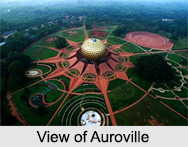 Auroville's slow population growth is a concern for the Governing Board. The chairman of the Board stated publicly that he would like to see more young people from India and abroad joining Auroville. The town planners too are eager to start building the city but cannot proceed, as effective planning without an expected population increase is impossible. Auroville's slow population growth is a concern for the Governing Board. The chairman of the Board stated publicly that he would like to see more young people from India and abroad joining Auroville. The town planners too are eager to start building the city but cannot proceed, as effective planning without an expected population increase is impossible.
Aim of Auroville The goal of Aurovilian society is to work out the differences of culture and class in a new and higher way- a synthesis of East and West in hopes of realizing the ideal of human unity in diversity. They believed in a shared humanitarian goal. The Aurovilians are not supposed to engage in any political activities inside or outside the township. They act as a model community which embodies and celebrates cultural prosperity, international understanding, and the unity of human beings living together with progressive aims. The Mother wanted Auroville to be a drug-free society, with no internal circulation of money, and no institutionalized marriage. At present the Auroville Foundation through a Parliament Act, which is known as the Auroville foundation Act governs this project. Structure of Auroville The shape of the township of Auroville is in the style of a spiral galaxy. The 'soul' of the city, that is the Matrimandir that lies in the middle of the town and epitomizes the birth of a new consciousness. The other four zones namely 'Residential Zone', 'Industrial Zone', 'International Zone' and 'Cultural Zone' radiate from the center of this township. A 'Green Belt' has also been formed with the future purpose of a buffer zone and an area for recreation. Here one can also find the farms and forestries of Auroville. A large botanical garden is also in the making.  Economy of Auroville Economy of Auroville
As per the rule in Auroville, a citizen has to save a substantial amount of Rs 15 lakhs to start a life in Auroville. The residents are expected to pay a monthly contribution and are advised to help the community whenever possible. There is a system of "maintenance" (salaries), whereby some Aurovilians are supported by the community. Other Aurovilians who have their own financial means work for the community without accepting any reward. Auroville has a small economic base. Newcomers cannot find suitable work in the commercial units or in the services. Auroville finances itself by receiving donations and by commercial units who contribute 33% of their profits to Auroville's Central Fund. At Auroville, there are hotels, building construction units, real estate companies, information technology, small and medium scale businesses producing and re-selling items such as handmade paper for stationery items, as well as producing its well-known incense sticks. These items are sold around India and abroad. Each of these units contributes a considerable part of their profits to the township. Other activities include afforestation, organic agriculture, basic educational research, health care, village development, town planning, water table management, cultural activities and community services.  Education in Auroville Education in Auroville
Auroville provides a non-authoritarian learning which is free of any dogma. As a result, the children living in Auroville have freedom in choosing the topics of their study. There are a number of schools ranging from crèche to high school education. There are no colleges at Auroville at present and no formal certificates or diplomas are issued here. Media of Auroville The website of Auroville accesses journals and newsletters which provide open as well as restricted forums for various projects, interests, organizations and outreach which make up the life of the community. Auroville has a small media team who regulates the visits of journalists and film/video makers. The journals published in Auroville are Auroville Today, Ritam, Invocation, Matrimandir Journal, La Revue d'Auroville. Newsletters published in Auroville are AV News & Notes, Matrimandir Newsletter, Auroville Outreach, Land Fund Newsletter, Village Action News, Kuyil-Health Centre's Newsletter, Annapurna Times, Farm Group Newsletter, Pavilion of Tibetan Culture Newsletter, and New Creation Bilingual School. Visiting Information to Auroville Reaching the township of Auroville is very convenient. It can easily be reached via the East Coast Road that connects the metropolitan city of Chennai with Puducherry. Chennai Airport is the nearest airport and Guindi railway station is the nearest rail station to this place. |
| |||



Auroville in Puducherry
| Auroville is an experimental township located in Viluppuram district of Tamil Nadu near Puducherry. |
| ||||||||||||||||||||||||||||

