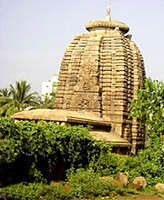
 The miniature temple of Parashurameswar, is believed to be an apt example of early Orissan architecture of the post-Buddhist period, as is seen from its basic vimana. Although dating as far back as circa 750 A.D., it is still in a good state of preservation. It is notable for its intricate stone engraving of the marriage of Shiva and Parvati (Uma) and for the elaborately sculptured medallions on its front facade. The royal lion, Kesari`s proud symbol, is conspicuous by its absence. In place of the bold, strapping animals depicted on the walls of other Orissan temples, those at Parashurameswar are almost invariably victims of the huntsman`s spear.
Another example of the early phase is the Vaital Deul, although it differs primarily from the Parashurameswar temple, it derives from quite another tradition. The tower of its inner sanctuary is reminiscent of the gopurams of the Dravidian temples, and many architectural features, such as its elongated vaulted roof in two stories, its ridged finials and its gable-ends, suggest that like those structures, it too developed from the Buddhist chaitya-hall. The Vaital Deul encompasses four replicas of the main shrine in each angle of the jaganmohan, which is also of uncommon design, and is thus representative of a panchayatana, or five-shrined temple in the earliest stages of its evolution.