





 The category branded as Indian literature virtually encompasses the whole of India and its every single aspect, both symbolically as well as realistically. And this certainly is not an overstatement or hyperbole, as writers beginning from the prehistoric age have tried to mirror their society, their times at large, a work to which they have also been successful. Indeed, the thought themes in Indian literature broadly hold within itself a magnificent yet clandestine vision, if viewed in an open angle. To state more precisely, it is generally seen that writers are of the habit to leave their piece of work with an open ending, i.e. , leaving his/her readers to judge the conclusion according to their own wish and understanding. And this where lies that much hidden 'success' of the writer, who is forever bound under societal norms when he/she is writing for the present generation. Before beginning with a novel, poetry, short story or play, a writer always has to bear in mind the previous happening in his community and consequences that might occur after the work is published. Hence, the writer never as such can move out from his society and publish an out-of-this-world creation; if such phenomenon ever comes into being, the writer, most likely is to be branded a 'social outcaste' or made 'incommunicado'. Thus, themes in Indian literature always have to be created keeping in mind the ongoing Indian society or the people associated with it. The category branded as Indian literature virtually encompasses the whole of India and its every single aspect, both symbolically as well as realistically. And this certainly is not an overstatement or hyperbole, as writers beginning from the prehistoric age have tried to mirror their society, their times at large, a work to which they have also been successful. Indeed, the thought themes in Indian literature broadly hold within itself a magnificent yet clandestine vision, if viewed in an open angle. To state more precisely, it is generally seen that writers are of the habit to leave their piece of work with an open ending, i.e. , leaving his/her readers to judge the conclusion according to their own wish and understanding. And this where lies that much hidden 'success' of the writer, who is forever bound under societal norms when he/she is writing for the present generation. Before beginning with a novel, poetry, short story or play, a writer always has to bear in mind the previous happening in his community and consequences that might occur after the work is published. Hence, the writer never as such can move out from his society and publish an out-of-this-world creation; if such phenomenon ever comes into being, the writer, most likely is to be branded a 'social outcaste' or made 'incommunicado'. Thus, themes in Indian literature always have to be created keeping in mind the ongoing Indian society or the people associated with it.
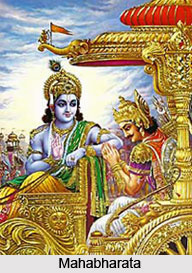
Now, when elaborated further on this very subject, i.e., Indian literature and its predominating themes, it can be found that a writer, be it of any capability cannot move out form the long-established themes of humanity, like romance, society, tragedy, comedy, adventure, war, or the ancient ones like mythological or epical. Since the ancient Indus Valley Civilization, it has been documented in historical annals that man had favoured to express themselves by speech or letter in the basic overriding conscious emotions stated just above. As such, the ancient Hindu society in India had always favoured and liked to base their writing on mythology and umpteen other legends and folklore, which perhaps was taken to a likeness by ladies and gentlemen both from the mass and the class. As such, mythological themes in Indian literature was the first to capture and enchant Indian readers, dealing with kings, queens, palaces, demons, gorgons, vision of heaven or hell, the Almighty, battles and ultimate winning, also including themes like 'never never land' and every sort of non-living thing being animated into a living being. Indeed, these mythological stories had so very appealed and captivated Indian minds, that none of the succeeding generations has ever been able to come out of this everlasting 'hypnotic' effect. Another vital modified version of mythological theme in Indian literature was the rather sophisticated development of epics in Sanskrit literature that was ushered in the Vedic Age. Epic themes in Indian literature began its journey with the two legendary magnum creations Ramayana and Mahabharata, influences and citations of which are still employed by contemporary Indian writers. Thinking in terms of such colossal dimensions called for expert Hindu Sanskrit scholars like sages Valmiki and Vyasa, who were the venerated writers of Ramayana and Mahabharata respectively. In societies that were yet to see modern light of day, these luminaries were capable to take India and Indians towards that modernistic section, that present critics refer to as much ahead of times. Indeed, maximum of later Sanskrit classical literature was based on these two epics, taking themes in Indian literature towards a genre by itself. Romantic themes in Indian literature was soon to follow the ancient Hindu society, jumping from staunch Hinduism and its priests and borrowing to some extent from west, precisely from its European counterpart. Romance as is known in strict terms in present Indian scenario was far from what was see in those times. Romance necessarily entailed virtually every aspect of life dealing with war, battles, crusades, chivalry, gallantry, relationships with heroic adventure and its knights wooing the princess etc and not only a love affair between a male and a female. Writers were successful to represent every kind of backdrop and link it with romanticism, which just as usual, is espoused by modern Indian regional or English writings. Indeed, contemporary Indian literature has derived out a sophisticated version of romantic theme in Indian literature, dealing again with convoluted versions of social backgrounds and yet falling in place with a perfect balance. In all these variety of literary genres, it can be witnessed that authorship is mysteriously and productively in line with societal norms, permanently portraying one or the other type of societal variation that has changed with age. Themes in Indian literature during Vedic Age, themes in Indian literature during Classical Age, themes in Indian literature during Medieval Age differs grossly with themes in Indian literature for the contemporary age. As such, social themes in Indian literature, be it in any kind of literal category, wholly falls in place with the structure organisation that humanity dwells in. |
| ||||||||||||||||||||||||||||

