Mizoram Temple Festivals - Informative & researched article on Mizoram Temple Festivals
  Indianetzone: Largest Free Encyclopedia of India with thousand of articles Indian Festivals


in  
Art & Culture | Entertainment | Health | Reference | Sports | Society | Travel
Forum  | Free E-magazine
Indian Festivals : Indian New Year Festivals l Indian Festivals l Indian Temple Festivals l Indian Religious Festivals l Indian National Festivals l Indian Regional Festivals l Indian State Festivals l Indian Fairs or Melas l Indian Hindu Customary Ceremonies l Shivaratri l Indian Customs and Rituals
Home > Art & Culture > Indian Festivals > Indian Temple Festivals > Mizoram Temple Festivals
Mizoram Temple Festivals
Mizoram Temple Festivals, influence by tribal rituals reflects the aboriginal culture of the state.

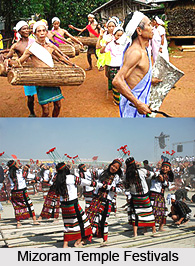
Mizoram Temple Festivals are some of the joyous events of the state that is well blended with the religion and culture of the Mizoram people. In Mizoram, there are three main religious festivals in a year. Festivals are called "Kut" in Mizo language and the three Kuts are Chapchar Kut, Mim Kut and Pawl Kut. All the three festivals are closely associated with agricultural activities. The festivals are celebrated with some pious ceremonies, feasts and dances.

Mizoram Temple Festivals Chapchar Kut is celebrated after completion of the cutting of jhums. It was a thanksgiving festival. The villagers faced many dangers and difficulties while cutting down dense forests with their simple Daos and axes. After success in clearing grounds for agriculture, they pray to God and complete some offering rituals in form of thanksgiving. They organise a big feast in the month of March to celebrate the success in jhum cutting. The festival continued for seven days and even more if the villagers could afford it. A few days before the day of the festival is fixed, the hunting parties from the village go out in the forests and rivers for hunting wild animals, trapping birds and catching fish. On this occasion, Zu - their much-loved drink is brewed in a large quantity.

On the first day of the Meghalaya temple festival, the members of the chief`s clan kill pigs for the feast. Pork in big quantities is eaten and lot of Zu is consumed. This day was called Lushai Vawk Tlah Ni, which literally means the day on which the Lushias kill pigs as offerings to the God in temples. The Mizoram Temple Festivals are grandly observed in the state with the passionate participation of people from all age groups.

On the second day, members of the other kinfolk in the village would kill their pigs for the village feast. On the third day, known as Kut day, Zu would be taken in the houses in which someone had died during that very year. On this day before sunset in the evening people particularly mother and children dressed in their best attire and gathered in the open space in the village at the Lungdawh, which is a stone platform put up as a memorial to the dead. They brought with them rice, boiled eggs and meat after making a short prayer to their tribal God. In case anyone did not want to have the food, one would try to force the food down the throat of his friends. This ritual was known as Chhawnghnawt. After sunset the young boys and girls assembled together in the houses of well-to-do-villagers and would spend the night in drinking, singing and dancing.

The next day was known as Zupui Ni or the day of drinking a particular type of liquor called Zupui that was brewed from well-husked rice. In the evening before sunset, young men and girls dressed in their best would gather in the open space of the village for singing and dancing. They formed a circle for the sacred dance in which the young men gave their arms across girls and stood alternate between the boys. Within the circle the drummer or gong beater stood, who chanted while the young people would sing and move slowly keeping time with the song. This dance was known as Chai dance and the children of the village would go on serving the dancing boys and girls Zu of the best variety in bamboo cups, during the dance.

The next day is called Zuthingni that marks the day of drinking a special type of Zu. On this day of this particular Mizoram Temple Festival, there would be a general dance in the village where all the villagers pray for a while. Zu drinking is innate in any kind of religious celebration in Mizoram. The dance of the villages continued day and night until the Zu supply would run short. The last day of this Mizoram Temple Festival was known as Ziapur ni or the day of rest after eating and drinking. On this day, people relaxed after hectic days of festivals. They believed, going back to the jungle after these religious ceremonies would bring them bad luck.

The Mizoram Temple Festivals are entirely tribal customs centric and till date these festivals are widely prevalent in the state.

(Last Updated on : 24/01/2009)
  More Articles in Indian Temple Festivals
 
Ratha Yatra Baneshwar Fair Gangaur Festival
Kandhashasti Festival Jwalamukhi Fair , Indian Fair Pandharpur Festival
Brahmotsava Festival Ranganath Temple Festival Cittirai Festival
Festivals of Sri Pataladri Narasimhasvami Temple Festivals of Sri Varadarajasvami Temple, Poondamallee Mahanavami Festival of the Vijayanagar Era
Andhra Pradesh Temple Festivals Arunachal Pradesh Temple Festivals Assam Temple Festivals
Bihar Temple Festivals Chhattisgarh Temple Festivals Delhi Temple Festivals
Gujarat Temple Festivals Haryana Temple Festivals Himachal Pradesh Temple Festivals
Jammu and Kashmir Temple Festivals Nagaland Temple Festivals Orissa Temple Festivals
Kerala Temple Festivals Tamil Nadu Temple Festivals Punjab Temple Festivals
Jharkhand Temple Festivals Uttarakhand Temple Festivals Manipur Temple Festivals
Tripura Temple Festivals Mizoram Temple Festivals Meghalaya Temple Festivals
Madhya Pradesh Temple Festivals Rajasthan Temple Festivals Maharashtra Temple Festivals
Uttar Pradesh Temple Festivals West Bengal Temple Festivals Karnataka Temple Festivals
Recently Updated Articles in Indian Festivals
  • Makar Sankranti
    Makar Sankranti is one of the most propitious occasions of India. It is celebrated with high enthusiasm and positive energy in several parts all over the country. Makar Sankranti marks the transition of Sun into the Capricorn or Makar zodiac sign.
  •  
  • Gangasagar Mela
    Gangasagar Mela is a famous pilgrim destination among people. It is located south of Kolkata, and it is second largest fair after Kumbha Mela.
  •  
     
  • Indian Independence Day
    Indian Independence Day celebrates the freedom of the nation from British rule. It is celebrated on the 15th August every year all over the country.
  •  
  • Arubathimoovar Festival
    Arubathimoovar festival is celebrated in Tamil Nadu between March and April. It is a tribute to the 63 saints of Lord Shiva.
  •  
  • Kanthuri Festival
    Kanthuri Festival is colourful event that is celebrated in the state of Tamil Nadu. It is celebrated by people of all religions.
  •  
    E-mail this Article | Post a Comment
    RSS Feeds
    Forum
    Forum on Indian Festivals

    Free E-magazine
    Subscribe to Free
    E-Magazine on Indian Crafts
     
     
    Mizoram Temple Festivals - Informative & researched article on Mizoram Temple Festivals
    Sitemap
    Contact Us   |   RSS Feeds
    Copyright © 2008 Jupiter Infomedia Pvt. Ltd. All rights reserved including the right to reproduce the contents in whole or in part in any form or medium without the express written permission of Jupiter Infomedia Pvt. Ltd.
