Indian scripts have existed and made their presence felt since ancient and unaccountable times, times when the country was not unwrapped from its fold of dogmatism. During this Dark Age, the society and world order in India was consciously divided into the higher and lower strata of living, which was additionally sub-divided into religious sequestering and the realisation of caste system. As is almost evident from such sensitive information, India was wholly dominated by Hindus, with Hinduism being espoused by nearly the greater section of society and class. Hinduism was, in its nascent period, ruled by sadhus, sages and saints, zealously dedicated to making their religion a wide-spreading one. The system of religious reverence was primarily concentrated on Agni (Fire) or Jal (Water), the elemental aspects in life, which were at first delivered in the system of guru-shishya (teacher-student), through word of mouth. This tradition however metamorphosed into a comparatively better one, when oral preaching was replaced by written scripts. Indian scripts in ancient ages pertain to those writings, which have been devoted to prose or poetry pieces in honour of the Almighty and His umpteen dealings with the universe.
With passage of time, Medieval or Middle Age took the place of Dark Age, which witnessed a much more overpowering influence of scripts in India, which can be illustrated by scriptures like the four Vedas, Upanishads, Mantras, Sutras and Brahmanas. The Mahabharata, Bhagavad Gita and Ramayana can be some of the illustrations of Indian scripts from this epoch. Evolution of Indian scripts is a wondrous and breathtaking gradual development of Indian language and the art of man mastering it. Increased learning, the supplementary eagerness towards education and understanding and sophistication in prose and verse structure with advent of Sanskrit, made the genre of scrip-writing in ancient India rather popular.
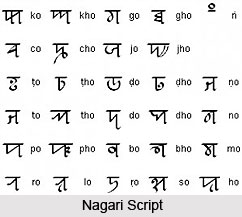
Indus Valley Civilisation and the prolonged rulings of Hindu dynasties had bettered Indian populace in every sphere of daily life, with special accentuation on education and art of war. Each meticulous attempts made, each attempt towards improvisation of their subjects, each attempts at admiration of literary writings were indeed triumphant. Various Indian scripts had in fact germinated and matured during these ages, with dynasties like Mauryans, Guptas taking centre-stage. The Indus script, Brahmi script, Kharosthi script, Gupta script, Siddham script and Nagari script had gained pan-Indian acceptance, with practically endless store-house of information and knowledge. Scripts of South India had also incidentally matured during this period, committed absolutely to Dravidian style of language, a significant hand of Indian languages.
Succeeding moments and periods in time witnessed the gradual maturation from pre-Christian era into post-Christian era, with countless invasions of Islamic reigns from Persia and Arabian countries. This was yet another turning-point towards the development of Indian scripts, which can hugely be distinguished from Hindu scripts. The mode of Urdu writing, its style, fashion of diction, including the pages itself had become far differentiated from erstwhile years, which for the very first time had a dash of modernity stamped all over. Gradual maturation, the gaping time gap with Mughal Empire and British Empire had paved way for India to enter into the era of contemporary literary outputs, with Hindi and English substituting ancient Indian languages. Indian primeval scripts were fast put to the shelf, with modern scripts seeing the light of day, and which is still in a phase of metamorphosis.