


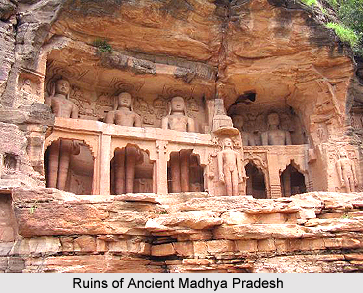
 History of Madhya Pradesh can be easily divided into ancient, medieval and modern. The ancient history of Madhya Pradesh deals with the rise of Ujjain and several ruling dynasties. Its medieval history witnessed the rise of the Muslim rule in India and the modern history narrates the tales of imperialism and the battle to achieve freedom. The history of Madhya Pradesh is dotted with incidents that are recounted even today to inspire people. Besides the ruling dynasties, the tribal races form an integral part of the history of Madhya Pradesh too. In fact, the tribal groups were part of the earliest civilisation in this part of the Indian subcontinent. History of Madhya Pradesh can be easily divided into ancient, medieval and modern. The ancient history of Madhya Pradesh deals with the rise of Ujjain and several ruling dynasties. Its medieval history witnessed the rise of the Muslim rule in India and the modern history narrates the tales of imperialism and the battle to achieve freedom. The history of Madhya Pradesh is dotted with incidents that are recounted even today to inspire people. Besides the ruling dynasties, the tribal races form an integral part of the history of Madhya Pradesh too. In fact, the tribal groups were part of the earliest civilisation in this part of the Indian subcontinent.
There were several princely states before independence. The historical sagas of Madhya Pradesh exhibit the glory of the past. Most of the places of Madhya Pradesh are still having historical monuments, namely forts, palaces, and other related architecture, although some of them have been ruined. Right from the north, the fort of Gwalior (Gwalior Fort), Raja Ram temple of the priencly state of Orchha, seven-storied palace of the priencly state of Datia, Chhatris of Shivpuri District , the fort of Mandu, Rajwada Place in Indore, and the central zone monuments such as Sanchi Stupa, Udaygiri Caves, etc. are exhibiting the magnificence of the past. Sanchi in Raisen district is a world-renowned Buddhist pilgrimage center known for Bhimbetka. Khajuraho Temples in Chhatarpur district are renowned the world over for its unique temples. Built by the kings of Chandela dynasty from 950 - 1050 A.D. Orchha in Tikamgarh district is a medieval legacy in stone built by Bundela rulers in the 16th and 17th centuries. Early History of Madhya Pradesh The history of Madhya Pradesh dates back to the Palaeolithic age. Evidences of earliest human settlements have been found in Bhimbetka and other places of Raisen district. The rock shelters of Bhimbetka have witnessed the civilisation in the Prehistoric Ages. Over 600 rock shelters have been discovered in Bhimbetka. About 500 caves have rock paintings, which depict the life of pre-historic cave dwellers. In the 6th century B.C, the history of Madhya Pradesh witnesses the rise of Ujjain as the central political power. Mauryan Empire remains the first dynasty in the ancient history of Madhya Pradesh to rule the state. Chandragupta Maurya established the dynasty in 321 BC. After the Mauryas the state was administered by a number of empires, such as, the Sungas, Kanva dynasty, Satavahana dynasty, Nagas, Gupta Empire, Utkals, Chalukya dynasty, Rashtrakutas dynasty, Chandelas and others. Mediaval History of Madhya Pradesh The medieval history of Madhya Pradesh witnesses the rise of Harshavardhana of Thanesar who reorganised the states of Northern part of India. After his death, the Bundela kingdom rose to power in Madhya Pradesh. In the later half of the medieval period, the Rajputclan ruled over the state. Apart from changing dynasties, the medieval history of Madhya Pradesh also witnessed architectural grandeur. Khajuraho temples were built during this period. However, there were series of conflicts from the 12th to 16th centuries due to Muslim invasions. With the Akbar's ascension to the throne of Delhi, Madhya Pradesh became his stronghold from 1556 to 1605 AD. Madhya Pradesh once again underwent transfer of powers when the Maratha Empire snatched away the reins of power from the ruler of Mughal dynasty in 1720. They ruled over Madhya Pradesh until 1760 AD. Modern History of Madhya Pradesh The Third Anglo Maratha war altered the fate of Madhya Pradesh forever. The state ushered into the modern period with British supremacy. Several freedom fighters, including Chandra Shekhar Azad, hailed from this Central Indian state. Even in the Revolt of 1857 Madhya Pradesh played an important role. People like Gaya Dutt, Manik Chand Kochar, Choudhary Shankar Lal, and several other Indian Freedom Fighters inspired the masses to participate in the Indian freedom struggle for the Indian Independence Movement. The modern history of Madhya Pradesh also witnessed numerous martyrs who willingly laid down their lives for liberating their motherland from the British Raj. In the freedom struggle, many movements were successfully launched in Madhya Pradesh coinciding with the Non-Cooperation Movement and Quit India Movement. Almost all parts of the state were active in freedom struggle, though at different times. After India gained independence in August 1947, the state of Madhya Pradesh was reorganised and Bhopal was declared its new capital. The undivided Madhya Pradesh was formed on November 1st, 1956. Madhya Pradesh, in its present form, came into existence on 1st of November, 2000 following its bifurcation to create a new state of Chhattisgarh. Today Madhya Pradesh stands out as an important state in the Indian sub-continent with its historical places, natural beauty, an interesting demography and numerous places of interest. Thus, it can be said that history of Madhya Pradesh is steeped tales of kings, clashes and finally the freedom struggle. |
| |||



History of Madhya Pradesh
| History of Madhya Pradesh indicates that this state has remained a ground of warfare for a long time. Madhya Pradesh, often referred to as the Heart of India, has its roots in the Prehistoric Ages. |
| ||||||||||||||||||||||||||||

