


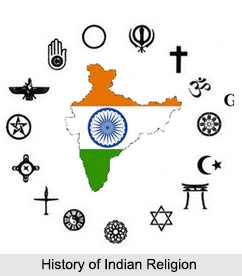
 History of Indian Religion guides to the understanding of its religious beliefs and practices of various Indian Religions which have a large impact on the personal lives of most Indians and influence public life on a daily basis. Indian religions have deep historical roots that are recollected by contemporary Indians. India has a list of religious beliefs that represent Indian religion. The religious culture going back at least 4500 years has come down only in the form of religious texts. The religious beliefs postulated by human beings play a dominant part in the history of Indian religion and these beliefs are 100,000 years old. History of Indian Religion guides to the understanding of its religious beliefs and practices of various Indian Religions which have a large impact on the personal lives of most Indians and influence public life on a daily basis. Indian religions have deep historical roots that are recollected by contemporary Indians. India has a list of religious beliefs that represent Indian religion. The religious culture going back at least 4500 years has come down only in the form of religious texts. The religious beliefs postulated by human beings play a dominant part in the history of Indian religion and these beliefs are 100,000 years old.
Role of Indian Religions on Indian Society Religion is an integral aspect of life in India. The country is a secular state and respects all religion equally. History of Indian Religion is very ancient. India is the cradle of Hinduism, Buddhism, Jainism and Sikhism. The country also has followers of the religions such as Islam, Judaism, Christianity, Zoroastrianism and Baha’ism. History of various Indian Religions The recognised history of Indian Religion begins with historical Vedic religion. The religious practices of the early Indo-Aryans gave rise to certain religion. Their practices and rituals were collected and framed into the Samhitas. These texts are the central Shruti or revealed texts of Hinduism, which lasted from 1500 to 500 BC. Hinduism is a prehistoric religion and constitutes an overwhelming majority in the country. It is a ritualistic religion with various customs and traditions. The origin of this age-old religion is not documented and thus Hinduism can be called the native religion of the country. After the 6th century BC, Jainism and Buddhism sprang up in India. Buddhism was founded by Gautama Buddha and was spread all throughout the country and beyond India through missionaries. Buddhism began in India as a reaction to the Vedic sacrificial system and the Brahmin's control on religions. Jainism is another religion among the Indian Religions that was established by Mahavira. Besides Hinduism, Buddhism and Jainism are the oldest religions practiced today in the country. Sikhism was founded in the 15th century on the teachings of Guru Nanak in Northern India. Though Christianity and Islam originated outside the Indian subcontinent, yet with the frequent invasions these religions became popular in the country. Christianity arrived in India with apostles of St. Thomas. St. Francis Xavier was the person who helped in spreading Christian missionary activity in the country. He arrived in the country in the 16th century and worked in the fields of reform and education. Zoroastrianism originally arrived with the traders and was represented by small population and mostly settled down in and around the Indian West Coast. The emergence of Islamin the country is simultaneous with the Turko-Muslim invasion of medieval India. Islam has made noteworthy religious, artistic, philosophical, cultural, social and political influences to Indian history. An in-depth study of the Indian religion helps to explore India. A review of the growth and the development of western civilizations included their language, literature, history and religion. History of Indian Religion also reveals the authentic form of Sanatan Dharma and tells the original philosophy of Vedas, Puranas, Bhagavad Gita, Bhagwatam and Darshan Shastras. The distinctness of Indian religious system finds expression with the truth that in the diversity of beliefs, castes, rituals and religions India has given liberation to them and allowed each of them equal status. |
| |||



History of Indian Religion
| History of Indian Religion is very intense entwined with varied cultures and beliefs. |
| ||||||||||||||||||||||||||||

