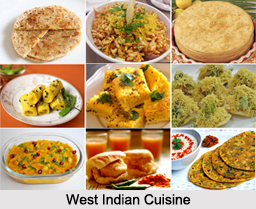
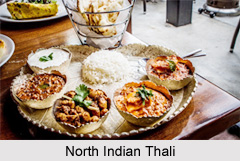
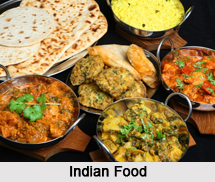
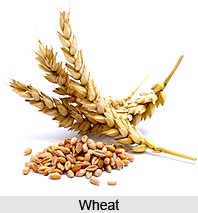
 Wheat is a cereal grain which gives immense health benefits. It originated in Southwest Asia in the area which is acknowledged as the Fertile Crescent. The wild wheat was reclaimed as part of the origins of agriculture in the Fertile Crescent. Cultivation and repeated harvesting and sowing of the grains of wild grasses led to the domestication of wheat whilst paving the way to a number of wheat dishes in Indian culinary.
History of Wheat Dishes in India
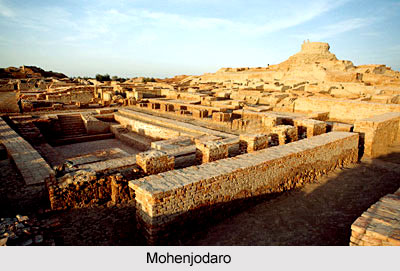
The predominance of the wheat dishes in Indian culinary was first observed during the Harappan civilisation. The Harappans of ancient India used to savour the wheat dishes. In the Vedic literature, mention of wheat dishes can be seen. This clearly points out that in the long gone era wheat dishes in the Indian culinary were pretty common.
Types of Wheat Dishes in India
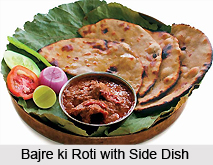
Literature in Kannada refers to an umpteen number of wheat dishes, common in Indian food. The literature mentions various wheat based food items that could be roasted, baked, steamed or fried. The `rotis` contain a large number of variation that include and included the `mucchala`, `kivichu`, `chucchu`, `savudu` and `uduru rotis`, and numerous sweet-stuffed `mandiges`, `puriges`, `huriges`, `holiges` and `obattu`. Cream is blended into wheat flour to yield such delicacies as the `yeriyappa`, `pavuda` and `chilimuri`. Wheat `rava` and wheat vermicelli are preferred as the base for many sweet confections of the sweet delicacies such as `shalianna`, `ghrtapura`, `payasa`, `ladduge`, `pheni`, `chirotti` and the crescent shaped `karaji kayi`.
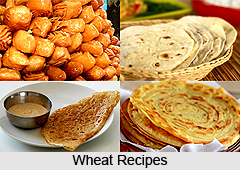 The literatures of the central and southern India portray the most reflexive and imaginative use of wheat and wheat dishes. The `Mdnasolldsa` of the primitive age refers to the `gulalavaniya`, which appears to resemble the tiny `gole-papdi` of the present. They are made both salty and sweet and are in demand among the people. Most of the wheat based items are sweet. The `hayapunna` is a fried wheat preparation dispersed with fine sugar. `Kasara` is a conflation of wheat flour, milk, ghee, crystal sugar, cardamom and black pepper. This concoction is stuffed in a wheat envelope, yielded the `udumbara`. A mixture of wheat flour, guda, black pepper and cardamom was named as `murmura`. `Ghrtapura` or `havispura` seems to have been the `ghevara` which is presently common in Gujarat. This item is prepared with a pressed mass of fine wheat flour mixed with milk, fried in ghee and coated with sugar. The food item termed as `khaja` was referred to as the `khajjaka` in the Mdnasolldsa. It was made either plain or sweet, and `phenaka` is presently known by the name of `pheni`. The vedhami which is a famous dish of Gujarat and Maharashtra was a spiced, sweetened paste of `besan` which was rolled in wheat flour before being baked on an earthen plate. The `Patrika` were discs of wheat that were rolled out and placed one upon the other. Then they were fried deep as a mass and then dusted with sugar. This dish is the primal form of the present dish called `chirotti`. The Shivatattvaratndkara, written in western India in about AD 1700, describes the `suppani` as a mixture of wheat and rice grits deep fried till brown and crisp, and were admired by the kings as nutrient.
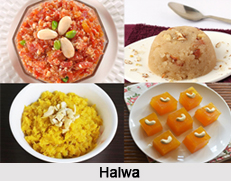
Wheat dishes were also famous during the Delhi Sultanate Era. The wheat dishes, served in the Sultanate period included the `khubi`, paratas, `naan-e-tunuk` which is a light bread and `naan-e-tanuri` or a `tandoori rod`. Stuffed wheat `samosas` boasted even as part of a meal. In the Mughal period that followed there were several items in which wheat was finely ground with spices, like `harisa`, `halim` and `kaskh`, while the `samosa` was named as `qutab`. The wheat flour is boiled with water and washed repeatedly, and is finally transformed as what finally remains is an elastic mass which is presently known to be the protein gluten. This was seasoned in Akbar`s kitchen to a product called `chikhi`. The same elastic residue mixed with fruit juices and cream yielded the drink `falooda` which is said to be a favourite with Jahangir. Wheat washings are also an ingredient in the chewy Sindhi halwa of present day.
Though, wheat dishes had been in the list of Indian dishes, the modern culinary system is still in the process of modifying and inventing new recipes considering the present life style and food habit of multitudes.