Virata Parva is the fourth Parva from among the eighteen parvas of Mahabharata. This consists of four sub-parvas. This episode of Mahabharata largely deals with the thirteenth year of exiled life in incognito in the kingdom of Virat. The five brothers disguised themselves according to their skill and their quality and Draupadi also stayed for a year in disguise in that kingdom with the Pandavas. In this episode there is also the description of the death of Kichaka, the general of the army of Virat and the brother of Sudeshna, the wife of Virat and the episode ends with the defeat of all the Kuru warriors in the hands of Arjuna disguised as Brihannala.
Pandavas in Disguise
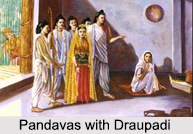
As per the descriptions in the Virata Parva, the five Pandava brothers resolved to disguise themselves according to their quality and personality. The Virata Parva portrays that Yudhisthir, who was well versed with both the scriptures and skills of dice, rules and functioning of royal court, assumed the name as Kankanbhata and was appointed in the kingdom to serve the king in the capacity of his adviser and priest. The mighty and huge body of Bhima asked for a large amount of food to satisfy his appetite. Thus, he made up his mind and appointed himself in the Royal kitchen as the chief cook and assumed the name of Ballava. On the contrary Arjuna was cursed by Urvasi to stay as a eunuch for a year and thus he became Brihannala and took the duty to train the princess Uttara in dance and music. Nakula name himself as the Granthic, the caretaker and guard to the horse stable and Sahadeva was called as Tantipal. Draupadi, the beautiful and virtuous daughter of Drupada and the queen of the Pandavas, was disguised as Sairandhri and was appointed as the chief maid-servant to the queen. Thus, the five Pandavas and their queen Draupadi were properly disguised and stayed well in the kingdom of Virat without the notice of anybody.
Kichaka Badha
Kichaka was the army general of King Virat and he was also the brother of Sudeshna, Virat`s queen. Virat solely depended on Kichaka for the protection of his empire and thus Kichaka enjoyed a commendable position in Virat`s kingdom. Once Kichaka saw Draupadi in the chamber of his sister Sudeshna and asked his sister to possess her. Thus, according to a plan, Sudeshna ordered Draupadi, who was then in the disguise of a maid-servant named Sairendri, to go to the quarters of Kichaka and bring some wine. When Draupadi went there, she was abused and insulted by Kichaka and later the evil general of Virat was killed by Bhima.
The five Pandavas and their queen Draupadi thus lived peacefully in disguise in the kingdom of Virat. They obeyed all the orders of the king who gave them shelter when they needed the most. While the Pandavas were staying in the kingdom of Virat, the Kauravas once captured all the cattle of Virat. In order to free the cattle from the Kurus, the son of Virat was accompanied by Arjuna who was then disguised as Brihannala. A great battle was fought between all the great Kuru warriors and Arjuna along from the side of the king Virat, and Arjuna was able to free the cattle of Virat at last and defeated the Kuru generals. With the end of the thirteenth year of exile of the Pandavas, they five brothers along with Draupadi made themselves visible to the world with more power and determination and thus conclude the Virata Parva of Mahabharata.