Udyoga Parva describes the preparations for the great battle at Kurukshetra and the efforts to bring about peace. This Parva consists of eleven sub-parvas and forms the fifth Parva of Mahabharata. It narrates the preparations of the Kauravas for war by getting the aid of various princes and kings who were there friends and relatives and the Pandavas after completing thirteen years of exile returned with full glory and they stayed in the kingdom of Drupada and from there they raised a great army with a large number of their alleys as different kings and warriors. The effort of Krishna to bring about peace between the Pandavas and the Kauravas has also been described in this Parva of Mahabharata. In this Parva the meeting of Krishna with Karna has also been described prior to the war at Kurukshetra.
Ambassador from Dhritarashtra
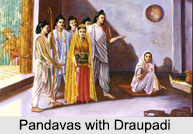
When the thirteen years of exile were over, the Pandavas made themselves visible to the world. The held a great council of kings at the court of one of their allies, the king Drupada who was the father of Draupadi. Dhritarashtra, the king of Hastinapur, after hearing about the return of the Pandavas along with Draupadi from exile, sent an ambassador charged with vague words of peace and friendship to the Pandavas. However, he did not give any definite proposal for giving the Pandavas their kingdom and property through the ambassador. The ambassador from Dhritarashtra reached the place where the five Pandavas were staying and he narrated those which were told to him by the Kauravas to convey the Pandavas. After hearing the words of the ambassador, which were full of vague message of friendship and peace and no mention of the return of the half of the kingdom to the Pandavas, all agreed with Yudhisthir that there was only one answer to the peace message of Dhritarashtra and that was that either the Kauravas would return them their kingdom which was due to them or they would be ready for a fatal combat.
War Preparations of Pandavas and Kauravas
The aggression of Duryodhana was very severe and persistent and the insult to the Pandavas and Draupadi at the gambling party was too personal and offensive. Duryodhana, however, had had all the opportunity he craved and for thirteen years, while the Pandavas were in exile, he had enjoyed the power of making alliances and dispensing benefits. Thus, that was the right time to test the faithfulness and the courage of the friends he had won. The clouds of war hung thick and black above the rival houses, and both knew then that the contest would end up in death. Duryodhana put the command of the Kaurava forces into the hands of Bhishma, while Karna, in order not to create a separate faction in the army, decided not to fight till the grandsire was slain. The Pandava forces were put under the command of Draupadi`s brother, the Panchala prince, Dhrishtadyumna.
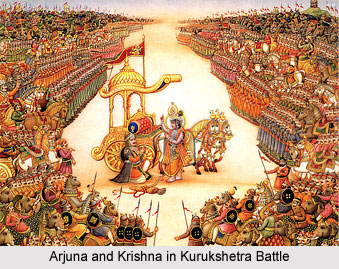
Hastinapur, at the approach of battle, crowded with kings and armed personnel, with elephants and chariots and thousands of foot-soldiers, looked like the ocean at the moment of moonrise. The Pandavas gathered their forces in the capital of Drupada. From the beginning Duryodhana had given orders that Bhishma, as commander, was to be protected, and having heard vaguely from Bhishma that through Shikhandi alone he could be killed, he ordered that every effort was to be made in the battle to kill Shikhandi. Since Krishna was the cousin of both the Pandavas and the Kauravas, thus it was his duty to help both the sides in the great battle at Kurukshetra. Both Arjuna and Duryodhana went to Lord Krishna to ask for his help in the battle. While Duryodhana was pleased after getting the huge army of Krishna to fight in his side, Arjuna got the consent of Krishna to let him perform the duty of his charioteer in the great battle.
Krishna as an Envoy to Hastinapur
Lord Krishna went on behalf of the Pandavas before the outbreak of hostilities to see if it were possible to persuade Dhritarashtra to restore Indraprastha peacefully to the Pandavas, and thus to avoid war. Krishna tried his best in his mission as an envoy, but the blind king Dhritarashtra, blinded even of his sense of reason and wisdom, was unable to accept the proposal of Krishna. He was however deeply influenced by the love of his elder son Duryodhana and was, from the beginning, unable to deny his son of any matter. That time, while Krishna was an ambassador of peace in the court of the Kauravas, Duryodhana even tried to arrest Krishna, ignorant of his actual self. By that act of foolishness of Duryodhana Krishna showed his real self and departed from Hastinapur by warning al of a severe consequence.
Krishna Meets Karna in Hastinapur
When the peace mission of Krishna failed in Hastinapur court, he tried a last attempt to avoid war and thus met Karna in a lonely place. He told Karna of his real identity and asked him to be a part of the Pandavas since he was the eldest of all the Pandava brothers and the first son of Kunti. Karna listened with his usual courtesy and he told that the same was known to him for long. He also told that it was by the command of the Sun god that his mother Kunti abandoned him and floated him out on the river beside which he was born. At the same time, he was unable to forget all the love and devotion of the old charioteer and his wife, who adopted him when he was very small and treated him as they own son. He was also unable to forget that they had no other child, and that if he gave them up there would be none to make the ancestral offerings for them. He had also married in the caste of the charioteer, and his children and grandchildren were all of that rank. Thus, out of mere desire for empire, he was not able to cut loose his heart from those bonds. His gratitude, which he owed to Duryodhana for all his help, could not be overlooked. Only for his fearless and heroic friendship he had enjoyed a kingdom for thirteen years without any care. His desire in life for a single combat with Arjuna was the only thing for which Duryodhana was bold enough to declare war. Thus, he was not able to change his mind and be a part of the Pandavas, since that would be a treachery to his friend Duryodhana.
Meeting of Kunti and Karna
The Udyoga Parva in Mahabharata also describes the meeting of Kunti with Karna. Before the start of the war at Kurukshetra, Kunti tried to strengthen the side of her sons by persuading Karna to fight for the Pandavas. Thus, one morning, by the river-side, as Karna ended his devotions after bathing, and turned, he was surprised to find the aged Kunti, mother of the Pandavas, waiting behind him. He bowed gravely and introduced himself as the son of Adiratha, the charioteer, and asked if he could do anything for her. Then Kunti quivered at his words and told to Karna that he was not the son of a charioteer, but her eldest son and asked him to let the fact known to the five Pandavas and urged him to fight from their side in the battle. Replying to what Kunti told him, Karna asked her the reason to demand his obedience at that time while he was left to death by her when he was newly born and for the charioteer and his wife he was saved and grew up into what he was then. Then he told that he could not abandon his friend Duryodhana even for the sake of his mother. However, he promised to Kunti that he would only fight against Arjuna and also assured her that her total number of sons would remain five. Either he would kill Arjuna or Arjuna would kill him, in both the cases the sons of Kunti would remain five.
Thus, one after the other, the udyoga or effort made by the Pandavas to find an alternative for the war failed and at last it was decided from both the sides that the ultimate war would decide the fate of both the princely families. The Udyoga Parva thus covers all the incidents starting from the end of the thirteen years of exile of the Pandavas and the preparations for war by the Pandavas and the Kauravas.