


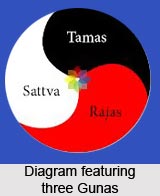
 Kundalini meditation theories state that an individual exists only because of the Three Gunas, namely the Sattva, Rajas and Tamas. Sattva Guna and Tamas Guna are two sides of the same aspect. Kundalini meditation theories state that an individual exists only because of the Three Gunas, namely the Sattva, Rajas and Tamas. Sattva Guna and Tamas Guna are two sides of the same aspect.
Sattva is considered as Amrita, which is of the essence of the Fire Element. The Amrita present in the head is a glandular substance and it is a physical manifestation of pure Sattva. Tamas Guna is Visha or the essence of Water Element. Tamas Guna is a fatal poison. The metabolic toxins are both present in the physical self and mind in the form of a body poison. When the bad qualities from poison are removed, it becomes nectar, and if the bad qualities are added to nectar it will become poison. Ayurveda has abundance of instances of how poisonous plants and minerals can be used for medicine, and of how improperly used medicines act as poisons. The Indian medicinal plants prove to have a special effect on these three Gunas. Rajas Guna is the bridge between Sattva Guna and Tamas Guna. Rajas can transform Tamas into Sattva, and it can also degrade Sattva into Tamas. Rajas Guna is a pure Shakti, energy and the very personification of illusion of Maha Maya. Rajas Guna does not know of its own activities but carries on its action involuntarily. Thus, the Rajas Guna must be well controlled. If the Rajas Gunas can be properly controlled, almost anything can be achieved. It is believed that only Lord Shiva can control Shakti. Lord Shiva has another name, Rudra that indicates the shedding of tears. Before the Rudra Granthi is pierced, the sadhaka or the worshipper sheds tears of misery of Maya, because he cannot be sure of himself, or of the existence of God. This doubt continues until that Knot is pierced and eventually all doubt is removed. The three Gunas participate intensely in these actions. The glands of the body then begin to secrete Amrita, or shed tears. This Amrita Guna is the main reason for a devotee to shed tears of joy.  Lord Shiva drinks poison, but He converts the lethal into Amrita. In order to do this, one must know the association between visha (poison) and vishaya (sense object). The world of sense objects is the true poison because it is temporary. People ordinarily call it as permanent, and this leads to hallucination. Everything Shiva takes in is converted into Amrita, which is called Amrita because it is permanent, not momentary. Thus, it is connected only with Lord Shiva or the real Self and the soul. As long as one can be in the world, his/her consciousness is connected with sense objects. Usually, a person lives in the state of transience and ignorance. But when one's meditation leads the way to Lord Shiva, can the person attain Amrita Guna. Lord Shiva drinks poison, but He converts the lethal into Amrita. In order to do this, one must know the association between visha (poison) and vishaya (sense object). The world of sense objects is the true poison because it is temporary. People ordinarily call it as permanent, and this leads to hallucination. Everything Shiva takes in is converted into Amrita, which is called Amrita because it is permanent, not momentary. Thus, it is connected only with Lord Shiva or the real Self and the soul. As long as one can be in the world, his/her consciousness is connected with sense objects. Usually, a person lives in the state of transience and ignorance. But when one's meditation leads the way to Lord Shiva, can the person attain Amrita Guna.
Attaining Amrita Guna is a difficult way that requires the grace of the guru. The most painful stage of attaining all the three Gunas is to live without food. When the disciple is young, he has to be trained by the guru to forget hunger and be ready to starve during his sadhana. After this particular stage then there will be further restrictions and further periods of adjustment. The person should lose his taste for all sense objects, because sense objects can disturb his consciousness. Consciousness is a chemical phenomenon, which exists at the mercy of the chemical composition of the diet. The food consumed, the water one drinks, and the air one breathes can disturb a person's Sadhana. Thus, Kundalini Tantra lays such stress on the purification of the three Gunas that make up one's body. |
| |||



Three Gunas
| Three Gunas, namely the Sattva, Rajas and Tamas are subdued, yet strong elements of a physical body. According to Kundalini meditation theories, an individual exists only because of the Three Gunas. |
| ||||||||||||||||||||||||||||

