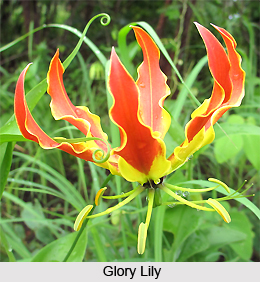
 Fire lily holds the botanical name Gloriosa superba and belongs to the family Colchicaceae. It is recognised as of great use in the medicinal spheres. This plant is named differently even in the same state. Fire lily is commonly known as `Bishalanguli` in Bengali, `Dudhiovachnag` in Gujarati, `Kalihari` in Hindi, `Agnisikhe` in Kannada, `Malattamara` in Malayalam, `Kallavi` in Marathi and `Agnisikhha` in Telugu and Oriya.
Distribution of Fire Lily
Fire lily is distributed throughout tropical India in open or secondary forests from sea level to about 2000 metre elevation. It generally grows under a variety of soil conditions. Fire lily is common in hedges, chiefly on black soils in central India and throughout southern India. Keeping in view the value of this plant, it is often cultivated in gardens throughout India. The plant is of great value not only in India, but also among the people residing abroad.
Anatomy of Fire Lily
Fire lily is a branched, herbaceous climber with annual, slender stems arising from a perennial, fleshy and tuberous rhizome. The rhizome is cylindrical, bifurcated and usually V-shaped with the two limbs that are 20 cm to 30 cm long and 2.5 cm to 3.8 cm in diameter. Leaves are alternate, opposite or whorled, 7.5 cm to 15 cm long and 2 cm to 4.5 cm wide, ovate lanceolate, apex is acuminate and spirally twisted to serve as a tendril. Flowers are beautiful and showy, large, solitary or in clusters. Fruits are linear oblong, greenish yellow in colour, about 4.5 cm long and 2 cm in diameter and contain many globose seeds. In central India, plants appear with the onset of the rains. This plant generally bear flower in August and September and fruits come out in September and October.
Medicinal Use of Fire Lily
In Ayurveda the tuber (root) of fire lily is considered anathematic, laxative and alexiteric. This plant is used to treat chronic ulcers, leprosy, inflammation, piles, abdominal pains, itching and thirst. The powdered tuber is reportedly used in the form of a paste as a local application for parasitic skin diseases, as a cataplasm for relieving rheumatic pains, and as an external application to promote the expulsion of the placenta after childbirth. The white, starchy powder obtained after repeated grinding and washing of the tubers of fire lily is reportedly taken to treat gonorrhoea and as an abortifacient. Although the drug is reportedly taken internally in very small doses (5-10 grains) as a tonic, stomachic and anathematic, it is an extremely poisonous gastrointestinal irritant, causing vomiting and purging if it is taken without any consultation with the physician.