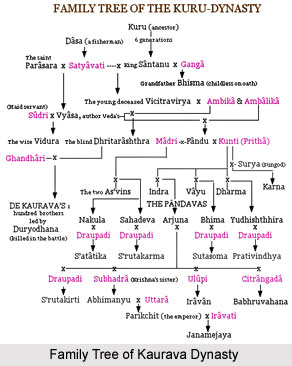
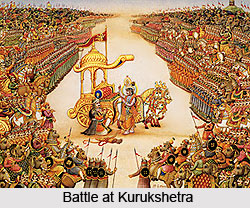
 Salya Parva is the ninth Parva of the great epic Mahabharata written by Veda Vyasa. It consists of four sub-parvas from among the one hundred sub-parvas. The parva describes the taking over of the charge of commanding the Kuru army by Salya, the king of Madra, after the death of Karna in the hands of Arjuna. This Parva describes the last day of the battle at Kurukshetra and it also describes the death of Shakuni in the hands of Sahadeva. This ninth Parva also gives an account of Yudhisthir`s slaying of Salya and the mace fight of Bhima and Duryodhana resulting in the end of the great battle, since Duryodhana was killed after his thigh was smashed by Bhima with his mace.
Salya was the ruler of Madradesa or the kingdom of Madra. He was a very skilled archer and a formidable warrior. Even if the Pandavas thought him to be joining their army in the great battle at Kurukshetra, Duryodhana tricked King Salya and made him to fight with his huge army from his side. Thus, the great charioteer was asked by Yudhisthir to promise in turn to demoralize Karna in every possible manner and dampen his spirits. As a great warrior, Salya confronted many a great warriors who were fighting from the side of the Pandavas and killed them. Salya was ultimately killed in the battle field by Yudhisthir. In this Parva there is also an elaborate description of the combat between Shakuni and Sahadeva and ultimately Sahadeva overcame the wicked uncle of Duryodhana and killed him. This Parva also describes in detail the huge loss experienced by the Kauravas in the great battle.
There remained a very small number of troops alive after the immense slaughter in the battle and Duryodhana left the battle field and went to a lake where he created a room within the waters of the lake and lay stretched at that place for some time. The Pandavas, however, came to know about the place where Duryodhana was hiding and unable to resist the offensive speeches of Yudhishthir, Duryodhana came out and presented himself before the Pandavas. The mace fight between Bhima and Duryodhana took place and at that time Balarama, the elder brother of Lord Krishna arrived there. The fight between Duryodhana and Bhima continued and at last Bhima smashed the thigh of Duryodhana with his mace and killed him. Thus ends the Salya Parva of Mahabharata with the death of Duryodhana. As per the historical evidences this Salya Parva comprises of fifty-nine sections, three thousand two hundred and twenty shlokas put forth by the great sage Ved Vyasa.