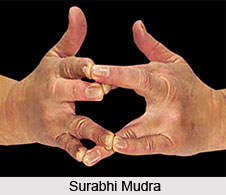
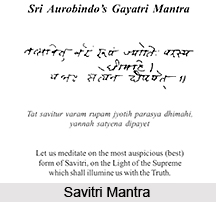
 Savitri Mantra is the chanting that brings about realisation in the mortal world, of the spiritual transformation. It is given in a succinct way as follows. The Rishi of the Mantra is Sri Aurobindo himself. Savitri Mantra is also known as the Gayatri mantra.
This spiritual mantra must always be performed in water. Since Savitri is the power of the sun, the Surya Nadi works more strongly when this mantra is repeated. It is not recommended in Kundalini meditation process that only one Nadi will function continuously. Water that is ruled by the moon is strictly recommended in order to persuade the Chandra Nadi to neutralize any ill effects of excessive solar influence. This keeps the sun and moon in balance. If a single syllable of the Savitri Mantra is chanted in a particular way, only eleven times as much fire can be exerted from his inner self that is capable of distorting the mental state of any ordinary individual.
Savitri Mantra has emerged from the legend of Savitri in the Mahabharata-written in the third of the eighteen parts of this epic. This legend is placed in the Vana Parva and is called Savitri Upakhyana. The legend of Savitri with a subtitle, Pativrata Mahatmya, indicates the nature of the story. The legend describes in dignified style the stunning deeds of a woman who observes virtuous rites and rituals, performs diligently the acts of austere sacrifices and offerings.
In Mahabharata, Rishi Markandeya recounts the story of Savitri to Yudhishthira, the eldest of the Pandavas. King Aswapati is an ardent follower of the dharma and is firmly established in the path of truth. But he was greatly afflicted in his old age, since he was issueless. Eventually, with the intention of getting a son, King Aswapati engages himself in arduous Tapasya. For eighteen years, he worships Goddess Savitri in a dense forest. Pleased with his sincerity and devotion, Goddess Savitri emerges out of the sacrificial flames and grants him the boon of a beautiful and effulgent daughter, kany` téjasvin`. The baby girl grew upto a beautiful lady - Savitri. However her beauty and personality was such that no prince dared to offer her the proposal of marriage.
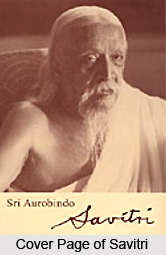 Savitri sets out on her search, travels to different kingdoms, and meets Satyavan. Savitri returns to her father`s house, when the revered sage Narad and king Aswapati were amidst a conversation in the palace. Savitri tells that she has chosen Satyavan as her life partner life`s partner. Narad speaks at once a note of alarm, of deep regret, that one year after the marriage Satyavan is to die on that very day. Despite all warnings, Savitri marries Satyavan.
When there were only three days for her husband`s death, Savitri performs trir?tra vrata, of fasting and standing at one single place through the entire period. On the very day of Satyavan`s destined death, she lights a bright fire before sunrise and makes offerings to the gods. Then she makes obeisances to the Rishis and all the elderly people around her. They all blessed her and Savitri accomplished the Yoga of Meditation or dhyanayogaparaya.
On that very day, Savitri accompanies her husband to the forest for his daily work. He seemed energetic till the mid day but suddenly fainted and Sun God himself appears in front of this blessed lady. His body is lustrous in hue and carried a noose in his hand. On seeing him, Savitri lays aside Satyavan`s head and stands up with folded hands. He said that he was Yama, the God of death and took away Satyavan`s soul from the body.
Savitri, afflicted with agony, follows Yama, eventually he offers her a number of boons, but Savitri insists for the return of the soul of Satyavan. She pleads with him with great words of the eternal Truth, pleased with her pleadings; Yama finally returns back the soul of her husband. This legend of Savitri gave birth to the Savitri Mantra that depicts truth and transformation. It is said that Savitri is one of the most rare instance in Indian mythology that signifies the depth of sprititual self and insightfulness of praying the Almighty.
Today, Savitri Mantra has become the most common Gayatri Mantra. The significance of Savitri mantra lies in implementing honesty and reverence in everyday work, thus it is recommended in scriptures that Savitri Mantra should be chanted in the early morning before starting the routine of a day. The mantram not only inspires an individual`s soul but also helps to built the self confidence within.