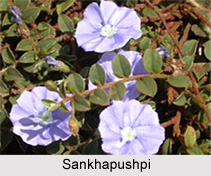
 Sankhapushpi is a perennial herb which an Indian Medicinal Plant. The Sanskrit word "Sankhapushpi" literally means that the flowers of which are in the shape of a conch or Sankha which is considered to be auspicious. The plant grows wildly in open grassy places throughout India, up to 1800 m elevation.
Different Names of Sankhapushpi
The plant named Sankhapushpi or Shankahuki is a well known Indian medicinal plant having the scientific name of "Convolvulus Pluricaulis Choisy". The plant has several names in different native Indian languages and it is called as "Dankuni" in Bengali. The Punjabi speaking people call the plant as "Dodak" or "Porprang". Sankhapushpi is the Sanskrit name of the plant and it is also called as "Sankhapushpi" in Sanskrit. The Hindi names of the plant are "Shankahuki" and "Sankhapushpi".
Characteristic Features of Sankhapushpi
Sankhapushpi is a small perennial herb with prostrate branches and small elliptic to oblong, lanceolate, obtuse, mucronate leaves, flowers mostly solitary in upper axils. The leaves of the plant have a length of 1.2-2.5 cm and their shape is linear-oblong or the upper elliptic. The apex is obtuse, mucronate, with the base tapering and it is villous on both sides. The leaf margins are slightly hairy, having short petioles. The sessile or short-pedicelled flowers of Sankhapushpi or Shankahuki are axillary and they remain 1-3 together. The bracts beneath the calyx are linear-lanceolate, hairy, having a length of 3 mm and the sepals are 0.6 cm long. The ovate-lanceolate or linear-lanceolate sepals are sparsely hairy, while the corolla of the plant is wide, funnel-shaped, having a colour of pale rose or rose-yellow. The fruit of the plant is an ellipsoid or globose capsule, having length of 0.3 cm and they are smooth, as well. The flowers, light blue in colour, mostly solitary in upper axils. The plant usually flowers in October in west-central India. Sankhapushpi or Shankahuki is a common weed that is found in cultivated fields throughout most of India.
Medicinal Uses of Sankhapushpi
Sankhapushpi or Shankahuki shrub has several medicinal properties and usages and it is used in the traditional Ayurvedic and other treatments. The species is considered the source of the drug named "Sankhapushpi", in northern Indian Ayurvedic practice. Sankhapushpi is astringent, pungent and bitter in taste, sweet in the post digestive effect and has hot potency. It alleviates all the three doshas, predominantly, vata and pitta.
The whole plant is also used in a number of formulations as a nervine tonic for improving memory and intellect of people. It is useful in epilepsy, as a brain tonic and also as an aphrodisiac. The leaves and flowers of the plant are reported to possess hypertensive properties and are useful as a sedative in treating anxiety neurosis, as well. The medicated oil of the herb is useful as a hair tonic, to promote the hair growth. Its paste is also applied externally in skin diseases. Sankhapushpi hair oil prevents the premature graying and falling of hair. It also works well as mucolytic and is useful in cough and hoarseness of voice. Sankhapushpi being diuretic is useful in urinary disorders and hypertension. It promotes conception in female and is rewarding as an aphrodisiac in sexual debility in males. Sankhapushpi is one of the best herbs used as a general tonic and rejuvenative. Apart from that, both the leaves and flowers of Sankhapushpi or Shankahuki also possess antifungal properties.