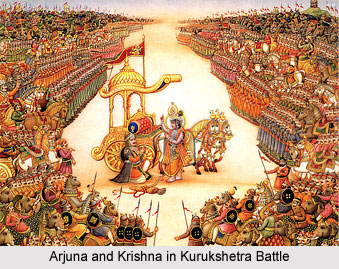
Musala Parva is the sixteenth Parva from among the eighteen Parvas of Mahabharata and it consists of only one sub-parva. The Parva narrates the sorrowful incidents of Lord Krishna and his fellow tribesmen. The Musala Parva consists of about two hundred and fifty verses. The Kuru women suffered the most in the great battle at Kurukshetra and mainly Gandhari was the one who suffered the most. She lost all of her one hundred sons, and thus cursed Krishna that he would be a spectator to a similar type of disintegration of his family, even if he had the divine potentiality to stop the war. Thus, it is described in this Parva that, Lord Krishna acknowledged the curse of Gandhari which became effective after thirty six years from the end of the great battle at Kurukshetra.
The Curse of Sage
The Musala Parva commences with the Pandavas expressing their grief over Krishna and his men. Yudhisthir ordered Arjuna to see the rest of the survivors of Krishna who were dead. Once it so happened that a rishi had visited the Yadavas. The Bhojas and Yadavas, Vrishnis, Kekeyas and others who were devoted to Krishna and his men became undisciplined and their culture and lived very luxuriously. Sambha was dressed up like a woman and they tied several robes to his belly in order to present him as a pregnant woman. Then they put Sambha before the rishi and asked him whether he would bear a boy or a girl. AS the rishi understood the mischievous act, he became angry and cursed them by telling that Sambha would produce a lump of mace which would be responsible for destroying the Yadavas and all those who were devoted to them.
After being cursed by the rishi, they opened the robes which were tied round the belly of Sambha and found a lump of mace. The mace was carried by them to show Krishna and then they told him everything what they did and about the curse of the rishi. Krishna asked them to grind the mace and to disperse it in the sea. The order of Lord Krishna was obeyed and the mace was grinded and the powder was scattered in the sea and they felt that they were then out of any danger. However, Krishna knew that the danger could not be avoided. The powder generated from the grinding of the mace and after it was dispersed in the sea, got deposited in the sea coast and grew into Eraka trees which resembled clubs of mace and the trees grew large and dense and a huge forest was created in the sea coast within a very short span as per the curse.
Days passed, and the Yadavas did not remember the curse of the rishi. Once they were enjoying at the beach by drinking and merry making. Satyaki, one of the powerful Yadava warriors, started telling Pradyumna (son of Krishna) how Kritavarma, Ashwatthama and Kripa murdered the Pandava`s sons while they were sleeping. Kritavarma told of the end of Bhurisravas. Pradyumna attempted to stop the quarrel, but was not successful and the fight increased and Kritavarma was killed by Satyaki. Then the Bhojas attacked Satyaki and murdered him. Thus the Yadavas fought against the Bhojas. Vrishnis and Kekeyas divided themselves between Bhojas and Yadavas. All of them rushed towards the Eraka trees which resembled huge maces and they entered inside the forest and killed each other.
Death of Krishna and Balarama
The left over mace from the sea shore were taken by a hunter who fixed them on his arrows which made his arrows very sharp. Babrua and Daruka, who were left alive, went to Lord Krishna. Krishna ordered then to gather the women of the fort and asked them to leave Dwarka. However, both Babrua and Daruka were killed by the hunter`s sharp arrows formed by that mace. The hunter dispatched his arrow towards the sky and it fell on both. Thus Krishna called upon all the women and along with them he left the city of Dwaraka since he knew that Dvaraka would sink underwater. Balarama and Krishna were taking rest under a tree and at that time a silver serpent came out of the head of Balarama and he was dead. Then the hunter mistook the feet of Krishna for the face of a deer and showered a sharp arrow towards it and Krishna was killed then. Thus, the rest of the people who were then alive followed Arjuna. Arjuna decided to take them to Indraprastha. However, on their way, several thieves tried to rob those following Arjuna and Arjuna was unable to save them. Most of the people were killed by the thieves and the rest of people killed themselves in fire. In this Parva there is also the mention of the demise of Krishna`s father Vasudeva and the sacrifice of the wives of Balarama and Krishna in burning pyre.
The Musala Parva in Mahabharata is an account of the recitation of the incidents by Vaisampayana to Janamejaya in the Sarpa Yajna which was arranged by the King. Vaisampayana told the king all about the death of Krishna and Balarama and their entire race and also those who devoted themselves to Krishna. The description of the infighting between the Yadavas with maces or musala leading to the eventual destruction of the Yadavas is well-presented. It also describes that when the thirty-sixth year was completed after the great battle at Kurukshetra, Yudhisthir, the king of Hastinapur, beheld several evil omen. Those omens brought fear and danger to the mind of the king and it also filled the minds of his countrymen with anxiety. This Parva ends with the destruction of the race of Krishna.